Front Matter
Introduction
Introduction
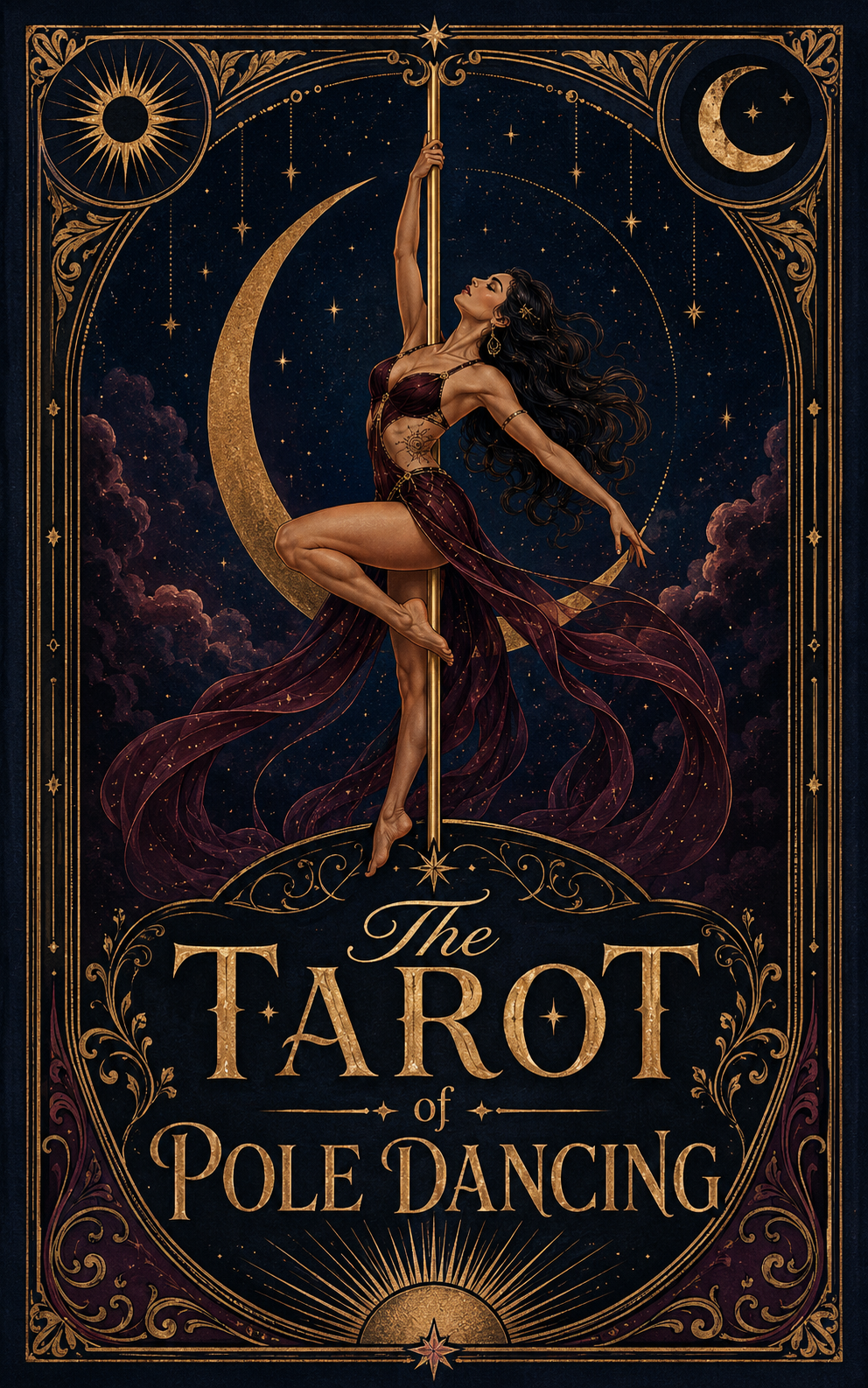
This is not a book about fortune-telling.
The body does not predict the future. It remembers it into being.
Each chapter is a reading. The cards are not tarot cards but movements: pole moves, dance positions, held shapes, gestures, marks.
The Present Card is the move being learned.
The Crossing Card is what resists it.
The Root Card is the past beneath it.
The Hidden Card is what the body knows before the mind does.
The Future Card is not prediction, but consequence — the shape the lesson will one day make possible.
Each card speaks twice. First the deck describes it — upright, reversed, the move itself — in the flat voice of things that have seen everything. Then comes the life the card was dealt into.
That second voice is mine.
If the whole book were laid out as a single spread, it would read like this:
Present: a woman of forty-eight standing outside a studio door with her coat still on.
Crossing: a marriage that has held the same shape for so long it has forgotten there was a shape.
Root: a girl of seventeen on a plane home from Macau, with the future inside her.
Hidden: a name she has not yet said out loud, even to the mirror.
Future: a shabby hotel in Ormskirk, one weekend a year, when the “circus” comes to town.
That is the story. Knowing it will not save you from it.
Cards do not spoil. They prepare.
A pole class looks, from the outside, like a woman learning tricks.
It is not.
It is a private language of grip, bruise, balance, lift, surrender, repetition and return. It is one of the few rooms where shame is asked to wait outside. The body is asked questions the life has avoided. Can you hold? Can you lean? Can you climb? Can you be seen? Can you fall? Can you get up? Can you want something without apologising for the wanting?
The cards answer slowly.
Not in symbols.
In skin.
The Major Arcana
I
The Crucifix
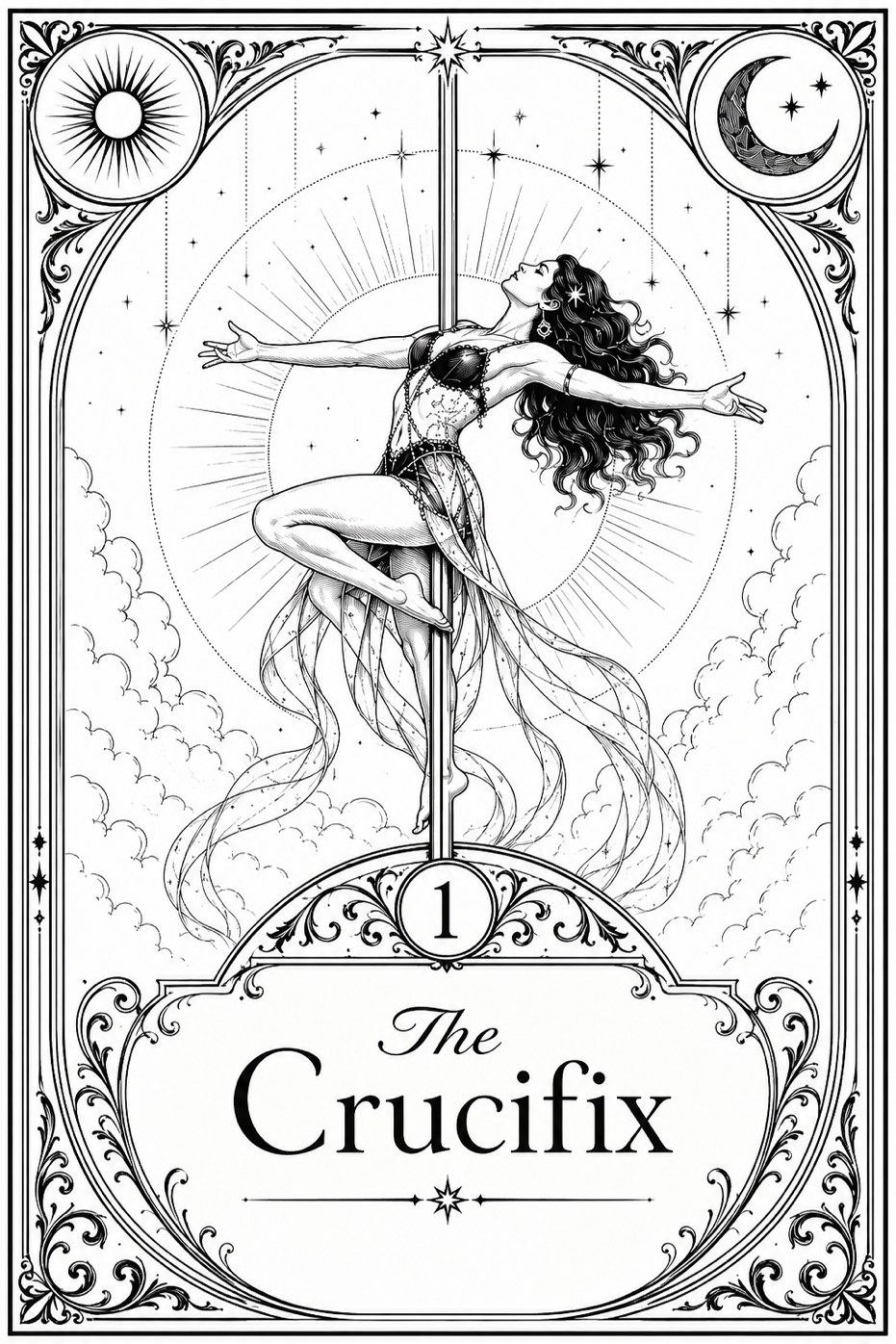
The Spread
Present Card: The Crucifix
Crossing Card: The Pole Walk
Root Card: The First Position
Hidden Card: The Body Wave
Future Card: The Hand Spring
✦
Present Card: The Crucifix
The card of the held shape.
Upright: the body permitted to lean. The arms open by choice and not by obligation. The structure that holds without consuming.
Reversed: the arms open because the woman has forgotten how to close them. The held shape mistaken for fate.
The move. The Upright Crucifix is performed from standing or from a low climb, the pole gripped between the inner thighs, knees or calves, the body held close to the vertical line. The arms may open into the shape that gives the move its name. Later, inverted, the same logic becomes more dangerous: the body upside down, the grip holding while the hands release. But here, on the first night, the Crucifix is still upright. Foundational. Almost merciful.
It is among the first shapes a dancer learns that looks like pole. It is taught early. It is returned to by the advanced because it teaches what alignment is. To stand in the Crucifix is to feel where the body actually carries itself, and where it has been lying.
✦
I nearly did not go in.
I want to start there because everything afterwards depends on it. Not the lift. Not the line. Not the woman I would become, eventually, who could speak about pole at a dinner party without watching the room for the smirk. The first true thing is that I stood outside the studio door with my coat still on and thought, who the hell am I trying to kid.
I went in anyway.
That is the only reason there is a book.
I should probably mention that the thing I had gone in to discover was not some ancient wisdom hidden in a forgotten temple.
It was a room above a shop with mirrors on the walls and a metal pole in the middle.
There was a part of me — the part that had spent years being sensible — that considered this evidence that something had gone badly wrong.
The rest of me had already taken off my coat.
✦
Crossing Card: The Pole Walk
The card of approach.
Upright: the body learning that the pole is not a threat. The first negotiation with the centre of the room. Sovereignty in the smallest movement.
Reversed: circling without committing. The woman who walks around her own life so she does not have to enter it.
The move. Standing beside the pole, one hand resting against it. The outside foot steps. The body turns. The hand allows the circle but does not yet commit to weight. The dancer walks around the pole, keeping the body lifted, the shoulder open, the gaze moving with the turn.
It looks like nothing. That is its danger.
✦
It is the Pole Walk that crosses the Crucifix because before I could lean, I had to learn that the pole was not a thing to be afraid of. The Crucifix asks for surrender; the Pole Walk taught me the room was safe enough to surrender in. We did the walk first, before any of the held shapes, because the teacher knew what I did not — that the body in mid-life does not arrive trusting. It arrives suspicious, defended, ready to flinch.
So we walked.
For most of that first class I walked around the pole like a woman walking around a difficult sentence, looking for the place to enter. The teacher said let the hand soften, and the hand softened. Let the shoulder drop, and the shoulder dropped, slightly, the way reluctant things do. Let your eyes travel with you, and my eyes did not travel, not the first day, because the mirrors were unbearable and the room was unbearable and the woman in leggings doing slow turns was unbearable, and the only way to survive was to look at the floor.
The strange thing was that nobody else seemed to think this was strange. The teacher was calm. The women around me were calm. Everyone behaved as if walking slowly around a pole in a mirrored room was a perfectly normal Tuesday evening activity. Apparently I was the only person who had not received that particular memo.
The Crucifix would not have held me if I had not first walked around the pole long enough to believe it would.
✦
Root Card: The First Position
The card of beginnings already lived.
Upright: the body that has done this before. The lineage of dance held in the muscle. The girl waiting under the woman.
Reversed: the body that remembers what it is no longer asked to do. Mourning held in posture.
The move. The feet turned out, heels touching, the arms held softly forward in a low oval. Taught to every child who has ever stood at a barre. The first shape a dancer is asked to make. The shape from which all other shapes are reached.
✦
I stood in First Position before I stood in anything else.
I was four. Possibly five. The leotard was peach and slightly wrong. The studio was above a dry cleaner’s and smelled of the chemical they used on suit jackets in the seventies. The teacher clapped twice for attention. We turned our feet out. We held our arms in a low oval. We made the shape.
I had not thought about First Position since Macau. It had not, however, stopped thinking about me.
The body holds positions the way a house holds furniture — even after the furniture is gone, the room knows where the table used to be. First Position lived in me through ballet, through tap, through jazz, through the auditions, through Macau, through the pregnancy that ended Macau, through the years of standing at the kitchen counter with my feet, I now realise, still turned slightly out. Just a few degrees. Just enough that any dancer walking past would have known me on sight.
The Pole Walk was, when I think about it now, First Position in motion. The same lifted spine. The same soft hand. The same trained restraint. I had been a dancer the whole time. I had been a dancer at the school gate. I had been a dancer at the supermarket. I had been a dancer while I made packed lunches.
The Crucifix could not have held me if the First Position had not already taught my body the line.
The four-year-old had not been waiting.
The four-year-old had been doing First Position quietly under the kitchen table for thirty years.
Hidden Card: The Body Wave
The card of what the body knows before the mind does.
Upright: instinctive movement. The grace that returns without being asked. The dancer’s intelligence held below speech.
Reversed: movement disowned. The body suppressed into stillness. Grace performed as embarrassment.
The move. Standing, feet apart, the wave begins at the crown of the head and travels down through the spine, ribs, hips, knees, ankles. Each segment of the body moves in sequence. It is the simplest expressive move in any dancer’s vocabulary and also one of the most exposing. It cannot be muscled. It can only be allowed.
✦
I will not say much about the Body Wave here because it is hidden in the spread for a reason: it had not yet returned to me by the night of the Crucifix. The Body Wave would come back later, and when it did it would terrify me — the body remembering, without permission, how to move like a thing that had been watched. There will be a chapter where the Body Wave is the Present Card when the time comes.
For now, the Body Wave is in the corner of the spread because something underneath the chapter is already moving. The teacher would not have seen it. I did not see it. But the body had begun, beneath my notice, to remember itself. Three nights after the first class I caught myself in the kitchen, waiting for the kettle, and my hips made a tiny unnecessary curve from one side to the other. A wave’s smallest possible cousin. The body was practising.
The Crucifix held me because the Body Wave, hidden, had begun to wake.
✦
Present Card, continued
The teacher said: put your hand here. Put the other hand there. Lean your spine into it.
I did not lean.
Not the first time she said it.
I gave a quarter of my weight to the pole and took it back, the way you test water with a toe. The teacher watched. She didn’t say anything. She let me lie to her with my body, because she knew the lie would not last.
More, she said.
I gave a little more.
More.
I leaned.
The pole took my weight.
It was not religious, though it would be easy to make it religious because the move is called the Crucifix. It was not erotic, though it would be easy to make it erotic because the world has decided anything a woman does with a pole is erotic by default. It was not maternal, though my arms had been open in roughly that shape for thirty years.
It was the first time in twenty-seven years that something in the room had agreed to hold me up without expecting anything in return.
I stood there.
I did not move.
The teacher said good and then, very quietly, welcome back.
She did not know what she had said.
I knew.
The four-year-old in First Position knew. The seventeen-year-old in the wings of a stage on the other side of the world knew. The body that had been doing First Position under the kitchen table — for thirty years, while I made packed lunches and looked for lost shoes and held two babies in arms that went numb at three in the morning — that body knew best of all.
✦
Future Card: The Hand Spring
The card of the woman who has stopped being held.
Upright: the body that lifts itself by its own grip. The hands taking the whole weight, the body suspended by intention alone.
Reversed: the lift attempted before the strength is ready. The body trying to prove freedom before it has learned trust.
The move. The dancer stands at the pole, both hands gripping above her head. The shoulders engage, the core locks, and the body lifts — feet leaving the floor, legs extending into shape. The Hand Spring is one of the moves in which the dancer discovers that the pole is no longer carrying her in the old way. It is not cradle, lap, or spine. It is axis. Resistance. Witness.
The dancer lifts herself.
It is one of the hardest moves in the vocabulary. It belongs far ahead of this first night, almost impossibly far. But that is why it appears in the spread. The future card is not the next thing you learn. It is the thing this first lesson has already begun preparing.
✦
There is a class in a future I cannot yet see in which I will do my first Hand Spring.
I will be older than I am now. The Static Hold will have ended. The lie will have stopped being useful. The Pleasers will be in my bag in the corner. The Instagram account will exist and I will not be embarrassed by it. The marital house will have been sold. The new house will be small and mine and quiet in a different way. There will be a community of women I have not yet met — weirdos, freaks, witches, dancers, friends — who I will love, by then, more than I have ever loved any room of people in my adult life.
I will write about them.
They will get their own cards.
I will be alone in the studio that Thursday. The class will have ended. The lights will be lower than they are in class. I will have stayed behind, as I will have taken to doing, to work by myself on the move I cannot yet do.
On that night, the move I cannot yet do will be the Hand Spring.
I will have failed at it for months. I will have hung from the pole with my arms shaking and my feet refusing to leave the floor. I will have asked my teacher to spot me — the woman whose name I still have not told you, because she has not yet earned her name — and she will have, and the spot will have helped, but the spot will not have been the move.
The move requires that I do it alone.
The Hand Spring is the move that cannot be done by two people.
On the night I do it, there will be no spotter.
I will stand at the pole. I will put both hands above my head. I will breathe.
I will pull.
The feet will leave the floor.
The Hand Spring will, by then, have made sense of everything the Crucifix was trying to tell me on the first night.
The Crucifix was the pole agreeing to hold me.
The Hand Spring is me, agreeing to hold myself.
The future card is not the next move I will learn next week.
The future card is the move that will tell me, one Thursday night in a studio I have not yet taught in, with women I have not yet met waiting for me on the other side of the door, that being held was never the end of the story.
It was the beginning of strength.
✦
To draw the Crucifix is to be told that you are allowed to be vertical.
That the line you have been holding along the ground was always meant to be held against something upright. That the structure you have feared will pin you is, if you turn toward it, the structure that frees you.
I did not yet know this.
I leaned.
The pole held me.
I went home to bed. The next morning, the first bruise — a faint thumbprint on the inside of my forearm — was the body’s small receipt for what had happened.
I pressed it gently with my thumb.
It hurt.
I smiled.
I had walked around the pole. I had leaned into it. The body, secretly, had begun to wave. First Position had lifted its head under the kitchen table. And somewhere ahead of me, in a future I could not yet see, the woman I was going to be was gripping the pole with both hands and lifting herself from the floor.
That is the chapter.
That is all the chapter is.
I went in.
I leaned.
And somewhere, years ahead, I began to rise.
II
The Pole Sit
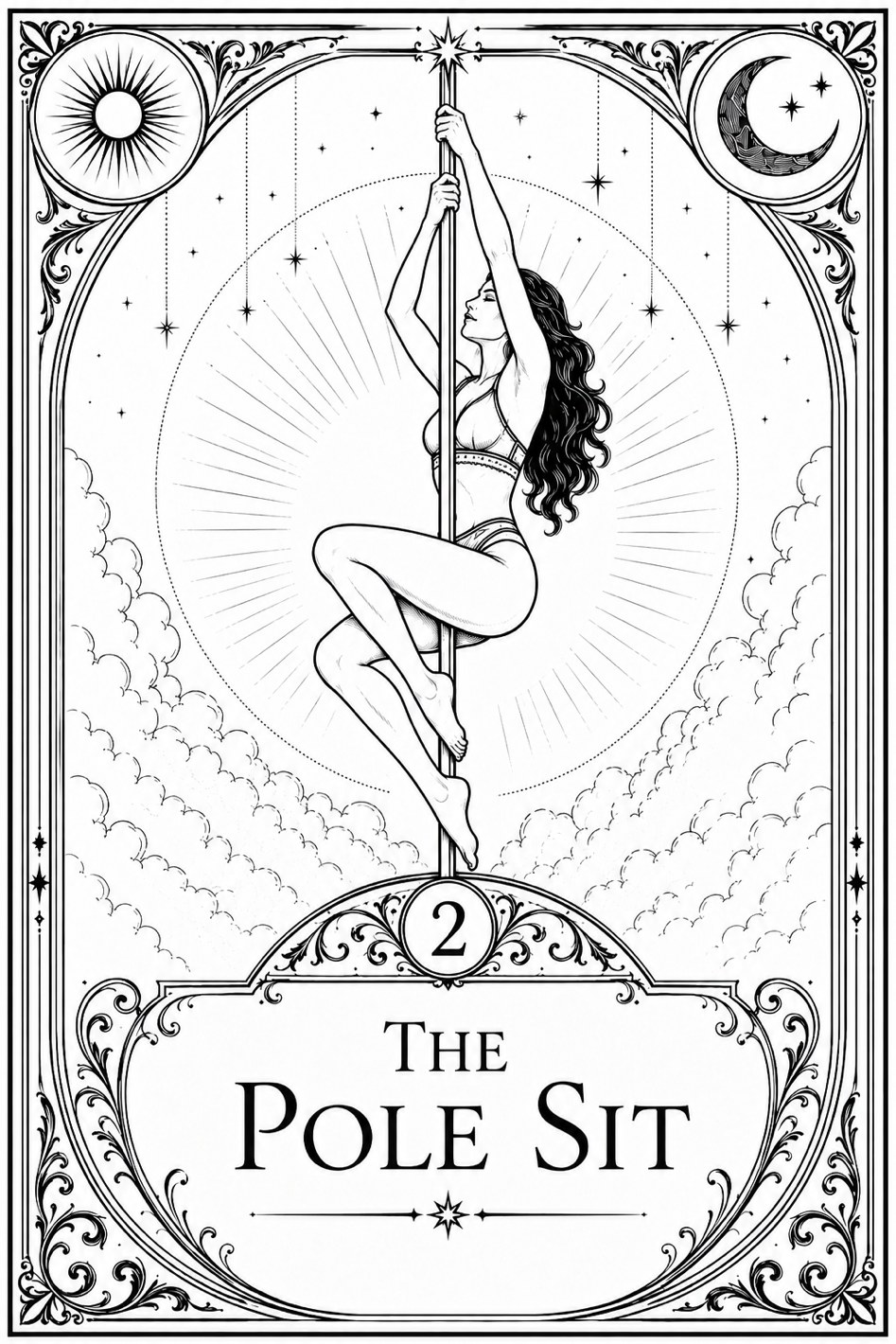
The Spread
Present Card: The Pole Sit
Crossing Card: The Static Hold — reversed
Root Card: The Barre
Hidden Card: The Held Smile
Future Card: The Entrance
✦
Present Card: The Pole Sit
The card of the first lift.
Upright: the body discovering it can carry itself. The first time the floor lets go. The grip that becomes permission.
Reversed: the body that does not yet trust its own weight. The lift refused. The dancer who chooses the ground because the air is not yet safe.
The move. From standing, the dancer climbs a short way up the pole using the legs, then settles the body into a sitting position — one thigh pressed against the pole, the other crossed over it, the hands gripping above the head. The pole runs through the lap, locked between the legs. The dancer holds, suspended, off the floor entirely. The whole body weight is carried by skin against steel.
It is taught after the first held shapes have been mastered. It is the move in which the dancer discovers, for the first time, that the pole will hold her in the air. Before the sit, every move has been a negotiation with gravity. After the sit, gravity has agreed to wait.
✦
The first time I sat on the pole I did not believe it would hold me.
This is the thing about the Pole Sit that nobody tells you. It looks, from the floor, like a trick of strength. It is not. It is a trick of trust. The grip is provided by skin. The skin grips the pole because the pole grips the skin. The transaction is mutual and silent and it requires the dancer to commit her entire weight to a piece of metal she has known for fewer hours than she has known the postman.
The teacher said, up. Knee here. Other thigh across. Now sit.
I said, I can’t.
She said, you can. Sit.
I sat.
For a half-second the world inverted. The floor, which had been the only surface I had stood on since I was nine months old, simply was not there. My feet were not on it. My body was not falling, but it was also not held by anything I had ever before agreed to be held by. The pole was warm against the inside of my thigh and the lock between my legs was holding and I was, for the first time in my adult life, off the ground while doing nothing.
I started laughing.
I do not remember the last time I had laughed at something my body had done. The laugh was not for the teacher and it was not for the other women in the class. It was for the body itself — for the small ridiculous miracle of having lifted me up by no method that made sense.
The teacher said, good. Now hold.
I held.
✦
Crossing Card: The Static Hold — reversed
The card of the body that has stopped moving without noticing.
Upright: stillness as discipline. The dancer holding a shape against gravity, the body taut and intentional, the breath even.
Reversed: stillness as habit. The body that has held the same shape for so long it has forgotten there was a shape. The pose mistaken for the self.
The move. Any position on the pole in which the dancer takes a shape and simply holds it — for two counts, eight counts, sometimes much longer. No motion. The whole craft of the move is in not moving. The arms locked, the legs placed, the breath controlled, the face composed. Watched from outside, a Static Hold looks like nothing. From inside the body, it is the entire load of the dancer’s training meeting the floor’s gravity, and refusing to break first.
✦
The marriage had been performing a Static Hold for the better part of two decades before I noticed.
I do not mean we broke. We did not. We held. That was the problem. We had been holding the same shape — me at home, him at work, the children running between us — for so long that the shape had become indistinguishable from the marriage. The children grew up inside it. The children left. The shape stayed. The arms still placed where they had been placed. The breath still even. The face still composed. Only the music had stopped, and neither of us was sure how to come down.
The eldest left first. Three hundred miles north to a university and a flat with people I had not met. I drove him up in a car packed to the headrests and cried in the service station on the way home. The youngest followed fourteen months later. By the time she went, I had learned what they actually needed at the door of a new life, and I cried less, and I stopped at the same service station, and I ordered the same coffee, and I sat in the car park for forty minutes before driving the rest of the way.
The house was very quiet after the second one.
I had taken a job four years before the eldest went — a part-time thing at the local council that grew, over time, into proper work that took most of my days. I was good at it. I had not expected to be. The job filled the daytime hours the children no longer needed me for. But the job was not the marriage, and the marriage was the thing the children had been holding up.
He had not been home much in those years. The office had taken him to other cities a few times a month. The children had been mine and the work had been his and the division had not, in two decades, been questioned. I had not asked him to do bedtimes. He had not offered. The household had run on the silent fact that I was at home and he was at work, and the children had been the river flowing between us — full enough that we did not notice we had stopped looking directly at each other.
The river dried up.
We were left in a Static Hold neither of us had agreed to. He on the sofa. Me at the counter. Both of us composed. Both of us, technically, still in the shape of a marriage. Neither of us moving.
He said, one Sunday morning about three months after the youngest left, what shall we do today?
I do not remember the last time we had had to decide what to do together on a Sunday. Sundays had been about the children — their matches, their parties, their homework, their friends. What shall we do today was a question for a couple. We were no longer sure we were one.
I said, I don’t know. What do you want to do?
He said, I don’t know.
We sat at the kitchen table with the radio on and read the papers and did not do anything. By lunchtime he had gone to play golf with a man from the office and I had gone to the supermarket. We came home at different times and ate at different ends of the kitchen. The day passed.
That Sunday became other Sundays. The Static Hold held.
I did not start the class the week after that Sunday. I did not start it the month after. I did not start it the year after. The Static Hold held for years. The job took up most of my attention. He travelled. We were polite. We had Christmases. We saw the children when they came home, and the house briefly filled and then briefly emptied, and we held the shape between visits, and the shape became more comfortable in the way old shoes become more comfortable — harder, every year, to take off.
The class came in the sixth year of the empty house. I had been forty-eight for three months. The body had been silent for so long that I had stopped expecting it to speak. The Static Hold had absorbed a marriage and the leaving of two children and the taking of a career and the long quiet of an upstairs in which two empty bedrooms had begun to acquire the smell of rooms that are no longer being lived in.
I started thinking about a class.
That is the sentence I want the chapter to hold. I started thinking about a class. Not I left him. Not I changed my life. Not I rebelled. I started thinking about a class. The Static Hold was so total that even the thought of a class felt, for several months, like a thing I could not quite reach. The body had to remember it was allowed to think about a class before it could think about one.
The thinking took about a year.
Then I booked the class.
✦
Root Card: The Barre
The card of the body’s first instruction.
Upright: the lifelong frame. The discipline the body received before it had language. The line that runs through every shape the dancer will ever make.
Reversed: the frame mistaken for the cage. The training that becomes the only permitted movement.
The move. A wooden rail mounted to the studio wall. The dancer stands beside it, one hand resting on it lightly, and works through the foundational exercises — pliés, tendus, ronds de jambe, fondus. The barre is where every classical dancer’s training begins and where, at the start of every class for the rest of her life, she returns. The hand on the wood is the first agreement: I will let this hold me while I learn the shape.
✦
When the pole held me in the Pole Sit, the body that recognised the situation was the body that had stood at the barre.
The barre was older than everything. The barre was older than the Static Hold, older than the marriage, older than the children, older than the plane to Macau. The barre was the first surface I had ever asked to hold my balance. I was four. Possibly five. The teacher’s name was Miss Anne. The studio was above the dry cleaner’s on the main street of the town I grew up in, and the barre was painted white and chipped where the older girls had pressed their fingernails into it for years.
I stood at it twice a week.
By the time I was nine I was at the barre five days a week. By eleven I was in the youth company. By thirteen I was in the junior company. By fifteen I was a senior. By sixteen I was choreographing a small piece for the under-twelves. By seventeen I was on a plane.
I will not write about that plane yet. The plane is its own card. The barre was the foundation of every shape I ever learned, and the body’s relationship to the barre — hand here, let it hold you while you learn — was what allowed the body, thirty years later, to put a hand on a pole in a beginner studio above a kebab shop and trust the pole would hold while I learned the next shape.
A dry cleaner's under one, a kebab shop under the other. Dance, in this country, has always lived one flight up from the shops. The way to somewhere else starts on a staircase that smells of something ordinary.
Thirty years. Thirty years between the last time my hand had rested on a wooden rail in a studio and the night my hand rested on a vertical pole of metal. Thirty years of the body not being asked to hold anything except a child, a kettle, a steering wheel, a bag, a hand, a phone, a pen. Twenty-seven years of the body being treated as the thing that did the holding rather than the thing that was held.
The barre and the pole are not the same. The pole is vertical where the barre is horizontal. The pole takes the body’s weight where the barre only takes the body’s balance. The pole is metal where the barre is wood. The pole is the centre of the room where the barre is the edge. Everything about them is different except the one thing that mattered to my body, which was: here is a structure to hold while you learn.
The Pole Sit is the barre’s grandchild. The body that had learned to trust the barre at four knew how to trust the pole at forty-eight.
I had been forty-eight for three months when I walked into the studio. I had been a mother for thirty years. I had been a wife for twenty-seven. I had been a council officer for eleven. I had been performing a Static Hold for nineteen. I had been a dancer all along, underneath, the way a stream runs underneath the floor of a house and the people in the house do not hear it unless they put their ear to the ground.
When I sat on the pole and laughed, I was not laughing only at the lift. I was laughing because the barre, somewhere, was laughing back. The body had remembered who it was.
Hidden Card: The Held Smile
The card of the face that does not match the body.
Upright: composure as discipline. The dancer’s mask that allows the body to do hard work without showing it. Grace under load.
Reversed: composure as concealment. The face that lies about what the body knows. The smile worn to protect the household from the truth.
The move. Across nearly every move in the dancer’s vocabulary, regardless of difficulty, the face holds a small composed expression. Not a grin. Not a grimace. The trained dancer’s neutral — eyes soft, jaw relaxed, mouth in something just shy of a smile. The face says this is easy while the body does something nearly impossible.
✦
I told him it was Pilates.
I did this on the second class, not the first, because nobody had asked after the first. I had gone to the first class without telling him I was going. I had said only that I was going to a class on Tuesday evenings, which is the kind of sentence a wife says to a husband in a long marriage and which a husband does not, in a long marriage, follow up on. He had said fine and gone back to whatever he was reading. The first class had passed without a name.
After the second class he was in the kitchen when I came in. He had made himself a sandwich and was eating it standing up. He said, how was the class?
I said, fine.
He said, what is it again?
There was a half-second.
I had thought about this on the drive home. Not with the front of my mind. With the back of it. I had known, before I knew, that he was going to ask, and I had known, before I knew, that the answer pole was not going to come out of my mouth. The answer pole belonged to a different woman in a different marriage. The answer pole would have arrived in the kitchen with a smirk attached to it that I was not prepared to defend.
The Held Smile arrived on my face before the word did.
I said, Pilates.
He said, oh. Good for your back.
I said, yes.
And the word Pilates entered the household and took up residence and was very well-behaved.
I want to say something here that took me a long time to be able to say. The lie was not against him. The lie was not even about him, really. The lie was for the thing the lie was protecting. The new self was too young and the new self could not yet survive the smirk. The new self required a sheltering name. Pilates was the name.
He was not, in any case, going to investigate. He had not investigated anything I did during the day for nineteen years. The marriage had been built on a division of attention as well as labour — I knew where his shirts were and what time his train left and which colleague he was annoyed with this week. He did not know which night was bin night. Pilates was a Tuesday-evening fact and Tuesday evenings were mine and the fact would stay where I put it.
I was lying to protect the lie’s beneficiary.
The beneficiary was not him.
The beneficiary was me.
He said, Pilates costs money, doesn’t it?
I said, I’m paying for it from my salary.
He said, oh, good.
He took his sandwich into the living room.
The word stayed in the kitchen, on the counter, where I had left it. The Held Smile stayed on my face for another half-minute and then, when I was sure he was watching the television and not me, came off.
I put the kettle on.
✦
Future Card: The Entrance
The card of the body offered to an audience again.
Upright: the dancer walking into the light. The body that has earned, by its labour, the right to be watched. The opening pose held under the spotlight before the first beat lands.
Reversed: the entrance attempted before the woman is ready. The body presenting what it does not yet own. Visibility mistaken for arrival.
The move. The first position of a pole routine, taken under the lights, before the choreography begins. The dancer walks from the wings to her pole. She finds her mark. She places her hands, her feet, her gaze. She holds. The music has not yet started, or has just started, and the body is offering itself to the audience in the shape of a held opening line. The Entrance is the move that no studio practice can fully prepare a dancer for. It cannot be rehearsed in front of a mirror. The mirror is a kind audience. The real audience is not.
It is the move in which the body says: I will be looked at, and I will not collapse under the looking.
✦
There is a night in a future in which I will walk back onto a stage after thirty years.
I will be older than I am now. I will be in a group of women — friends, by then, the kind of friends I do not yet know how to make — and we will have prepared a routine together. There will be six of us. I will be the oldest by six years. Possibly more. The young ones will be in their twenties. The middle one will be thirty-six.
I will have spent the four weeks before the performance unable to sleep properly.
I will have told myself, every night in those four weeks, that I have agreed to this for a reason and that the reason is good. That I am not too old. That my body is ready. That the routine is well-prepared. That the audience is friendly. That the show is, in fact, an annual showcase put on by the studio for the studio’s own community, and that the room will be full of other dancers and their partners and their parents, and that nobody in that room has come to mock anyone.
I will have told myself these things and I will not have believed any of them.
The fear will be specific. I will not be afraid of falling. I will not be afraid of getting the choreography wrong. I will not be afraid of the boots, which by then will be a comfort. I will be afraid of two things, very precisely. First, that I will ruin the routine for the other five women by being the weakest dancer on the stage — the one whose timing slips by half a beat, the one whose extension does not match the line, the one the audience’s eye catches on for the wrong reason. Second, that the audience will look at me and see what I am afraid they will see — a forty-something woman in a costume she has not earned, doing a young woman’s art, mistaking enthusiasm for ability, mistaking belonging for licence.
The second fear will be worse than the first. The first fear is technical and can be addressed by rehearsal. The second fear is the old world speaking, and the old world does not respond to rehearsal.
On the night of the performance I will arrive at the venue four hours early. I will not be able to eat. I will sit in a dressing room with the five other women and they will be putting on glitter and laughing and arguing about a transition in the third eight-count, and I will be putting my hair up and taking it down again, and the youngest of them — twenty-three, I think she will be twenty-three — will notice and will sit next to me on the bench and say, you’re going to be brilliant, you know.
I will say, what if I let everyone down.
She will say, you won’t.
I will say, what if the audience looks at me and thinks I’m too old to be doing this.
She will say, without missing a beat, then they’re not the audience.
I will not understand that sentence for some time afterwards. I will think about it for years. Then they’re not the audience. The fear of the wrong one is the old world’s last bid for your obedience.
The music will start. We will walk out.
I will find my pole. I will place my hand on it. I will hold my opening position. The lights will be hotter than I have expected. The floor will be slipperier than the studio’s. The held second before the first beat will be longer than any second of my life — a stretched moment in which the audience sees me, and I am offering myself to be seen, and the body has not yet been told it is allowed to move.
The first beat will land. The first eight-count will pass and I will not remember any of it. By the second eight-count my body will be doing the routine without my mind. By the third I will hear the audience breathe in at a moment we have not anticipated — a moment in the choreography where we hit a held position in unison, six women, six poles, six bodies at the same angle in the same light — and the audience’s breath will be the first proof I have ever received in my adult life that being watched is not the same as being judged.
The audience will not be looking at me to see if I am too old. The audience will be looking at me because I am on a stage and the stage is asking them to. They will be on our side because the routine is good and because they came to be on our side and because the right audience always was.
The routine will finish.
We will hold the closing position. The lights will be on us. The audience will be loud. I will not cry, on the stage, because the discipline of the Held Smile will hold me through the bow. I will cry in the wings about thirty seconds later, into the shoulder of the twenty-three-year-old, who will be crying too because she always cries after shows, and who will hold me without saying anything for the time it takes for my breathing to come back.
I will go home that night to my own house. The marital house will be long gone by then. I will run a bath. I will lie in the bath with the glitter still on my collarbones. I will look up at the ceiling and I will say, out loud, into the steam: I went on.
The Entrance will, by then, have settled a debt I did not know I had been carrying for thirty years.
I had got off a plane once, in a country I cannot yet write about, and I had not walked onto a paid stage since. The body had carried that absence for three decades. The body had not known what to do with it. The body had filed it under over, and the body had been wrong.
The body had simply been waiting.
The Pole Sit was the night I learned the floor could let me go.
The Entrance is the night I will learn the audience can be trusted with what the floor let go of.
The future card is the move that will tell me, one night in a venue I have not yet entered, that the woman who walked off a stage at seventeen and the woman who walks onto one at forty-something are the same woman, and that the thirty years between them were not a punishment but a preparation.
I will be afraid.
I will go on.
The right audience will be there.
III
The Climb
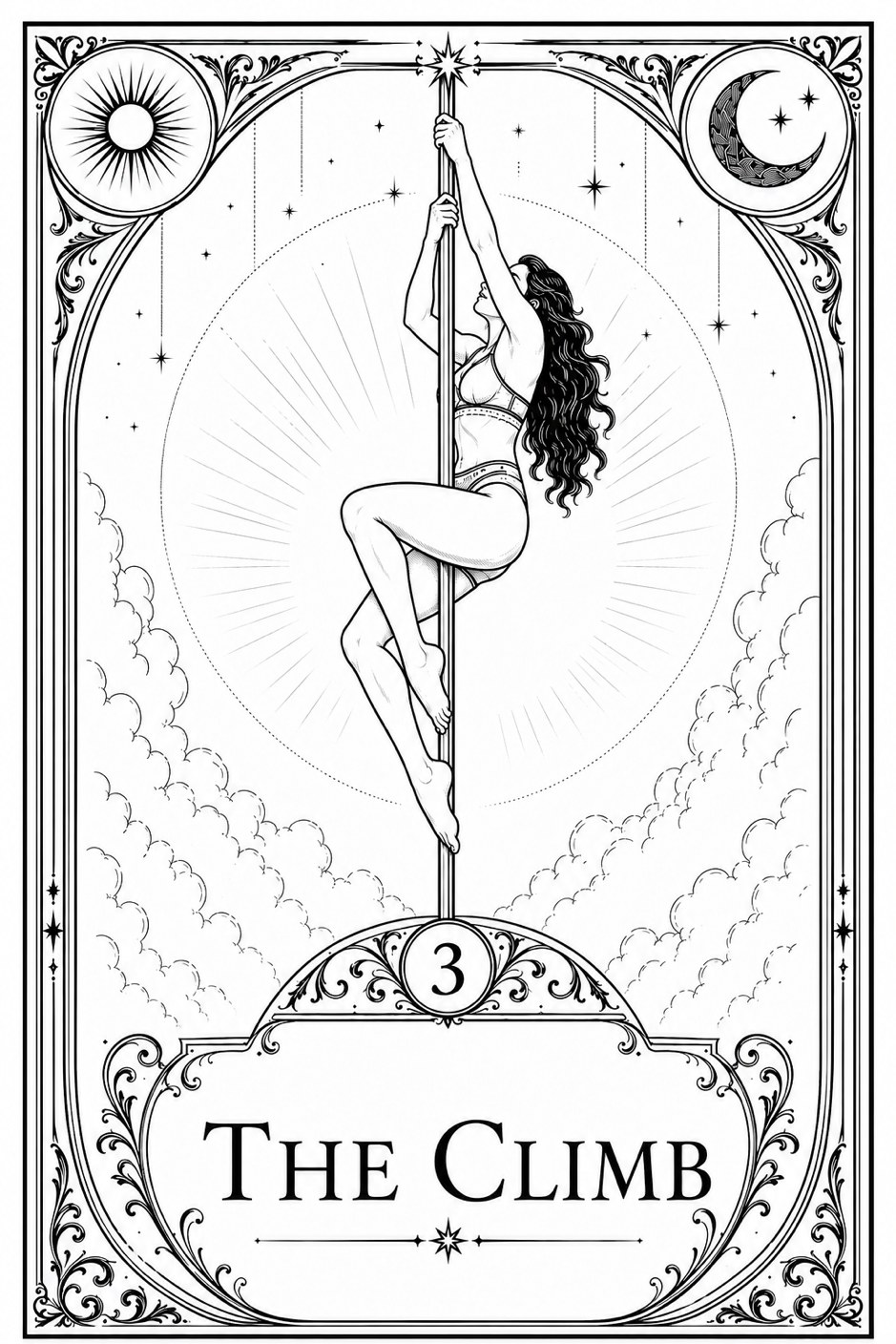
The Spread
Present Card: The Climb
Crossing Card: The Long Sleeve
Root Card: The Attitude
Hidden Card: The Wanting
Future Card: The Silk
✦
Present Card: The Climb
The card of laboured ascent.
Upright: the body rising in increments. Effort as the price of height. The acceptance that the floor will not be left in a single brave moment but in many small bad ones.
Reversed: the climb attempted by force. The dancer who muscles what must be learned. The belief that rising must hurt because everything else has.
The move. From standing, the dancer grips the pole high with both hands. The inside leg hooks or presses, the outside leg assists. The knees squeeze. The feet push. The arms pull. The body lifts a few inches. The hands re-grip higher. The legs reset. The body lifts again. The Climb is taught after the first held shapes and the first lift because it is the move in which the dancer discovers that vertical progress is not a single act but a vocabulary — hand, knee, grip, push, breathe, repeat. The Climb is the first move that requires the body to commit to repetition rather than to a single brave gesture.
It is one of the moves that humiliates most dancers in their first attempts. Strong women cannot do it. Flexible women cannot do it. Brave women cannot do it. Only the woman who has accepted that she will fail many times in a row can do it. The Climb does not reward courage. It rewards stubbornness.
✦
The first time I tried to climb the pole I moved approximately nowhere.
The Climb is the move in which the body discovers it has been carrying things for thirty years without ever having been asked to carry itself. I had hauled babies. I had hauled shopping. I had hauled, more than once, a sleeping eight-year-old up two flights of stairs without waking him. My arms knew weight. My arms had been doing weight for three decades.
But the Climb did not want what I had.
The teacher said, hand high. Hook the inside knee. Squeeze. Now push with the outside foot.
I hand-highed. I hooked. I squeezed. I pushed.
Nothing happened.
I mean nothing. The body did not move. It made the noises of moving — there was effort, there was breath, there was a small sound that may have been a swear word — but the floor stayed exactly where the floor had been. My hands gripped, my knee gripped, my foot pushed, and my body remained, with what felt like deliberate insolence, on the ground.
The teacher said, higher with the hands.
I went higher.
Nothing.
She said, tighter with the knee.
I went tighter.
Nothing.
She said, push harder with the foot.
I pushed harder.
A half-inch.
The first ascent in my pole life was a half-inch off a wooden floor in a beginner studio above a kebab shop, achieved by a forty-eight-year-old woman who had spent thirty years carrying every weight her household had asked her to carry, and who could not, when finally asked to carry her own, do more than a half-inch.
The teacher said, good.
I said, that was not good.
She said, that was the start.
I came down. I shook out my hands. The skin on the inside of my upper arm was already a slightly different colour than it had been when the class began. I would, by the next morning, have a bruise the size of a postcard there, and another on the inside of my knee, and another on the inside of my forearm, and a fourth that I would only discover three days later, in a place that had no business being bruised, which is one of the small private indignities the Climb introduces a dancer to.
I went home.
I did not tell him about the half-inch.
I did not tell him about the bruises.
✦
Crossing Card: The Long Sleeve
The card of the body that must be covered.
Upright: the discretion that protects the practice. The sleeve worn to keep the work from being misread. The dancer choosing which evidence to display and when.
Reversed: the sleeve worn out of shame. The body hidden because the household cannot bear what the body has done. Cover as collapse.
The move. The pole dancer leaves the studio with bruises she has earned. The next day she chooses her clothes around them. A long-sleeved top in May. Trousers when she would have worn a skirt. A high collar over a friction mark from a Genie. The body presents itself to the world in a configuration that has already absorbed the labour of the previous night. Across the day, the woman is conscious of the sleeve. She rolls it down when it rides up. She angles her arm away when she reaches for things. The Long Sleeve is the studio’s quiet companion — the move performed in daylight to protect what the studio gave the body in the dark.
✦
By the Tuesday of the third class I had begun, without consciously deciding to, to dress around the bruises.
I had three long-sleeved tops in regular rotation that I had not previously thought of as part of pole. By the fifth class I had bought a fourth. By the seventh I had quietly added a sixth to the laundry pile. The household washing machine had been running, every week, on a slightly higher cotton load than it used to, and no one had remarked on this, because no one had ever remarked on the laundry — laundry was mine in the same way bedtimes had been mine, and the labour of laundry, like the labour of bedtimes, had been invisible by design.
He noticed the first one on a Thursday.
I had reached for a wineglass on a high shelf in the kitchen, in front of him, with my sleeve riding up. He said, what’s that?
I looked at my arm.
It was a bruise I had thought I had got rid of with the second-day blue stage. It was now the fourth-day yellow stage, which is less dramatic but also less explicable — fresh bruises look like accidents, but yellowing ones look like time, and time invites questions.
I said, oh, I bumped it on the cupboard.
He said, which cupboard?
There was the half-second.
The Held Smile arrived on my face — by then a more practised resident than it had been three classes ago — and I said, the upstairs one, the corner of it, when I was getting your sheets out of the airing cupboard.
He said, oh. You should be more careful.
I said, I know.
He went back to the football.
The bruise had not been from the cupboard. The bruise had been from the inside of my upper arm, where the pole had pressed for nearly a minute the previous Tuesday while I attempted a Climb I had still been unable to complete. The bruise was the exact width of the pole. A circular bruise. A bruise the shape of a thing I was not telling him about.
I had not invented the cupboard story in advance. I had invented it in the half-second. The lying had begun to develop a craft. The Pilates lie had been the first lie. The cupboard lie was the second. The cupboard lie was structurally different — it was reactive, it was specific, it was deniable later if necessary. The cupboard lie was the lie of a woman who had begun, without intending to, to keep a second life.
The lie did not feel like betrayal in the kitchen. It felt like protection. I do not know whether protection of the new self was the same as betrayal of the marriage, or whether they were two faces of the same act, or whether the difference only exists in retrospect. I know only that the kettle came on, the football continued, the sleeve was rolled back down, and the lie sat in the kitchen with us for the rest of the evening like a third party at the table that neither of us could see.
He went up to bed at half past ten.
I stayed in the kitchen and looked at the bruise.
It was the shape of the pole.
It was the shape of the thing I was carrying for myself for the first time in thirty years.
The cupboard had not given it to me.
The Climb had.
✦
Root Card: The Attitude
The card of the lifted leg.
Upright: the classical line carried into a new room. The body that knows what beautiful means because it learned beautiful at the barre. The shape that recognises its own lineage in a foreign place.
Reversed: the line refused. The dancer who has forgotten she once knew what beautiful was. The body that performs the shape without permitting it.
The move. The dancer holds a position on the pole — usually a sit or a held shape — and extends one leg behind her, bent at the knee, the foot lifted, the line long. The Attitude is borrowed directly from classical ballet, where the same position is held at the barre and across the floor. In pole the Attitude is a quotation — the body, mid-pole-move, suddenly speaking a language the studio’s mirrors recognise as older than pole itself. Done well, the Attitude tells the room that the dancer doing it has been trained in classical dance. The carriage of the shoulders, the turn of the foot, the lift of the chin — all of it betrays a body that learned its first lines a long time ago.
✦
I did not learn the Attitude on the pole during my first three classes.
The teacher had not taught it to us yet. It belonged, in the syllabus, to the next term. But the body knew the Attitude before the pole did. The body had been holding the Attitude since I was twelve.
I want to write about a competition.
It was in Croydon. It was the regional under-fourteens. I was thirteen years old and I had been at the barre for nine years and the studio had entered me as a soloist in two categories — classical and modern — and my mother had sewn the second costume on the kitchen table at eleven o’clock the night before because the lycra had torn in dress rehearsal and the costume hire shop had been closed by the time we got back.
My mother was not a seamstress. My mother could replace a button. She could not, by any reasonable measure, sew lycra. But she had sat at the kitchen table with the costume on her lap and a borrowed needle and a length of black thread from a Christmas-cracker sewing kit, and she had pulled the tear together with the small stitches of a woman who did not know what she was doing and was going to do it anyway. I had stood at the doorway of the kitchen in my pyjamas, told to be in bed, and watched her hands.
I want to say it now, because the chapter is the right place: my mother did the labour of the new costume that night without complaint, and she did so because she had understood, before either of us could have articulated it, that the costume was the difference between her daughter standing on the stage the next day or not. She did not understand ballet. She did not understand the Attitude. She understood, with the unflinching practicality of women of her generation, that her daughter required a costume in working order, and that the cost of the costume — in time, in fingers, in her sleep — was hers to pay, because the daughter would pay the cost on the stage.
The Attitude I held the next afternoon in Croydon, in the modern category, in a routine that lasted ninety seconds, was held on a leg supported by a lycra costume my mother had stitched closed at midnight. The judge gave me an eight-point-six. The teacher squeezed my shoulder afterwards and said, the line was beautiful. My mother said, I was so worried about that stitching. My father, who had driven us, said, what time do we need to be back for the next one.
The Attitude is the move I now hold on the pole when the teacher tells me to extend a leg behind me, and the leg goes up, and the foot turns out without my asking it to, and the chin lifts of its own accord, and the room, briefly, recognises that I have done this before. The Attitude is what the body did at thirteen on a stage in Croydon under lights and a judge’s gaze. The Attitude is what the body now does on a pole in a studio above a kebab shop while a woman two poles over says, bloody hell, look at her leg.
The Climb is the labour. The Attitude is the line.
They are the same body. The body in the kitchen who watched her mother sew at midnight. The body on the stage in Croydon. The body on the pole at forty-eight. The same body has been carrying the same Attitude through thirty-six years of weather, and the weather has not weakened it.
My mother died eleven years ago. She never saw me dance again after I left for Macau. She would not have understood the pole. She would have understood the bruise on my arm in the kitchen, because she had bruised her own fingers on a length of black thread for the same reason. The labour is the same labour. The line is the same line.
The Attitude was the root of the Climb because the Attitude is the body’s reminder that beautiful is earned by hours nobody sees. The Climb is the same lesson, redelivered in middle age. The half-inch off the floor is the same half-inch the mother’s needle took with each stitch. The body knows. The body has always known.
✦
Hidden Card: The Wanting
The card of the appetite that has returned.
Upright: the body’s first remembered hunger. The desire that arrives without permission and refuses to be sent back. The dancer who notices she is no longer doing this only because she was told it would be good for her back.
Reversed: the wanting denied. The appetite refused at the door. The woman who chooses, even now, to keep wanting small in case wanting unsettles the household.
The move. Not a single physical shape — the Wanting is the chapter the body writes in the days between classes. It is the move performed in the kitchen on a Sunday evening, when the hours between the woman and her next Tuesday have a number, and the woman knows it. It is the body counting the hours. It is the woman finding herself, while folding washing, replaying a moment from the previous class. It is the dancer realising she has begun to look forward to a thing — not as a hobby, not as a discipline, not as exercise, but as desire. The Wanting is the first move in which pole stops being something the dancer does and starts being something the dancer wants.
✦
I had not wanted anything for myself in thirty years.
I want to put this down carefully because it is not the kind of sentence I would have permitted myself to write before the Climb. I had wanted things for people. I had wanted my son to be happy. I had wanted my daughter to feel safe at her new school. I had wanted my husband to be promoted to the position he had been worrying about for two years. I had wanted my mother’s last six months to be without pain. I had wanted, in the supermarket, the right kind of yoghurt, the cheaper coffee, the bread that did not have seeds, the chicken thighs the family preferred.
I had not wanted anything for me.
I had not noticed this. The absence of wanting had been so complete that I had not, until the third class, even had a comparison point. The Wanting arrived, as wanting usually does, by accident. I caught myself, on the Sunday between class two and class three, checking the clock. I was at the sink. I had been at the sink for perhaps six minutes. I looked at the clock above the dishwasher and noticed it said five past four, and noticed that the noticing was purposeful — that I had been, somewhere underneath my own awareness, calculating how many hours until Tuesday at seven. I worked it out without meaning to. Fifty-one hours. Fifty-one hours until I could go back.
I stood at the sink and felt something I did not at first recognise.
It was not pleasure. It was not anticipation, exactly. It was appetite. The body wanting a specific future event. The body counting time toward the event. The body experiencing the absence of the event as a kind of weather.
I had not felt this in thirty years.
I am not talking about the desire for the children to come home from school. That is a different organ of feeling — that is love, mixed with worry, mixed with the small ongoing alertness mothers carry through every Tuesday afternoon of every term. I am not talking about wanting a holiday, or wanting a glass of wine on a Friday, or wanting a bath at the end of a long day. Those are appetites for relief. The wanting I felt at the sink on Sunday was different. It was an appetite for something to happen to me.
I had not had appetites for things to happen to me since I was sixteen.
At sixteen I had wanted the audition for the company in Macau in the way I now wanted the next Tuesday. I had counted the days. I had checked the clock. I had felt the absence of the event as weather. I had been, at sixteen, a body that was leaning forward into the future because the future was where the thing I wanted was going to happen. I had got on a plane.
Then for thirty years I had stopped leaning. The body had stopped wanting things to happen to it. The body had wanted things for other people, which is a beautiful and necessary form of wanting but is not the same form. The leaning-forward body had been replaced by the leaning-back body — the body that absorbed what arrived, that tended what landed, that responded rather than initiated. It had stopped anticipating.
The Climb woke the anticipation.
I want to say it again because it took me weeks to admit it to myself: the Climb woke the wanting.
The bruises had not been the cost of the Climb. The bruises had been the receipts. The cost of the Climb had been something much larger. The cost had been remembering that I was a body capable of wanting.
The return of appetite is not a small thing for a woman who has lived without it. The return of appetite changes the household. It changes the kitchen. It changes the way the body folds the laundry. It changes the way the woman looks at the clock above the dishwasher on a Sunday afternoon. The household had not been built for a woman with appetites. The household had been built, by silent agreement, for a woman who responded to the appetites of others.
I did not, on the Sunday of the Wanting, know what to do with the new appetite.
I told no one.
I did the washing.
I checked the clock.
I did not say to him in the kitchen, I am counting the hours until Tuesday.
I did not say to my daughter on the phone, I have begun to want something for myself.
I did not say to my mother, who could not have heard me, the body has remembered how to lean forward.
I held the Wanting in the chamber of my chest where the secrets had begun to live, alongside the bruises and the studio and the half-inch and the pole. The Wanting joined the secrets and the secrets, between them, began to constitute a self.
I would not have admitted, at the sink on that Sunday, that the self had begun to reassemble itself in secret.
I admit it now.
The Wanting was the first piece.
Future Card: The Silk
The card of ascent by another fabric.
Upright: the body leaving the floor by a route it did not know existed. The climb translated into cloth. The dancer discovering that the pole is not the only vertical language.
Reversed: the body tangled in possibility. The woman who sees the next world too soon and mistakes wonder for being out of place.
The move. Aerial silk hangs from above in two long falls of fabric. The dancer climbs by wrapping, stepping, gripping, locking, pulling. Unlike the pole, the silk moves. It gives and tightens. It burns differently. It requires trust not only in the body but in the knot, the wrap, the fabric, the ceiling, the hands.
The Silk is not pole.
That is why it belongs here.
It is the first proof that the room I had entered was not a room.
It was a country.
✦
There will be a hotel.
It is in Ormskirk.
The name will mean nothing to me at first. It will sound unlikely, practical, almost comic. Not a destination for revelation. Not the sort of place a woman imagines when she thinks of freedom.
That will be the point.
It will be ridiculous.
That will matter later.
At first, I will think the ridiculousness is incidental — the bad carpet, the tea urn, the glitter in the lift, the woman in rhinestones eating toast as if rhinestones and toast have always belonged together. I will think Ormskirk is ridiculous because Ormskirk is ridiculous.
Only later will I understand that the ridiculousness is the point.
No one in my old life would have chosen this as a prize. That will be why, one day, I do. Not Paris. Not a spa. Not a weekend in some tasteful hotel with white towels and a view. Ormskirk. A function room. A wristband. A silk rig beneath a ceiling that looks as if it was designed by someone who hated ceilings.
Nothing, really.
Everything.
The hotel will have bad carpet, overlit corridors, a tea urn on a trestle table, and a function room with a name too grand for its ceiling. There will be glitter in places glitter has no business being. There will be a woman in full rhinestone make-up eating toast at breakfast with the seriousness of an athlete before competition. There will be a drag queen in a dressing gown asking reception whether anyone has handed in an eyelash.
And then, for one weekend, the circus will come to town.
Not a circus with animals and sawdust.
Better.
A circus of women and almost-women and not-only-women and men in lashes, girls in glitter, strippers with practical knees, hoop artistes stretching hamstrings against skirting boards, burlesque dancers carrying feather fans through corridors designed for regional sales managers, pole dancers with bruised thighs and tote bags full of grip, tape, shorts, snacks and emergency glitter.
It will not be beautiful as a rule.
That will be one of its freedoms.
Beauty, in the old world, had been narrow. Young. Smooth. Managed. Lit correctly. Approved from outside.
Ormskirk will be too much for that.
Too much flesh. Too much glitter. Too much laughter in the lifts. Too many bodies that should, according to the rules I had inherited, have been quieter, smaller, more grateful, more hidden.
Instead, they will be everywhere.
The future will be in the queue for coffee wearing fishnets at breakfast.
I will stand in the lobby and feel, with a force that almost embarrasses me, that I have arrived in another world.
Not a better world exactly. Better is too clean a word for a place with that carpet.
Another world.
One with its own customs, equipment, jokes, dangers, saints, stallholders, beginners, veterans, bruises, rituals, tote bags and tea urns.
Until then, pole will have been Tuesday night above the kebab shop. A secret room. A class. A thing I did and then folded away under ordinary clothes.
Ormskirk will unfold it.
Ormskirk will say: this is not a hobby.
This is a world.
Other women have been living here for years.
That will be almost unbearable.
Somewhere in that weekend there will be a smaller function room, beside a fire exit, where two long falls of fabric hang from a ceiling nobody trusts. I will stand beneath them with the feeling I had on the first night beside the pole: that an object has been waiting longer than seems reasonable for my body to arrive.
The instructor will say the silk is not trying to help me.
She will be right.
I will not climb high. I will sweat, and swear once, and get the wrap wrong. But at some point, not high, not elegantly, my feet will leave the floor.
And the silk will hold. Not the way the pole holds. By wrap and tension. By complication.
That will be new information.
The Silk is the future card of the Climb because the Climb begins as effort on a pole and becomes, one day in Ormskirk, the discovery that there are other ascents. Other apparatus. Other women. Other rooms where the body can be difficult, ridiculous, overlit, glittered, bruised, renamed, and still taken seriously.
I will not understand Ormskirk all at once.
No one understands a circus the first time.
I will only know that I have seen something I cannot unsee.
Women with stage names.
Women with day jobs.
Women with children.
Women with scars.
Women with bodies the old world would have dismissed and a stage presence that made dismissal look foolish.
Women who had turned excess into method.
Women who had made art from the parts of themselves they had been told to reduce.
The future card is the place where the private climb will one day become a public absurdity.
The future card is the first time I will look around a shabby hotel in Ormskirk and realise that the private thing I had been doing alone was not private at all.
It had a people.
It had a costume rail.
It had a tea urn.
It had glitter in the carpet that would never entirely come out.
It had names.
And somewhere among those names, not yet spoken, mine was waiting.
✦
To draw the Climb is to be told that ascent is not a single brave act. It is the same small bad attempt, repeated, until the body becomes the thing it has been practising.
You will not move on the first try.
You will not move on the second.
You will move a half-inch on the third.
The half-inch will be enough. The half-inch will accumulate. The half-inch will, eventually, become the Hand Spring, the Silk, the Stage, the woman you have not yet permitted yourself to want to become.
The Climb is the move in which the dancer agrees, in private, that the floor is no longer the only home available to her.
I agreed.
The bruises that arrived in the weeks after the agreement were the body’s small receipts for the agreement.
The Held Smile that arrived on my face in the kitchen the following Thursday was the agreement’s first cost.
The Long Sleeve in the wardrobe was the agreement’s first uniform.
The Wanting on a Sunday afternoon at the sink was the agreement’s first reward.
The Attitude in my body was the agreement’s first proof that I had always, secretly, been a woman capable of this.
The Silk in a future hotel was the agreement’s first vindication.
I went home that Tuesday. I did not tell him about the half-inch. I held the half-inch in the chamber of my chest where the new self had begun to gather, and I went up to bed, and I lay in the dark, and I thought about Tuesday next week.
A hundred and sixty-five hours, the body said.
I’ll be ready.
IV
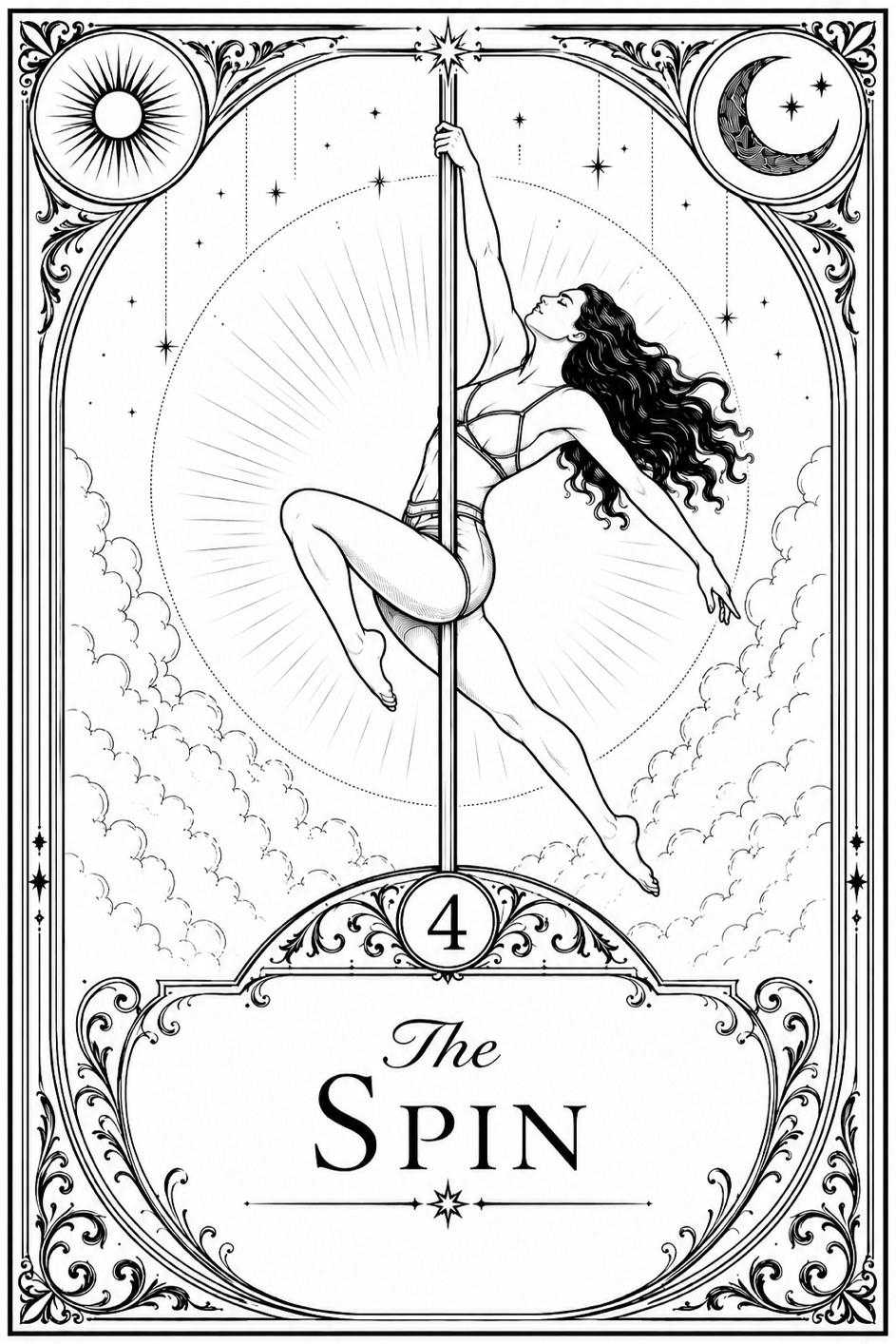
The Spin
The Spread
Present Card: The Spin
Crossing Card: The Bail
Root Card: The Call-Back
Hidden Card: The Body Memory
Future Card: The Workshop
✦
Present Card: The Spin
The card of motion permitted.
Upright: the body carried by momentum. The dancer who discovers that not every shape requires force. The pole giving the gift of movement back to a body that had forgotten how to be moved.
Reversed: the spin attempted with the body still braced. The dancer who turns but does not surrender to the turning. Joy refused even as it arrives.
The move. The dancer grips the pole, lifts the feet, and lets the body swing around the pole’s vertical axis. The grip may be one hand or two, high or low. The body may be in any of a hundred shapes — a Fireman, a Carousel, a Back Hook, an Attitude Spin — but the principle is constant: the dancer commits her weight, the pole becomes the axis, and momentum does the rest.
The Spin is the first move in pole in which the body is moved by the apparatus rather than holding itself against it. It is also the first move in which the dancer encounters the fact that the body can be carried.
This is harder than it sounds.
Most beginners brace through their first spins. The arms grip too hard. The shoulders rise. The face composes. The dancer turns, but she turns as a held thing rather than as a moving thing.
The teacher’s job, in the first Spin classes, is not to teach the dancer how to spin. The body knows how to spin. The teacher’s job is to teach the dancer how to let the spin happen to her.
This is the difficult part.
It is the difficulty of a lifetime.
✦
The first time I spun on the pole I held on too tight.
The teacher said, grip high, lift your feet, let the pole take you.
I gripped high. I lifted my feet. I did not let the pole take me.
I turned, technically, in that my body went around the pole once, but the turning was muscled. The arms were locked. The shoulders were up by my ears. The face was composed in the precise expression of a woman who has been asked to do a thing she is not yet prepared to allow.
The teacher said, you’re turning, but you’re not spinning.
I said, what’s the difference?
She said, the difference is whether you trust the pole to carry you or whether you carry yourself around it.
I came down.
I tried again.
I held on slightly less tight. I turned again. The turn was, technically, the same turn — the same number of degrees, the same grip, the same lifted feet. But something in the turn was almost different. The shoulders had dropped half an inch. The face had relaxed by perhaps two degrees. I could feel, in the turning, a moment where the body had almost allowed the pole to do the work, and then had taken the work back at the last second because the work had felt unfamiliar.
The teacher said, better. Now do it again and don’t take the work back.
I tried again.
I took the work back.
The Spin took me three classes to land. Not in the sense of executing the move — the move was technically correct from the first try. It took me three classes to receive.
The body had to learn, over three Tuesdays, that being carried was not the same as being abandoned. The body had to learn that letting the pole do the work was not the same as failing to do the work. The body had been doing the work, in some form, every day for thirty years.
Letting something else do the work was, for the body, an entirely new vocabulary.
By the third class I let it happen.
It was a Carousel Spin. The teacher had been talking me through it for ten minutes. She had said, in every variation she could think of, trust the lock, trust the lock, trust the lock.
I had been trusting the lock with my arms and not trusting it with my mind. The pole had been turning me, technically, but the turning had felt like an event happening to me rather than with me. I had been bracing through every revolution.
On the fourth attempt, somewhere in the middle of the second rotation, I let go.
I do not mean I released my grip. I mean the interior let go. The bracing in my chest stopped. The held breath came out. The shoulders dropped. The face — which I would see, later, on video — opened into an expression I do not remember choosing. The eyes closed, not from fear this time but from delight. The mouth opened slightly.
The body, suspended, turned by the pole, received the turning.
I went around.
I came around again.
The pole carried me.
I did nothing.
The body laughed. Not out loud. The body laughed in the way the body laughs when it has been holding its breath for a long time and finally exhales — a kind of internal release that has the shape of laughter without the sound.
The body said, oh.
The body said, this.
The body said, this is what I had forgotten.
What the body had forgotten was that it could be moved. Not moved emotionally. The body had been moved emotionally many times across the previous thirty years. The body had not been moved physically without effort. The body had not, since the choreographies of a stage in Macau at seventeen, been carried by anything.
The body had been doing all the moving for three decades.
The body had been the engine of the household, and engines do not get to be passengers.
The Spin was the first time, since the plane home from Macau, that the body had been a passenger.
The pleasure was not erotic, exactly, though it had erotic neighbours. The pleasure was kinetic — the body remembering that motion could happen to it. The pleasure was cellular — the body remembering that being-carried was a category of experience it was allowed to have. The pleasure was, somewhere underneath, grief — the body realising, while spinning, that it had not been carried in three decades and that nothing in the household had been built to carry it.
I came down from the Spin.
The teacher said, there it is. You felt it.
I said, yes.
She did not ask what I had felt.
The teacher of an intermediate pole class does not ask. The teacher knows. The teacher had felt it, possibly twenty years earlier, on her own first true Spin, and had been waiting, with the patience of all good teachers, for the moment her student found it.
She said, good. We’re going to do that again now, and then again, and you’re going to spend the rest of your pole life learning to do it on more difficult moves than the Carousel.
I went home.
I did not tell him about the Spin.
He was on the sofa. The news was on. I walked into the kitchen and put the kettle on and stood, for a moment, at the counter, aware that I had been transported. The transport was still inside the body. The body was, in the kitchen, very slightly still spinning — not literally, but in the sense that the pleasure of having been carried was still circulating in the chest, looking for a way to land.
I poured the tea.
He did not look up.
I went up to bed.
The body remembered.
The body would not forget.
✦
Crossing Card: The Bail
The card of the abandoned attempt.
Upright: the honest release. The dancer who recognises, mid-move, that the attempt is not the attempt, and comes down before the move breaks the body. Wisdom disguised as failure.
Reversed: the whole practice abandoned because one attempt failed. The dancer who mistakes a single bad video for the truth about her pole life. The near-quit dressed as reason.
The move. A dancer, mid-attempt at a move, realises the move is not landing. Perhaps the grip is wrong. Perhaps the strength is not there today. Perhaps the shape has begun in a way that will not resolve. She has two options. She can push through and risk injury. Or she can bail — come down from the pole controlled, feet first, and reset.
The Bail is one of the most technically important skills in pole. Every serious dancer bails hundreds of times across her career. Bailing well is what separates dancers who continue from dancers who get hurt.
The Bail is not failure.
The Bail is survival.
The Bail reversed is different. The Bail reversed is bailing on the pole itself — not from one attempt, but from the whole practice. The dancer who sees a video of herself and does not come back. The woman who books one class and does not book the next. The Bail reversed is the abandonment the studio never sees, because it happens after the woman leaves the building.
✦
The first time I nearly bailed on pole entirely was after Marion filmed me.
Marion was forty-two, possibly forty-three, with pink hair cut blunt at her jaw and the air of a woman who had made several decisions in her life purely to see what would happen. She worked in HR for a logistics company and had come to pole, she told me later, because she had spent twenty years asking other people about their development goals and had realised, one Tuesday afternoon, that hers had become survive the quarter.
This was, the teacher said, the difference between taking a class and practising.
Marion airdropped the video to me on the studio floor before I had finished catching my breath.
I did not watch it until the following day.
I sat on the sofa on Wednesday afternoon while the house was empty. I opened the phone. I watched myself do the Fireman.
The woman on the screen was not the woman I had been in the studio.
The woman on the screen was smaller. The woman on the screen was older. The woman on the screen was heavier in specific places I had not been aware of. The woman on the screen had a back, when she gripped the pole, that did what backs of forty-eight-year-old women do — it curved slightly, it thickened at the waist, it revealed the shape of a life that had involved two children and thirty years and one significant proportion of takeaway curries eaten on Friday nights.
I stopped the video after eight seconds.
I put the phone face down on the cushion next to me and I felt, for the first time since the first class, that I might not go back.
What I nearly did was bail on the pole entirely. Not bail on the Fireman. Bail on the whole thing. Bail on the studio, on the teacher, on the Tuesday evenings, on the class fees, on the whole four-week beginning of my return to my own body.
I sat on that sofa for perhaps twenty minutes and I composed the excuse.
I composed the sentence I would use to the teacher.
I composed the sentence I would use to the husband.
I composed the sentence I would use to myself.
The sentence to the teacher would have been I’ve hurt my hip, I need to rest for a few weeks.
The sentence to the husband would have been the Pilates isn’t really helping my back, I’m going to stop for a bit.
The sentence to myself would have been I gave it a go, it wasn’t for me, at least I tried.
All three sentences would have been the Bail reversed.
The Bail reversed is the mechanism by which most women in mid-life abandon what they have started. It is not dramatic. It is not a crisis. It is the quiet composition of a reasonable excuse on a Wednesday afternoon while the house is empty and a phone lies face down on a cushion.
The Bail reversed is the sentence you rehearse for the teacher, the husband, and yourself, in that order, each one calibrated to be plausible enough to end the practice without anyone noticing that the ending has been decided by fear of a video.
I nearly wrote the message.
I picked up the phone. I opened the text app. I typed the teacher’s name.
I did not send it.
I did not send it because — and this is the smallest and most important detail of the chapter — as I opened the text app the phone showed me, at the top of the screen, that Marion had sent me a second message. I had not noticed it earlier because I had been trying not to look at the phone.
Marion’s message said:
watched mine back. Christ almighty. Are we allowed to hate ourselves this much on Wednesday? Xx
I laughed.
I laughed alone in the empty house, sitting on the sofa, with the composed excuse still open in the message field for a teacher whose name I had just typed. I laughed for perhaps twenty seconds and then I put the phone down and I said, out loud, to no one, oh, thank God.
Marion’s message told me I was not alone in the reaction. Marion, who was younger than me by five or six years, who had pink hair and a job that required her to use the phrase stakeholder alignment without laughing, had watched her own video and had also wanted to die. Marion had felt what I had felt. Marion had, presumably, also composed her own quiet excuse — the sentence for the teacher, the sentence for the husband, the sentence for herself.
But Marion had, instead of sending the excuse, sent me a message that was itself the anti-excuse.
Marion had made the reaction funny.
Marion had reclassified the phone’s evidence from tragedy to comedy, and she had done this by saying it out loud to another woman.
I texted her back.
I said, me too. I nearly cancelled the class.
She said, DO NOT CANCEL. If I have to sit through Tuesday alone with only Sandra for company I will actually die. Also she thinks pole is her spiritual awakening and I cannot cope with it on my own.
I said, I will be there. Tell Sandra to bring the incense.
She said, DO NOT ENCOURAGE HER.
We texted for about forty minutes.
By the end of the forty minutes I had gone back to my video. I had watched it, with the sound off, as the teacher would later tell me to — homework, not vanity, watch the arms, watch the line, do not watch the person — but that instruction came in the following Tuesday’s class.
On the Wednesday of the near-Bail, I watched the video because Marion had made it survivable to watch.
The community had, in a small way, arrived.
The Bail reversed did not happen because another woman I barely knew sent me a text message that reframed my Wednesday-afternoon private catastrophe as a shared Wednesday-afternoon private catastrophe, and the shared version was survivable in ways the private version had not been.
The teacher would, on the Tuesday, notice that I was bracing again.
She would ask what had happened.
I would say, nothing.
She would say, you know what a video is for, right?
I would say, homework.
She would say, homework, not vanity. If you’re watching the video and hating the woman on it, you’re doing it wrong. Watch the arms. Watch the line. Watch the angle of the shoulder. Do not watch the person.
I would fix the shoulder that week.
The Fireman would get better.
But it was not the teacher’s sentence that kept me in the studio. It was Marion’s.
The teacher’s sentence taught me how to use the video. Marion’s sentence taught me how to survive the video. Both were necessary.
The Bail is a real move. It saves lives.
The Bail reversed is what almost ended my pole life in the third week.
Marion’s text was the reason it did not.
✦
Root Card: The Call-Back
The card of the moment the trajectory becomes real.
Upright: the dancer’s name read out. The corridor. The list on the wall. The shorter list at two o’clock. The specific young body chosen from a room of bodies for the specific work it has been training for.
Reversed: the recall never issued. The list on the wall without the name. The corridor emptied. The trajectory that had felt inevitable revealed as one of many possible futures, and not the one on offer.
The move. In every performance discipline, the audition is followed by the recall — the list of names posted on a wall, or texted, or emailed, or announced, of those who will continue in the process. The recall is the moment the abstract audition becomes the specific selection.
In pole, the Call-Back appears in competition contexts — preliminary rounds followed by finalist announcements — and in showcase and troupe selection, where a studio’s teacher will ask certain students to be part of an upcoming performance.
The Call-Back is the move in which a dancer discovers, for the first or the fiftieth time, that the panel has chosen her.
✦
I want to write about the corridor in London now because the Spin has earned the chapter the right to write about it, and the Call-Back is the card that holds the corridor.
I had been in London the day the audition was held.
I had travelled up on the train from home on a Tuesday morning in March. I had been sixteen at the time — technically still sixteen — and I had told my parents I would be back on the last train. I had my ballet shoes in a bag. I had a jazz shoe in another bag. I had a leotard and a skirt for the modern section. I had a bottle of water. I had a sandwich my mother had made me at seven o’clock that morning.
The audition was in a rehearsal studio above a warehouse in an unglamorous part of the city that no one now would recognise as the address of a serious international cabaret audition.
There were thirty-two of us.
The choreographer was a Frenchman. His assistant was a Belgian woman I would later come to know. That day, in London, she was a stranger holding a clipboard.
We were taught a section of choreography in the morning. We rehearsed it for an hour. We were then asked to perform it in groups of six. The panel watched. They made notes. They said thank you.
We were dismissed for lunch and told to return at two.
At two, a list was on the wall.
Fourteen of us had made the recall.
I was on the list.
I had been standing in the corridor with the other girls, waiting. I had been chatting to a girl from Sheffield who had, like me, come down on the train that morning. We had been trying to distract each other from the list-checking that was about to happen. Someone had said, the list is up, and we had walked, twelve of us in a row, to the wall where the list was pinned.
I read my name.
I did not immediately understand that I had read it. My eyes had, by then, learned the shape of my name so completely that they could pass over it without registering. I read the list twice.
On the second reading, I saw my name and felt it.
The Sheffield girl was not on the list.
I want to record this because it is one of the moments the chapter’s ethics requires me to name. The Sheffield girl said, oh, well done you, in the way girls at auditions say oh, well done you when they have not been recalled and someone standing next to them has. Her voice was steady. She smiled at me. She said, good luck this afternoon, and she picked up her bag and she walked to the door, and I have never seen her again.
Every audition has a Sheffield girl.
Every recall has a not-recalled.
The room I am writing this chapter for includes all of them, and the Call-Back is a card that was won by not being someone else, and the not-being-someone-else is one of the things dance and every performance industry does not talk about.
The Sheffield girl left the corridor.
I went into the studio.
The fourteen of us learned a second section of choreography. We performed it in groups of four. We were dismissed. Two hours later, a shorter list was on the wall. Eight of us.
I was on it.
We were asked to stay for a brief interview with the producer.
The producer was a woman. I want to record this because the industry the chapter is describing is often assumed to have been run by men, and it was, largely, but the producer of this particular company in this particular year in London was a Chinese woman in her forties who had, I would later learn, danced in Paris in the seventies and moved into production in the eighties. She spoke to us in English with a French accent because her English had been learned in Paris.
She asked me three questions.
How old are you.
Sixteen.
When will you be seventeen.
In June.
The contract begins in August. You will be seventeen. Is that all right with your parents.
I said, I think it will be.
She said, make it be. If they say no, do not come. If they say yes, we will send you the paperwork within a week.
That was the audition.
The Call-Back had happened.
The paperwork arrived at my parents’ house eight days later. My mother read the letter first. She read it twice. She read the contract. She read it twice. She left it on the kitchen table with a note that said, we will discuss this when your father is home.
My parents took a week to discuss it. I was told, at the end of the week, that they were worried, and that they had decided, and that the decision was that I could go.
The plane was booked for the eleventh of August.
The Call-Back card is upright.
The trajectory is real.
I want the reader to hold the corridor. I want the reader to hold the girl standing in front of the wall reading her name for the second time and feeling it. I want the reader to hold the Sheffield girl saying oh, well done you and picking up her bag. I want the reader to hold the eight of us in the interview room and the woman with the Paris accent and the three questions.
Hold it.
The next chapter is where the trajectory begins moving toward the wing.
Another chapter will tell you where it broke.
But the Call-Back happened. It cannot be un-happened. The corridor is permanent. The name was read out. The list existed. The paperwork arrived. The plane was booked.
The trajectory was chosen.
The Root card of this chapter is the moment the chosen-ness became material.
Everything the pole would eventually give back was already contained, in seed, in the corridor on that Tuesday afternoon in London in March.
The Call-Back was the seed.
The Spin, thirty-two years later, on a Tuesday in October, was the seed germinating.
✦
Hidden Card: The Body Memory
The card of the training that has not been lost.
Upright: the body executing a move it has not been taught in this life because it was taught the move in an earlier one. The old training rising into a new studio without the mind’s consent. The dancer whose body knows what her mind has forgotten.
Reversed: the body memory refused. The dancer who does not trust the return of what she used to know. The old training suppressed to make room for a beginner’s grief.
The move. Body Memory is what happens when the returning dancer’s execution outpaces her stated experience. The teacher assigns a move. The dancer performs it with a line, an extension, a musicality the class has not been taught. The teacher watches and says, have you danced before? The dancer says, yes, but a long time ago. The teacher nods and does not push.
Body Memory has arrived.
The body has, without consulting the woman, resumed a syllabus it had put down. Body Memory is not conscious. Body Memory is not chosen. Body Memory is the body’s insistence that the training it received before is not lost. It has been stored, and the storage has been waiting for the right room to open in.
✦
The Hidden Card of this chapter is the discovery that the girl the Call-Back had chosen in London had not, as I had believed for thirty years, died.
I had believed she was gone.
I had told myself this in various ways. I had told myself she had been replaced by the mother. I had told myself she had been outgrown. I had told myself she had been a phase. I had told myself she had been lucky, once, and had used up the luck.
All of these had been the mind’s ways of managing the loss.
All of them were, I now know, false.
The girl had not died. She had been silenced by circumstance, but she had not died. She had lived, quietly, underneath the woman she had grown into. She had been in every kitchen the woman had stood in. She had been at every school gate. She had been in every waiting room, every supermarket, every meeting, every bedtime.
The mother had covered her.
The wife had covered her further.
The council officer had covered her further.
But the girl who had walked into a rehearsal studio in London at sixteen and had had her name read out on a list at two o’clock had not been erased.
She had been stored.
The pole was the studio that opened the storage.
The Spin was the move that opened it further.
Body Memory was the mechanism.
Body Memory is not remembering how to do a move. It is the body doing the move before the mind has decided the body could. The arms knowing where to go. The shoulder placing itself. The foot pointing without being asked. The eye finding the spot on the wall without instruction. All the small corrections a dancer’s teachers gave her, over years, absorbed into the body’s cellular architecture and never let go of.
The pole studio provided the room.
Body Memory returned to service.
I did not, at first, know this was happening. I only knew that I was executing moves better than my stated experience should have allowed. The Fireman had come more easily than the teacher had expected. The Pole Sit had held without wobble. The Climb had been slow — the Climb had been laboured — but the line on the Climb, once I could climb an inch, had been right, and I had not been taught why.
The Spin — the true Spin, the one I received on the third Tuesday of the Spin classes — had received me in a way the teacher said, afterward, that beginners rarely find in fewer than fifteen or twenty classes.
The teacher had, in the class after the received Spin, asked me the question.
She said, have you danced before?
I said, yes. A long time ago.
She said, how long ago?
I said, I stopped when I was seventeen.
She said, what were you training in?
I said, ballet, jazz, modern.
She said, how many years?
I said, thirteen. From age four.
She said, you were a serious dancer.
I said, yes.
She said, your body remembers everything.
I said, I don’t understand.
She said, I do. Watch me.
She got on a pole. She did a Fireman. Then she did a Fireman with the dancer’s line — the arm placed exactly, the foot pointed, the neck extended, the eye finding the point on the wall.
She said, see the difference?
I said, yes.
She said, your Fireman is closer to my second one than your first class had any business being. That’s not you learning fast. That’s your body doing what it was trained to do. It never lost the training. It’s just been waiting.
I said, how do you know?
She said, because I’ve been teaching for eleven years and I have seen returning dancers. I have seen women come back to pole in their forties who were serious dancers in their teens. Their bodies do this. Their bodies know things I have not taught them. Their bodies pick up moves I have not shown them because the moves are cousins of moves they used to know. Your body has been keeping the barre alive for thirty years. It’s not a beginner. It’s a returner.
I stood at the pole and did not know what to say.
She said, you didn’t know, did you.
I said, no.
She said, most of you don’t. The body knows. It’s been waiting. You provided the room. It’s coming home.
She named the mechanism.
She told me the girl I had believed had died had, in fact, been stored in my body, and that the storage was not sentimental, not metaphorical, not a story I was inventing to comfort myself. It was technical. It was visible. It was in the shoulder, the foot, the neck, the arm.
I had not been a beginner in the studio for four Tuesdays.
I had been a returner from the first Tuesday.
The teacher had known. She had not said so because some returners do not want to be told. Some returners want to be beginners.
Being a returner means acknowledging the pause.
The pause implies a cost.
The cost implies a life in which the pause was imposed.
The teacher had not wanted to tell me until I was ready to know.
The Spin had made me ready.
Something in my chest, which had been holding a specific shape for thirty years, released.
The shape had been the shape of believing the girl was gone.
The story had been comforting because it had been sealed. The girl’s death had been complete. The mother’s life had been the reason. The reason had been worth it because I loved my son and my daughter and there was no version of my life in which they did not exist.
The story had, for thirty years, been the story I had lived inside.
The teacher’s Body Memory conversation cracked the seal.
The girl had been doing her old barre exercises quietly under the kitchen table for thirty years. The girl had been keeping the training warm. The girl had been waiting for a pole to arrive.
The pole had arrived.
The girl was, now, on the pole with me. She was executing moves I had not learned because she had learned them. She was pointing the foot because she had been trained to point the foot. She was placing the shoulder because she had been placed by teachers whose corrections she had absorbed.
She was sixteen.
She had a fringe I had not worn since 1986.
She had, unmistakably, risen back inside me.
The mother, the wife, the council officer, the forty-eight-year-old body — all of these were still in the studio. All of them were still doing the moves. But now, sharing internal quarters with them, was a sixteen-year-old dancer who had been called back for an international cabaret company, and who had never, in thirty years of storage, given up on the possibility that she might yet.
The forty-eight-year-old body who had spent thirty years in a household that had trained her not to want, not to reach, not to expect, not to sing, not to be seen, not to take up space was now sharing internal quarters with a sixteen-year-old whose entire identity was want, reach, expect, sing, be-seen, and take-up-space.
The two of them were about to have to negotiate.
The Hidden Card of this chapter is the moment the negotiation began.
The girl was the negotiator.
The woman would, over the chapters that follow, discover that the girl had been waiting to negotiate for thirty years, and that the girl had not lost her negotiating position.
The next chapter is the chapter in which the girl’s story moves closer to the wing.
✦
Future Card: The Workshop
The card of the first door beyond the studio.
Upright: the first evidence that the studio is not the whole world. The class in another building, another town, taught by another teacher. The body’s first glimpse of the wider tribe.
Reversed: the workshop attended too soon. The dancer who travels before her local practice has taken root. The community sought before the woman has finished being her own audience.
The move. A pole workshop is a class held outside the dancer’s home studio. It might be a Saturday intensive at another studio in the same city. It might be a two-day weekend at a specialist studio in another town. It might be a residential three-day event at a hotel with pole rigs installed in the function room.
The workshop’s function is exposure — to new moves, new teachers, new dancers, new choreographies, new communities.
The workshop is where the local dancer meets the national dancer.
The workshop is where the woman who has been doing pole in her town for six months discovers, for the first time, that pole is a movement, not just a class she attends.
✦
On a Saturday in the future I will attend my first workshop.
It will be four months after the Spin. My local studio will have organised a coach to take twelve of us to a workshop in another town — three hours away, in a specialist studio the local teacher had trained at herself when she was younger.
I will be terrified before I go.
I will be terrified because the workshop is outside. Outside the studio I know. Outside the teacher I know. Outside the women I have grown used to sharing a floor with. Outside the room I have been received in for four months. The Saturday morning coach journey will feel, in advance, like the day I am asked to prove that I am a dancer, rather than a woman who goes to a class.
I will get on the coach.
I will sit next to Marion, because by then Marion and I will have been friends for four months, since the Wednesday she saved me from bailing. Marion will have kept saving me since. Marion will save me, on the coach, from a variety of pre-workshop anxieties, by telling me the story of the time she had accidentally gone into a Teams meeting with pink glitter still on one cheekbone and had tried to pretend it was an optical issue.
We will laugh most of the three hours.
We will drink terrible coffee out of the coach’s flask.
We will look at each other’s videos — mine still private, hers mostly unwatchable by her own assessment, both of us treating the evidence with the increasing seriousness of women who have learned that hating the person on the screen is less useful than watching the arm.
The workshop will be four hours long. There will be sixteen of us in the room, from studios all over the north of England. The teacher will introduce herself as Amber. She will be thirty-two. She will have competed at national level for six years. She will be, without doubt, the most skilled pole dancer I have ever seen in person by an order of magnitude that will astonish me.
She will teach us a combination.
I will not get the combination.
Not fully.
I will get parts of it. I will fail at other parts. Marion will fail at more parts than I will fail at. Two of the women from other studios will get the whole combination and will make it look effortless. I will watch them and I will feel, for a moment, the old feeling — the not-being-chosen feeling — and I will feel, immediately underneath it, the sixteen-year-old stir and say, no, this is different.
This is not an audition.
This is a workshop.
She will be right.
There will be no list to be on. There will be no producer. There will be only Amber, teaching a combination, and sixteen women trying to learn it, and no one measuring anyone against anyone else.
I will notice that no one is being measured.
I will notice that Amber is helping the woman who is worst at the combination with the same attention she is giving the two women who can do it perfectly.
The workshop is a sharing.
Amber has come to give us a combination. We have come to receive it. Some of us will receive more of it than others. That is not a problem.
The problem in dance is ranking.
The workshop is deliberately, structurally, un-ranked.
I will feel, four hours into the workshop, that I have arrived in a country I have not previously visited.
The country will not be pole exactly. Pole will be its language, but not its geography. The country will be the world of women who take their bodies seriously enough to travel to workshops. This country will, I will discover over the next year, have thousands of citizens. The citizens will meet each other at workshops, at intensives, at competitions, at showcases, at annual conventions in London and Manchester and, on more than one occasion, in shabby hotels in places like Ormskirk.
But that is another card.
The Circus is another card.
The weekend hotels, the drag queens, the strippers, the hoop artistes, the feathers, the stalls, the paint, the powder, the stage names, the woman I will one day call Saskia St. Clement — they are waiting further along the spread.
For now, the Workshop is only the first door.
The Future Card is the Saturday I will get on a coach and discover that pole is not just a Tuesday-evening class in a studio above a kebab shop.
Pole is a country.
The country will receive me.
The country will not care that I am forty-eight.
The country will care that I have been called back — by the pole, by the studio, by the teacher, by Marion, by myself — to be a dancer again.
The sixteen-year-old will, on that Saturday, be four months into her return.
She will still have the fringe from 1986 that no one else can see.
She will be, by then, ecstatic.
She will be waiting for the coach to leave the car park.
She will have packed her own bag.
✦
To draw the Spin is to be told that the body is allowed to be a passenger.
That motion can happen to the body without the body’s labour.
That being carried is a category of experience the body has been denied for as long as it has been the engine of a household.
The Bail was the near-quit that community saved.
The Call-Back was the trajectory that had been real.
The Body Memory was the technical name for the girl who had been stored inside me.
The Workshop is the country I will one day travel to.
The Spin itself is the move I learned on a Tuesday in October, in a studio above a kebab shop, when the body — for the first time in thirty years — was allowed to be moved.
The body, that night, remembered what it had been waiting for.
The body remembered it was allowed to be carried.
The body remembered it was allowed to laugh for itself.
The body remembered it was allowed to receive.
The body remembered it had once been called back.
The receiving had been the missing organ of my adult life.
The Spin gave it back.
V
The Invert
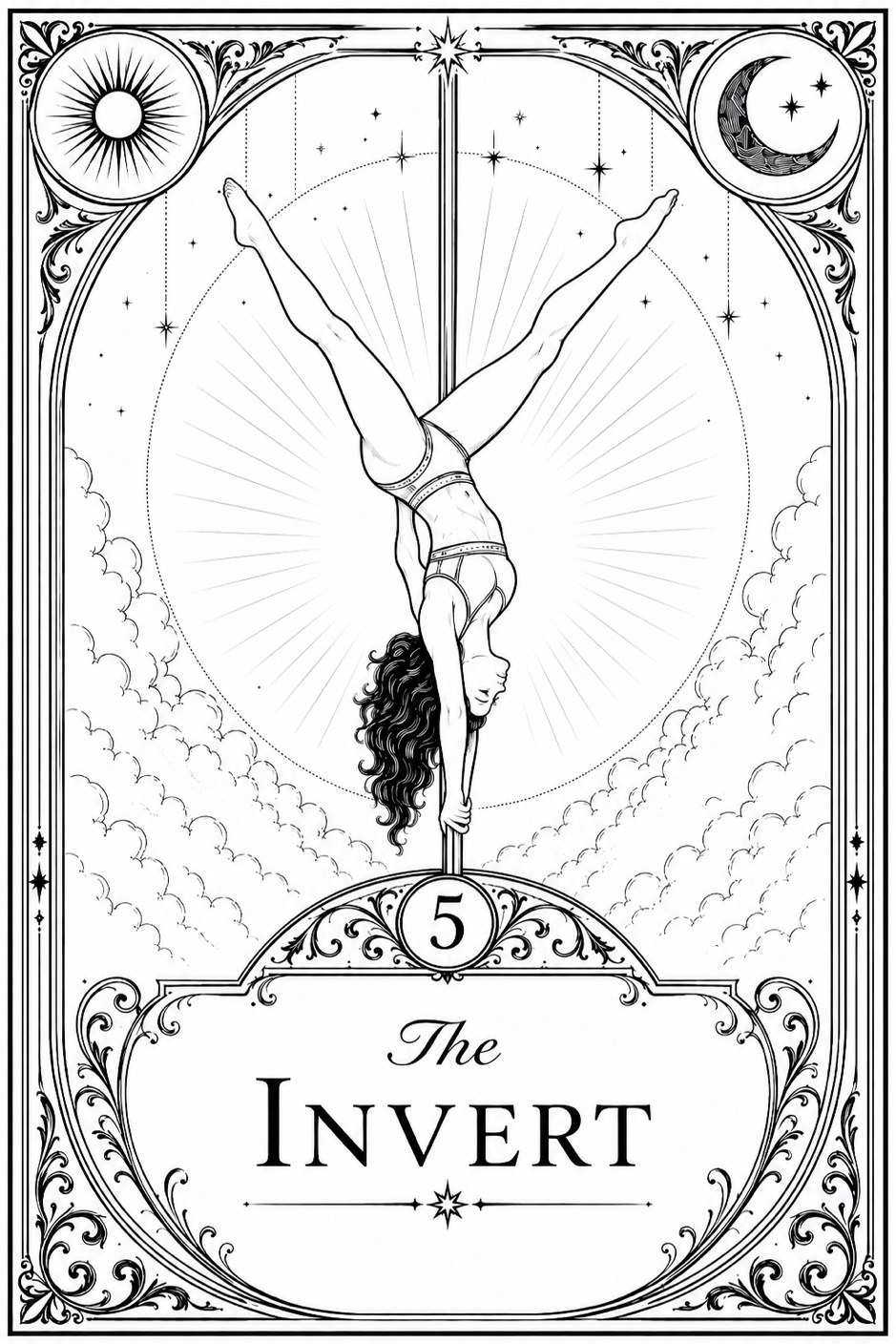
The Spread
Present Card: The Invert
Crossing Card: The Mirror
Root Card: The Wing — reversed
Hidden Card: The Dead Lift
Future Card: The Champagne Glass
✦
Present Card: The Invert
The card of the world turned over.
Upright: the chosen reversal. The body deliberately upside down. The head below the heart. The dancer discovering that the room has more than one truth.
Reversed: the body turned over by circumstance. The inversion that arrives before the dancer has consented. The world upside down without instruction on how to come back.
The move. From a Pole Sit, or from standing with the correct grip, the dancer sends the hips upward and the head downward. The hands hold. The core engages. The legs lift, open, fold, hook or extend. The body, which has spent its life obeying the old law — head above heart, feet below — breaks the law.
The Invert is taught after the first holds, sits, climbs and spins because it requires more than strength. It requires disagreement. The body must disagree with its own oldest instruction. The head goes down. The feet go up. The floor and ceiling exchange meanings.
The Invert is the first move in which the dancer learns that the upright world is not the only world.
It is one version.
There are others.
✦
The first time I inverted on the pole I closed my eyes.
I want to say that first because the closing of the eyes is the truth of it. Not the shape. Not the technique. Not the fact that my legs, somehow, found their way above me and the room tilted itself into another arrangement. The truth is that I went upside down and immediately refused to look.
The teacher had said, today we are going to try our first invert.
The younger women made the usual noises — half excitement, half dread. Someone said absolutely not. Someone else said I have made peace with dying. Marion, who had arrived with her pink hair scraped into two uneven buns and one sock inside out, said, if I get stuck upside down, please tell my team I died pursuing personal development.
I laughed, and I was grateful to her for making it funny because the body had not found it funny. The body had been preparing itself all week in ways the mind had failed to understand. I had burned onions on Monday. I had snapped at my daughter on the phone because she had used a tone of voice I invented entirely. I had forgotten a meeting at work and then sat in the wrong meeting for seven minutes before realising no one in it knew who I was.
The Invert was coming. The body knew.
The teacher showed us the first version. Controlled. Plain. Nothing decorative. Grip. Engage. Tip. Lift. Hook. Come down. She made it look like a sentence with punctuation.
Then it was our turn.
I stood beside the pole and put my hands where she told me to put them. I had done enough by then to understand that the hand is often the first part of the body to lie. The hand says yes before the ribs do. The hand says ready while the stomach is still considering emigration.
The teacher came to my pole.
She said, we’ll do this together.
I said, I don’t think I can.
She said, I know you don’t.
She placed one hand lightly near my back, not holding me, not yet, only letting the body know there was a human witness close enough to intervene if the laws of physics became unreasonable.
She said, tuck. Now send the hips up.
I tucked.
I sent nothing.
She waited.
The teacher had, by then, developed the patience of someone who knows that a woman will not invert because she has been instructed to invert. A woman in midlife does not abandon the upright world because a younger woman in leggings says now. She has to negotiate with every room she has survived in: the kitchen, the stairs, the supermarket aisle, the marriage bed, every place in which remaining upright had been the same thing as remaining functional.
The teacher said, again.
I tucked.
This time the hips moved. The head lowered. The room shifted.
There is a moment in the first Invert when the body understands that it is past the point at which the old arrangement can be restored without consequence. The head is already below where the head should be. The legs are already lifting. The pole is already taking information from the skin. The floor has begun to rise in the corner of the eye.
That was when I closed my eyes.
I closed them because seeing the world turn over felt like one demand too many. I could go upside down, apparently. I could not yet witness myself doing it.
The teacher said, good. Stay there.
I stayed there. It was not elegant. It was not brave. My thighs were clamped to the pole with the spiritual generosity of a bank vault. My arms were too tight. My jaw had locked. My face, I imagine, looked like a woman attempting to reverse a caravan down a narrow lane while being observed by her dead relatives.
But I was upside down. The head was below the heart. The feet were above the floor. The body had disagreed with itself and survived the disagreement.
The teacher said, come down slowly.
I came down too quickly.
She caught my shoulder, not because I was falling, but because I was returning to the world with more urgency than dignity.
Feet on floor. Hands off pole. Breath back in body.
The teacher said, there.
I said, what?
She said, you inverted.
I said, I closed my eyes.
She said, yes.
I said, does it count?
She looked at me as if I had asked whether rain counted as weather.
She said, of course it counts. You came back.
✦
Crossing Card: The Mirror
The card of the witness without manners.
Upright: the body seen by glass. Reflection as instruction. The dancer learning that the mirror is not cruel, only immediate.
Reversed: the mirror as enemy. The dancer who can work only while refusing to look. The woman who avoids reflection because reflection threatens the story she has survived by telling.
The move. The studio mirror is not decoration. It is apparatus. It corrects the shoulder, the line, the hand, the hip. It shows the dancer what the body cannot feel. It confirms whether the leg is extended, whether the foot is sickled, whether the back has collapsed, whether the face has retreated into apology.
The mirror is the studio’s silent teacher. It does not praise. It does not soften. It gives the body back immediately.
✦
For the first weeks of pole I avoided the mirror with the discipline of a professional. I chose the pole that faced away from the largest wall of glass. I adjusted my angle during warm-ups. I used other women as cover. I checked my hair in the changing room mirror and nothing else. I had spent years reducing mirrors to practical instruments — hair, teeth, lipstick, acceptable face for work, acceptable face for supermarket, acceptable face for marriage.
The studio mirror refused to be practical. It was not there to confirm acceptability. It was there to show the body at work.
I did not want that.
The Invert ended my avoidance.
You cannot learn to invert properly without the mirror. Upside down, the body lies to itself. The inner ear becomes theatrical. The spine loses its map. The brain, suddenly suspicious of the ceiling, begins filing complaints. The only reliable witness in the room is the glass.
In the second Invert class, the teacher moved me.
She said, use this pole.
I said, that pole faces the mirror.
She said, yes.
I said nothing.
Marion, from the next pole, said, it’s fine, the mirror signed an NDA.
I laughed, but I still stood as if approaching sentencing.
The teacher said, you’re going to invert and open your eyes.
I said, am I?
She said, eventually.
She spotted me again. Grip. Tuck. Hips. Lift.
The body went upside down more easily the second time, which annoyed me. Fear prefers to believe it has permanent authority. The body, however, is promiscuous with evidence. It learns a thing once and immediately begins arguing for repetition.
I inverted.
I opened my eyes.
The woman in the mirror was someone I had not met.
She was not transformed. She was not lit into revelation. She was simply unfamiliar. Her face was redder than mine. Her hair hung the wrong way. Her mouth was slightly open. One shoulder was working harder than the other. The skin of her inner arm was pressed flat against the pole. Her stomach, which I had spent years regarding as aftermath, was engaged in the serious work of keeping her alive.
She was upside down.
She was me.
The teacher said, you saw her, didn’t you?
I said, I think so.
She said, good. Now you can’t unsee her.
She was right.
For the rest of that week I looked for the inverted woman in ordinary mirrors. Bathroom mirror. Hall mirror. Black phone screen. Microwave door. Shop window. She was not there exactly, not in the upright face. But the upright face had become less complete. It had lost its monopoly.
There was another version underneath.
The mirror had shown her to me.
✦
Root Card: The Wing — reversed
The card of the threshold not crossed.
Upright: the dancer in the wings, waiting for the cue. The music about to begin. The body one breath away from becoming visible.
Reversed: the dancer called back from the threshold. The stage interrupted. The trajectory altered before the body understands the alteration. The wing holding a future that will not arrive in the form promised.
The move. The wing is the space immediately offstage. Not stage, not backstage, but the charged strip of almost.
✦
I had stood in the wings in Macau.
Not just once. Night after night. Six nights a week, eight until two. The body learns that rhythm quickly: the long afternoon sleep that never quite restores you, the slow waking into evening, the smell of hairspray and hot lights before you have properly eaten, the waiting, always the waiting.
We lived in a shared flat that never quite cooled down. The windows opened onto noise that did not belong to us. The food was unfamiliar in ways that made you suddenly childish — textures you did not trust, flavours you could not name. We learned quickly where the McDonald’s was. We learned the route like a pilgrimage. Fries, salt, something known. Something that did not ask you to be brave.
We would eat there sometimes before call, sitting in costume jackets over bare legs, laughing too loudly, conserving energy without admitting that was what we were doing.
Then back to the theatre.
Pins in costumes. Blisters under plasters. Oranges in corridors between sets. The Belgian woman smoking and correcting my shoulder with two fingers. The French choreographer with beautiful hands and no patience for self-pity. The schedule pinned to the wall like a contract with the body.
I was seventeen.
I was paid.
I was good.
I want those sentences to stand without apology.
Some numbers were topless, in the European cabaret tradition of that time. The upper costume came off. The choreography continued. The work was not the nudity. The work was the dance.
The audiences wore jackets. The dancers wore feathers, sequins, skin, discipline.
And I stood in the wing.
Hand on the curtain. Heart in my throat. Music coming through the stage floor. The body already halfway into the light.
The wing is a place of certainty. That is its cruelty. The dancer in the wing does not wonder whether she will go on. She waits to go on.
At seventeen, I believed that certainty belonged to me.
There was a man then. Not yet a husband, not yet anything that could be named with the weight it would later carry, but already present in the architecture of my thinking. Calls made at odd hours. Messages that arrived out of sequence with the life I was living. A voice that belonged to another country, another future, another version of me that had not yet been chosen but was already exerting a quiet gravity.
He did not belong to the wing.
He belonged to the interruption.
I did not understand that yet.
I stood in the dark believing the stages would continue in a line: Macau, then somewhere else, then somewhere else again. Vegas, perhaps. Paris. London. The map existed, even if it was not detailed.
The Wing appears reversed because the body standing there did not yet know that the line would bend.
The body knew something.
I did not.
✦
Hidden Card: The Dead Lift
The card of strength that has been carrying without being named.
Upright: the body lifting itself by pure strength. No kick, no swing, no borrowed momentum.
Reversed: the strength refused. The body waiting for permission to use what it already has.
✦
I had been lifting for thirty years.
Children. Shopping. Laundry. Kettles. Bags. Wet towels. Christmas boxes from the loft. Sleeping bodies from sofas. Suitcases. Buggies. Buckets. Bins. Other people’s moods.
I had lifted my son through years in which I was too young to know that lifting him was also lifting myself into another life. I had lifted my daughter through fevers and parties and griefs that changed size depending on who was looking at them. I had lifted my marriage across gaps it did not acknowledge.
No one had called this strength.
They had called it getting on with things.
The teacher, three weeks after the Invert, said we were going to try the first phase of a Dead Lift.
Grip high. Pull down. No jump.
I pulled.
My feet left the floor.
Six inches.
Then eight.
The teacher said, have you been doing strength training?
I said, I have two children and a council job.
She laughed, but she was not being kind. She was being accurate.
The body had been depositing strength for thirty years.
The Dead Lift was the first withdrawal.
✦
Future Card: The Champagne Glass
The card of the body inside the spectacle.
Upright: the dancer entering the impossible vessel. The body performing inside the joke and making the joke become art. The inversion held within theatre.
Reversed: the spectacle entered before the body is ready. The dancer used by the prop rather than using it. The joke swallowing the dance.
The move. A Champagne Glass is a large glass-shaped performance prop, often six or eight feet high, sometimes filled with water, sometimes dry. The dancer climbs into the bowl and performs inside its curved architecture — sits, extensions, inversions, held shapes, theatrical gestures. The glass is absurd. That is the point. It is a cocktail large enough to hold a woman.
The dancer inside the Champagne Glass is the body inside the joke.
If she is good enough, the joke becomes the frame.
The dance becomes the truth.
✦
In the future, there is a workshop in which I will dance inside a Champagne Glass for the first time.
Not yet.
Not soon.
Years from now.
By then, the break will have happened. The local studio will no longer be the edge of the world. The workshop country will have opened. The circus will have come to town more than once. I will have a stage name by then, and the first time someone calls it across a hotel lobby I will turn as naturally as if I had been born with it.
The Champagne Glass will stand in the middle of a function room in a hotel that smells faintly of carpet cleaner, hairspray and chips. It will be ridiculous. It will be magnificent.
That is the combination the old world never understood.
The teacher will tell us not to fight the prop. Trust the bowl. Use the curve. Let the shape happen where the glass allows it.
I will climb in. The glass will be larger from the inside than it looked from the outside, which is true of most vessels you finally enter. The curve will hold my back differently from the pole; the lip will demand a new kind of grip; the bowl will make certain movements impossible and others inevitable.
I will not be good at it immediately.
That matters.
I will not climb into the glass and become, at once, the woman the photograph later makes me appear to have been. That is the lie of photographs and one of the cruelties of performance. The finished image erases the effort that made it. The audience sees the held line, the glitter, the arch of the back, the impossible leg. It does not see the first attempt, the bad grip, the sliding foot, the teacher saying again, or the woman inside the glass thinking, with some irritation, that she has apparently agreed to be humiliated by stemware.
The first attempt will be awkward. I will misjudge the curve. I will grip the rim too hard. I will forget the count. My thigh will stick where it should slide and slide where it should stick. The glass will not behave like the pole. The glass will be colder, more theatrical, less honest. The pole tells the truth immediately: grip or fall, hold or don’t. The glass is stranger. It offers surfaces that look supportive and are not, curves that seem decorative and turn out to be structural, a lip that must be trusted in ways the body has not yet rehearsed.
The teacher will say, again.
I will go again.
That is the real choreography of any new apparatus: attempt, indignity, correction, attempt. The body learns the prop by being wrong about it several times in succession.
Eventually, after enough wrongness, something will land.
I will invert inside it.
The first Invert in the studio will be inside me still — the closed eyes, the teacher’s hand near my back, the mirror waiting. The wing in Macau will be inside me too: the dark, the curtain, the girl breathing before the cue. The Dead Lift will be inside me, the named strength, the first withdrawal from the account. All of it will be inside the glass with me.
I will go upside down.
This time I will not close my eyes.
The audience will think, at first, of the joke. Of course they will. A woman in a giant Champagne Glass asks for the joke. It invites it. It puts feathers on the joke and lights the joke from below. It says yes, I know exactly what this looks like, and then waits to see whether the dancer can do anything more interesting than be looked at.
The dancer’s task is not to escape the joke.
The dancer’s task is to outdance it.
I will not understand this fully in the moment. In the moment I will be counting beats. In the moment I will be trying not to slip. In the moment my hand will be on the rim and my leg will be finding a line and the bowl will be pressing into the back of my thigh and the teacher will be saying, hold, hold, hold.
But afterwards, when I come down, the meaning will arrive.
The Champagne Glass is the future card of the Invert because it is the inversion performed inside spectacle. The body upside down, yes, but now inside the theatre of being watched. Inside the absurdity. Inside the thing the world would like to reduce to a punchline.
The household had made jokes of parts of me.
The world had made jokes of women like me.
The Champagne Glass will be the place where I learn that a joke can be entered deliberately and changed from the inside.
The future card is not the next move I will learn next week.
The future card is the move that will tell me, in a function room I have not yet entered, with women I have not yet met, that the body can live inside the spectacle without becoming only spectacle.
The body can be inside the glass.
The body can be inside the joke.
The body can be upside down.
The body can still be the dance.
VI
The Layback
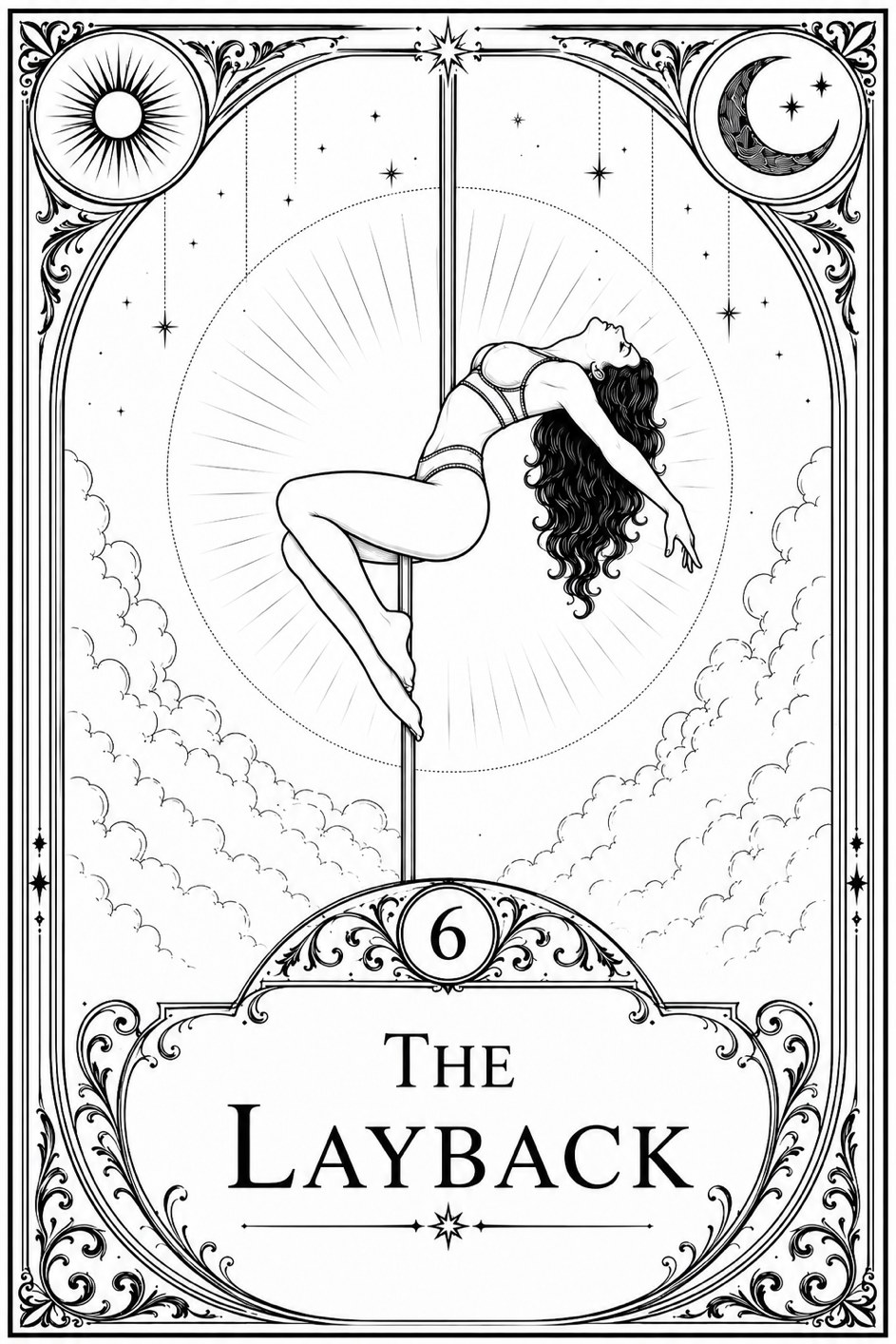
The Spread
Present Card: The Layback
Crossing Card: The Gaze — reversed
Root Card: The Pole Sit
Hidden Card: The Back Hook Spin — reversed
Future Card: The Playback
✦
Present Card: The Layback
The card of the heart exposed.
Upright: the body trusting the backwards fall, the chest opened, the head released, the dancer allowing the world behind her to exist without turning first to check it.
Reversed: the body that cannot lean back because it has spent too long bracing, the heart protected by habit, the dancer who mistakes vigilance for strength.
The move. From a Pole Sit, the dancer secures the legs against the pole, locks the thighs, engages the grip of skin and muscle, and then slowly leans the upper body backward. The hands may release. The head drops. The chest opens. The spine curves. The pole holds the lower body while the upper body moves into space.
The Layback looks like surrender, but it is not surrender. It is an agreement between lock and release. The legs must hold so the chest can open. The grip must be trusted so the head can drop. The dancer cannot perform the Layback by collapse. Collapse is not the move; collapse is what happens when the move has not been built.
The Layback is not falling. It is choosing the fall only after the body has made the fall safe.
✦
The first time I tried a Layback, I did not lay back.
I sat on the pole, locked the thighs, crossed the ankles, held the position the teacher had given me. Technically, the bottom half of the move had happened. The legs were secure. The pole was gripped. The body was prepared.
Nothing above the waist agreed.
The teacher said, now lean back.
Her name was Jade.
I had avoided giving her a name for several chapters, partly because I did not know, at first, what she would become. At the beginning she was only the teacher — the woman with the keys to the studio, the playlist, the grip spray, the authority to say again when the body had already decided once was quite enough.
She was thirty-five, perhaps thirty-six, with the particular brightness of women who are often mistaken for unserious by people who do not understand discipline. Jade was bubbly in the lobby, funny while taking the register, likely to call someone babe within thirty seconds of meeting them. But once the music started, the softness sharpened. She saw everything. A sickled foot. A lifted shoulder. A grip placed two inches too low. Fear pretending to be humour. Laziness pretending to be fear.
She was kind, but she was not casual.
That distinction mattered.
I said, absolutely not.
Marion, from the pole beside me, said, I second that, on behalf of the minutes.
The teacher said, you are both very secure.
Marion said, I have been secure before and regretted it.
Jade ignored her, which was one of Jade’s gifts. She was good at letting jokes pass through the room without letting them take the room with them.
She came to me first.
She said, feel the lock.
I said, I can feel the lock.
She said, trust the lock.
I said, I have met the lock quite recently.
She placed one hand lightly against my upper back — not pushing, not holding, only there.
I had been spotted before by then — through the Invert, through the beginnings of harder climbs — but the Layback was different. The Invert asked me to go upside down with effort. The Layback asked me to go backwards with trust.
Backwards was worse. Backwards is the direction in which the body cannot see. Backwards is where history lives.
Jade said, just a little.
I leaned back a fraction. The fraction was insulting.
Jade said, good.
I said, that was not good.
She said, that was the beginning of the move.
The body knew otherwise. The body knew that what had happened was not a move but a negotiation. The chest had agreed to open by perhaps half an inch. The head had remained upright. The neck had refused even the concept of release. My hands had clamped around the pole as if the pole owed me money.
Jade said, again.
I tried again. This time I leaned further. The upper spine bent. The throat opened slightly. The ceiling moved into view — not above me exactly, but behind and above, a new version of above. The body stiffened immediately. The ribs, the throat, the stomach all said no at once.
I came up too fast.
Jade’s hand was still at my back.
She said, you are safe.
I nodded. I did not believe her.
I wanted to believe her. That is different. Wanting to believe safety is not the same as feeling safe. The body is not persuaded by grammar. The body believes history. The body believes repetition. The body believes the rooms it has survived in.
The studio had been kind to me for months by then. The body was still checking.
Jade said, again.
I went again: sit, lock, breathe, lean.
This time the head dropped — not fully, not elegantly — but it dropped. The hair moved. The ceiling entered the body’s field of vision. The front of me opened into the room.
I made a noise — not a scream, not speech, a small startled sound, as if someone had opened a drawer inside me that I had believed was locked.
Marion said, was that the sound of personal growth?
I said, shut up.
Jade said, hold.
I held for three counts: one, two, three.
Then I came up, red-faced and furious with the air.
Jade said, good.
I said, I hated that.
She said, you did it.
I said, I hated it.
She said, yes. Those can both be true.
✦
Crossing Card: The Gaze — reversed
The card of being seen wrongly.
Upright: the dancer allowing herself to be witnessed. The face lifted. The chest open. The body accepting the look of the room without shrinking from it.
Reversed: the look that reduces. The eye that names badly. The watcher who mistakes cruelty for accuracy and calls it a joke. The woman who learns to see herself through the gaze that diminished her.
The move. In performance, the gaze is part of the choreography. The dancer does not only move; she looks. She chooses where the eyes go. To the hand, to the floor, to the audience, to the mirror, to the body’s own line. A lifted gaze changes the whole shape. A dropped gaze can make even a strong move apologise for itself.
In pole, as in dance, the gaze is never decorative.
The gaze tells the room who owns the looking.
✦
The Layback was crossed by the Gaze because the Layback opens the front of the body to being seen.
The throat. The chest. The face. The stomach. The soft places the body has spent years learning to guard. The Layback asks the dancer to trust the lock in the thighs and then offer the upper body to the room. It is not only backwards. It is visible.
I did not know, the first time Jade asked me to lean back, how much of my fear belonged to the movement and how much belonged to the looking.
Jade said, trust the lock.
I heard, expose the body.
Jade said, let the head go.
I heard, let the room see your face.
Jade said, open the chest.
I heard, offer them the evidence.
There are bodies that arrive in a studio already accustomed to being seen kindly. Mine was not one of them.
He had ways of putting me back.
I want to write that carefully because he did not do it all the time, and that was part of the method. If diminishment arrives every day, the mind eventually names it. If it arrives occasionally, disguised as humour, it becomes weather. A comment here. A look there. A little correction. A joke at precisely the place where the body is softest.
My eyes, he once said, were the colour of a dirty river.
He said it as if it were funny.
Perhaps it was funny to him. I do not know. Marriage contains whole rooms of humour in which only one person is laughing.
The colour of a dirty river.
I laughed, probably. I had learned to laugh quickly in those years, not because things were funny but because laughter was the fastest way to keep the room moving. If you laughed, the comment became harmless. If you did not laugh, you had no sense of humour. If you objected, you were making a fuss. If you remembered it years later, you were bitter.
So I laughed.
But the body does not laugh at the same things the mouth laughs at.
The body writes things down.
After that, I saw my eyes differently. Not every day. Not dramatically. I did not stand at the bathroom mirror weeping over them. That is not how small cruelties work. They do not usually announce themselves as wounds. They become adjectives. They become facts you did not choose but somehow inherit.
Dirty river.
It lodged somewhere behind the glass.
When I looked in the mirror, the phrase was occasionally there before I was. Especially when I was tired. Especially under bad light. Especially in the years when the face had become more practical than expressive, more weathered than looked-at, more used than seen.
This is one of the things a reversed gaze does. It continues looking after the person has left the room.
By the time I came to pole, I had not thought about that comment for years.
The body had.
The Layback found it.
Of course it did. The Layback finds the places where the body has hidden its small protections. It asks the head to fall back, the throat to open, the face to stop managing itself. It asks the dancer to let the room look.
On the first attempt, my chin stayed clamped toward my chest. The body would lean a fraction, but the face would not go with it. The face remained responsible. The face kept watch. The face was still in the old room, the room where being seen meant being assessed, reduced, joked back into place.
Jade said, let the head drop.
I said, I am.
She said, your head and I disagree.
Marion said, for what it’s worth, I’m on the head’s side.
Jade ignored her.
She said, look back.
I said, at what?
She said, nothing. That’s the point.
I did not understand her at first.
Look back at nothing.
Not at the mirror. Not at the audience. Not at him. Not at the old verdict waiting in the bathroom glass. Not at the woman on the phone screen I had nearly abandoned. Nothing. Just the space behind me. Just the ceiling. Just the fact that the room could receive my face without needing to comment on it.
That was harder than the grip.
The thighs knew how to hold. The hands knew where to go. The body, by then, had learned the beginning of the lock. But the face did not know how to be unguarded. The gaze had been trained downward, sideways, careful. The gaze knew how to check a room. It knew how to laugh quickly. It knew how to pass a mirror without asking for trouble.
It did not know how to open.
On the third attempt, the head dropped.
Only a little.
The ceiling came into view. The throat opened. The eyes, without being told what to do, looked up and back. There was no dirty river there. There was no joke. There was no husband standing in the doorway with a line prepared. There was only the ceiling of a studio above a kebab shop, a strip light, a water stain shaped vaguely like France, and Marion saying, well, that was dramatic.
I laughed while upside down enough to ruin the shape.
Jade said, again.
I went again.
This time, I let the head drop for three counts.
The room looked back without cruelty.
A room that looks back without cruelty is one of the first freedoms a body learns.
The Gaze appears reversed in this chapter because I did not yet know how much of what I called self-consciousness was borrowed sight. I thought I was embarrassed by my own body. I thought I was embarrassed by age, stomach, skin, face, the ordinary evidence of having lived. Some of that was mine, perhaps. But not all.
Some of it had been given to me.
Some of it had been said casually in kitchens.
Some of it had entered through jokes.
The Layback began the work of returning it.
Not all at once. Dance is not magic. A single move does not undo a sentence that has lived in the body for years. But the move made a counter-sentence.
The old sentence was: dirty river.
The new sentence was: look back.
Jade did not know she had given me that sentence.
She was only teaching the move.
Good teachers often are.
✦
Root Card: The Pole Sit
The card of the first lift.
Upright: the body discovering it can carry itself. The first time the floor lets go. The grip that becomes permission.
Reversed: the body that does not yet trust its own weight. The lift refused. The dancer who chooses the ground because the air is not yet safe.
The move. From standing, the dancer climbs a short way up the pole using the legs, then settles the body into a sitting position — one thigh pressed against the pole, the other crossed over it, the hands gripping above the head. The pole runs through the lap, locked between the legs. The dancer holds, suspended, off the floor entirely. The whole body weight is carried by skin against steel.
It is taught after the first held shapes have been mastered. It is the move in which the dancer discovers, for the first time, that the pole will hold her in the air. Before the sit, every move has been a negotiation with gravity. After the sit, gravity has agreed to wait.
✦
The Layback had its root in the Pole Sit because without the Sit, there is no backward movement.
A card means differently in different positions. As the Present, the Pole Sit had been the first lift. At the Root, it is the foundation. Everything builds from here.
The body must first learn to hold itself.
The Sit is not glamorous. It burns. It bruises. It teaches the skin to grip, the muscles to engage, the body to stay. Before I could lean back, I had to learn to stay: stay in the discomfort, stay in the hold, stay long enough for the body to understand that it could support itself.
The Sit taught me that stability is not given.
It is built.
Macau had taught me that too, though I did not have the language for it then.
What I remember most from Macau is not the glamour.
I remember the work.
The repetition. The count. The ache in the calves after the second show. The way the dressing room became practical after the first week: powder, pins, plasters, oranges, cigarettes, hairspray, women stepping over one another’s bags in nothing but tights and professional indifference. The body learned quickly there. It had to. There was no time for the kind of self-consciousness that would come later. A girl who worries too much about being seen misses the cue.
I loved that.
Not being looked at exactly. That is too simple.
I loved the moment when being looked at stopped mattering because the work took over. The body knew the count. The lights were hot. The music entered through the floor. The line of girls moved as one thing and I was inside it, not pretending, not helping, not mothering, not explaining.
Dancing.
That was what Macau gave me before it took anything away.
It gave me the knowledge that spectacle is built from repetition.
It gave me the knowledge that glamour is mostly labour under lights.
It gave me the knowledge that my body could be a profession.
It gave me the knowledge that I could be serious under feathers.
Years later, sitting on the pole with my thighs burning and my hands pretending not to help, I recognised the lesson in another form. The audience sees the shape. The body knows the work beneath it. Nothing holds unless something underneath has been built.
The Pole Sit was not glamorous.
Neither, really, was Macau.
That was why both of them mattered.
✦
Hidden Card: The Back Hook Spin — reversed
The card of momentum interrupted.
Upright: the smooth rotation, the body moving around the pole with ease, the hook secure, the spin continuous.
Reversed: the hesitation, the missed hook, the body stopping mid-motion, the fear of committing to the turn.
The move. The dancer hooks one leg behind the pole and allows the body to spin around it, using momentum and control.
Reversed, the spin falters. The body hesitates. The movement breaks.
✦
The Back Hook Spin reversed lives in the hesitation before the Layback.
It is the moment where the body knows what to do but does not do it.
The hook is there. The grip is there. The movement is understood.
But something interrupts.
The body pauses where it should flow.
That pause is history.
✦
Future Card: The Playback
The card of seeing the self twice.
Upright: the body watched without punishment. The dancer learning from her own image. The second viewing, kinder than the first. Progress made visible.
Reversed: the image used as evidence against the body. The woman who watches herself only to confirm the old verdict. The video mistaken for shame instead of instruction.
The move. The dancer props the phone against a water bottle, a shoe, a grip bottle, a folded hoodie. She presses record. She walks back to the pole. She performs the move, or the combination, or the eight-count she is trying to remember. Later, she watches the video. Not to admire herself. Not yet. To learn.
The Playback is the mirror delayed.
The mirror says: look now.
The Playback says: look again.
✦
There is a future version of me who will watch the video all the way through.
That sounds too small to be prophecy, but it is not small. The first videos had almost undone me. The Fireman Spin on Marion’s phone had nearly sent me back to the sofa, the television, the kitchen, the old life with a plausible excuse folded neatly in my hand. I had seen myself and mistaken seeing for judgement.
But the Playback will teach me another use for the image.
Not immediately.
Not easily.
At first I will still watch myself like an enemy gathering evidence. I will see the stomach before I see the shoulder. I will see age before I see timing. I will see thickness, awkwardness, hesitation, the arm not long enough, the foot not pointed enough, the face doing something unforgivable while concentrating.
Then Jade will say, stop watching the woman.
Watch the move.
She will take my phone from my hand and play the video again. She will stand beside me in the studio, both of us looking down at the small bright rectangle in her palm.
There, she will say. See that?
I will say, see what?
Your lock held.
She will rewind.
Watch the thigh.
I will watch the thigh.
She will play it again.
Watch the shoulder.
I will watch the shoulder.
Again.
Watch the moment you stopped bracing.
And there it will be.
A fraction. Half a second, no more. The body leaning back, the lock holding, the chest opening, the head beginning to trust the space behind it. Not perfect. Not beautiful in the way I had been trained to understand beautiful. But real. Visible. Mine.
I will watch it again.
This time, I will not look first at the woman.
I will look at the evidence.
The Playback is the future card of the Layback because the Layback cannot be believed by the body all at once. The body needs proof. It needs to see that the lock held. It needs to see that the head dropped and the room did not punish it. It needs to see that what felt like collapse was, from the outside, a controlled shape.
The body needs a witness it can replay.
The phone will become that witness.
Not Instagram yet. Not performance. Not the public body. That comes later, and it will bring its own dangers, its own permissions, its own ridiculous little negotiations with courage.
This is earlier.
This is private.
This is homework.
The first time I watch the Layback and do not hate myself, I will understand that the phone has changed sides. It is no longer the enemy. It is no longer the cold little judge on the sofa. It is a tool. A witness. A notebook made of light.
I will begin to collect myself there.
Not the self I imagine. Not the self I fear. The self that is actually moving.
Week by week, the videos will gather. Fireman. Pole Sit. Climb. Spin. Invert. Layback. Bad attempts. Better attempts. Attempts that begin badly and find themselves halfway through. Attempts in which Marion walks through the back of shot making a face. Attempts in which Jade’s voice can be heard saying again, which will become, over time, one of the holiest words in the language.
Again.
Again.
Again.
The Playback will show me what memory cannot. Memory is dramatic. Memory lies in both directions. It makes humiliation larger and progress smaller. The phone, for all its cruelties, has one mercy: it keeps the record.
I will see myself.
Not as a revelation.
As a practice.
The future card is the moment I will sit on the studio floor after class, sweating, bruised, embarrassed, alive, and watch myself lean back on a six-inch screen without leaving my own body.
The future card is the moment the image stops being proof against me.
The future card is the moment the image becomes proof.
I can see myself.
That will be the sentence.
Not I am beautiful.
Not I am young.
Not I am fixed.
I can see myself.
And for a woman who has spent years disappearing in rooms where everyone knew her name, that will be enough.
VII
The Body Wave
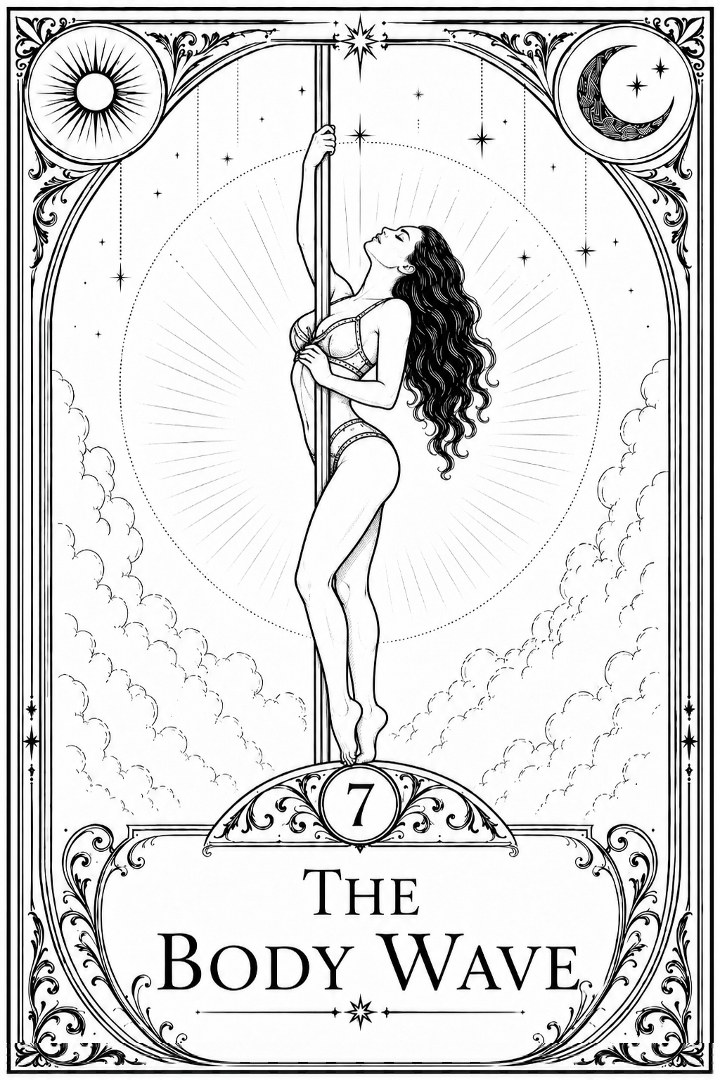
The Spread
Present Card: The Body Wave
Crossing Card: The Voice — reversed
Root Card: The Cue — reversed
Hidden Card: The Heat
Future Card: The Pleasers
✦
Present Card: The Body Wave
The card of the spine remembering music.
Upright: the body moving as one continuous sentence. The chest, ribs, stomach, hips and pelvis passing the movement from one to another without apology. The dancer allowing the body to speak in a language older than instruction.
Reversed: the body made stiff by shame. The movement broken into parts. The dancer attempting sensuality as technique and finding, to her horror, that technique is not enough.
The move. The Body Wave begins in one part of the body and travels through the rest. Chest, ribs, stomach, hips. Or hips, stomach, ribs, chest. The order depends on the direction, but the principle is the same. The dancer does not perform separate positions. She lets movement pass through her.
The Body Wave cannot be bullied.
Strength does not help.
Control, if overused, makes it worse.
A good Body Wave is not a series of instructions obeyed by the body. It is a current.
The dancer has to let herself become water.
✦
The first time Jade taught us the Body Wave, I hated her.
Not permanently. Not in any meaningful moral sense. But for the duration of that class, and perhaps for fifteen minutes afterwards while I drank water too quickly and pretended not to be cross with my own spine, I considered Jade an unreasonable woman with dangerous priorities.
She had put on a slower song than usual. That was the first warning.
The studio changed when the music slowed. Fast music gave the body somewhere to hide. Counts arrived quickly. Mistakes passed. Hair, legs, laughter, spins, grip, reset, again. There was always another beat coming to rescue the last one.
Slow music had no manners.
Slow music watched.
Jade stood in the middle of the studio in black shorts and an oversized T-shirt tied at the waist. Her hair was up. She had already taken us through warm-up, conditioning, climbs, sits and a sequence involving a spin I had decided privately to regard as optional.
Then she said, we’re going to do Body Waves.
Marion made a noise.
Jade said, no commentary from HR.
Marion said, I was just breathing in a legally protected way.
Jade ignored her.
She said, Body Waves are not about being sexy.
This was exactly the sort of sentence that meant the thing was absolutely going to be about being sexy.
Jade continued. They are about articulation. Control. Musicality. Knowing where movement starts and where it travels. If it looks sensual, that is because the body is moving honestly. Don’t perform sexy. Please, for the love of God, don’t perform sexy. Let the movement pass through.
She demonstrated.
Of course she did.
Jade could demonstrate a Body Wave in a way that made it look like the body had been poured. The movement began somewhere high in her chest and travelled down through ribs, stomach, hips, thighs, into the floor. Nothing jarred. Nothing asked permission. There was no moment at which one part finished and another part began. The whole thing simply moved through her and left the room briefly altered.
That, she said, is the idea.
Marion said, I regret to inform you my idea has gone home.
We laughed.
I laughed.
But the laugh did not settle me. Something in the room had changed. It was not fear exactly. I had known fear by then. Fear had a taste. Fear tightened the throat and made the palms practical. This was something else. Exposure, perhaps. Or embarrassment before the fact. The particular humiliation of being asked to move in a way the body cannot justify as useful.
A climb is useful.
An invert is impressive.
A layback is frightening enough to excuse whatever face the body makes while attempting it.
But a Body Wave?
A Body Wave had no plausible alibi.
It was movement for the sake of movement. It was the body making a phrase and not pretending the phrase was about strength, survival, fitness, flexibility or personal development. It was the body saying something in public without first submitting the sentence for approval.
Jade put us in front of the mirrors.
Naturally.
She said, start with the chest.
I started with the shoulders.
She said, not the shoulders.
I tried again.
The shoulders moved.
Jade came over.
She placed two fingers gently on my upper chest.
Here, she said. Not here. She touched my shoulder. Here.
I nodded.
The music began again.
I sent what I believed was a wave through the body.
The mirror showed a woman having a minor disagreement with her bra.
Jade said, smaller.
I said, that was already smaller than my dignity.
She smiled but did not let me out.
Again.
I went again.
Chest. Ribs. Stomach. Hips.
In my head, it was a single liquid movement.
In the mirror, it was four separate departments failing to communicate.
Marion, beside me, was no better. Her Body Wave had the energy of a malfunctioning lift. We caught sight of one another in the mirror and both started laughing, which made Jade pause the music and look at us with the expression of a woman who understood friendship but had a duty to choreography.
She said, laugh, then do it again.
That was Jade exactly.
She never took the laughter away.
She never let it be the end of the work.
We did it again.
And again.
And again.
The Body Wave was not technically the hardest thing we had learned. That made it worse. I could not blame gravity. I could not blame the pole. I could not blame insufficient grip or poor skin contact or the treachery of moisturiser. The difficulty was not external. The difficulty lived in the passage between one part of me and another.
The movement kept breaking.
The chest would begin, then stop. The ribs would arrive late. The stomach would retreat. The hips would either refuse or overcompensate with the theatrical vulgarity of a hen party at ten-thirty.
Jade said, don’t place it.
I said, what does that mean?
She said, you’re putting each bit where you think it should go. Stop placing. Let it travel.
I wanted to say that letting things travel had not been my life’s strongest area.
Instead I nodded.
The next attempt was worse.
Jade said, good.
I said, you can’t possibly mean that.
She said, I mean it’s more honest.
That annoyed me too.
Honesty, I was discovering, was one of those words dance teachers used when they wanted the body to do something unbearable.
She made us turn away from the mirror.
That helped.
Then she made us close our eyes.
That did not.
With the eyes closed, there was nowhere to put the embarrassment. No mirror to blame. No other women to compare myself with. No external verdict. Just music, breath and the body I had brought into the room.
Jade said, start with the chest. Let it soften. Let the ribs follow. Then the stomach. Then the hips. Don’t make it pretty. Don’t make it anything.
The music moved.
I tried again.
For the first time, something passed through.
Not much. Not the poured-water movement Jade had shown us. Not the polished studio version that would one day appear on someone’s reel with flattering light and a caption about feminine energy. It was smaller than that. Rougher. Almost private. The chest softened. The ribs followed, awkwardly but truly. The stomach did not vanish. The hips answered.
Something travelled.
I opened my eyes too soon and lost it.
But it had happened.
A tiny current.
A sentence without words.
Jade saw it.
She said, there.
I said, what?
She said, you stopped managing it.
I had not known I was managing it until she said that.
The body knows how to manage. A woman’s body in the world is given management duties early. Manage the skirt. Manage the look. Manage the appetite. Manage the sound. Manage the face. Manage the joke. Manage the room. Manage the man who says something small and ugly then waits to see whether you will make it larger by objecting.
The Body Wave was the first movement that failed when managed.
It required the opposite of the life.
It required passage.
The move did not ask the body to be strong. It asked the body to be continuous. That was harder. Strength, by then, had become almost familiar. Strength could be gathered. Strength could be named. Strength could be practised in repetitions.
Continuity could not be forced.
The Body Wave was the first song I sang without using my mouth.
I did not know that yet.
But the body did.
✦
Crossing Card: The Voice — reversed
The card of the sound stopped in the throat.
Upright: breath becoming phrase. The dancer’s body speaking with or without words. The voice that does not apologise for taking up air.
Reversed: the mocked sound. The song turned into shame. The mouth that learns to close before the room has asked for silence.
The move. Every dancer has a voice, even when she does not speak. The line speaks. The breath speaks. The gaze speaks. The hand speaks. The spine speaks. Musicality is not only keeping time; it is allowing the body to become audible inside the music.
The Voice reversed is what happens when sound is punished before it becomes song.
✦
I used to sing in the kitchen.
Not well. I do not offer that as false modesty or bait for reassurance. I was not secretly a great singer waiting for the right teacher to release me. I did not have one of those voices that makes strangers turn around in pubs. I was ordinary. Sometimes in tune, sometimes near it, sometimes enthusiastic enough to compensate for accuracy.
But I sang.
I sang while cooking. I sang while cleaning. I sang while folding clothes, while wiping counters, while unloading the dishwasher, while putting away the life that everyone else had moved through. I sang songs from musicals, pop songs, fragments of adverts, songs the children had brought home from school, songs with only one remembered line repeated until the line became a kind of domestic spell.
The children and I had songs for things that did not need songs.
There was a sock song.
There was a song for finding shoes.
There was a song about broccoli that, in my defence, had begun as an emergency measure during a difficult tea and then somehow entered family tradition.
There were dances too. Small ones. Stupid ones. Hips at the cooker. Spoon as microphone. Tea towel as scarf. A whole kitchen choreography built from fatigue, play and the need to get through the hour before bedtime without anyone crying.
The children loved it until they were old enough to deny this.
Then he came in.
Not always. Not dramatically. That is the mistake people make when they imagine unhappiness. They picture slammed doors, speeches, decisive cruelties, scenes the mind can point to later and say: there, that was it. But some rooms are changed by less. A look. A pause. A joke. The simple arrival of someone who does not join the game and therefore makes the game feel foolish.
He called it a cat massacre.
The first time, I laughed.
Of course I did.
The children laughed too, because children take their cues from adults and because the phrase had the bright cruelty children find funny before they understand where it lands.
After that, I sang more quietly when he was in the house.
Then only when he was upstairs.
Then only when he was out.
Then mostly in the car.
Then not much.
He had not forbidden anything. That was the cleverness of it, though I do not know whether he was clever or merely careless in the exact shape of his cruelty. If I had said, you stopped me singing, he would have looked genuinely astonished.
I didn’t stop you doing anything.
And in one sense, he would have been right.
The mouth stopped by itself.
The body did not.
✦
Root Card: The Cue — reversed
The card of the body entering before its time.
Upright: the music beginning. The dancer hearing the count. The body ready in the wing, waiting for the signal that will carry it into light.
Reversed: the wrong cue. The body speaking before the mind has understood the language. A future entering from inside and changing the choreography without asking the dancer’s permission.
The move. In dance, the cue is everything. The entrance, the turn, the lift, the exit. A dancer learns not only the steps but the moment. Too early and the pattern breaks. Too late and the line is lost. The cue is the agreement between body, music and time.
The Cue reversed is what happens when the body hears something no one else can hear.
✦
In Macau, my body knew before I did.
That is the plainest way to say it.
There were other explanations at first, because there are always other explanations when the truth is too large for the room. Heat. Food. Tiredness. The hours. The smell of frying oil from the alley behind the theatre. The particular violence of waking in the afternoon with stage make-up still faintly at the edges of the eyes and the whole city sounding as if it had been built from neon and engines.
I told myself I was tired.
I was tired.
I told myself I was homesick.
I was not homesick.
I told myself the nausea was nothing, then something, then probably nothing again. I became, for several days, an expert in not knowing what I knew.
The body was less diplomatic.
The body changed the count.
It happened first in rehearsal. Not dramatically. There was no collapse, no hand to the brow, no woman catching me under the arms in the way films believe women are informed of their futures. I was in the second line, stage left, running the transition into the fan section. The music came in. I knew the phrase. I had known the phrase for weeks. Step, turn, reach, close. The body had done it so often that thought was no longer required.
Then thought returned.
That was the problem.
Dancers know this. A movement learned properly disappears into the body. The mind watches from the side, useful only if something goes wrong. That day, the mind came back into the movement because the body had failed to vanish into it. The turn arrived half a count late. The reach did not reach. The close was too careful. Something in me had withdrawn from the line before I knew I was withdrawing.
The choreographer stopped the music.
Again, he said.
We went again.
The same thing happened.
Not enough for anyone else to name. Enough for the body to know. I was inside the choreography, but no longer entirely given to it. Some part of me had turned inward. Some private, cellular attention had begun elsewhere.
After rehearsal, I was sick in the toilet behind the dressing room.
I remember the floor tiles. Small white squares with grey between them. I remember one cracked tile near the door because I stared at it for a long time, kneeling, waiting for the body to finish telling me what the mind had not yet allowed.
The Belgian woman found me.
She said, you look terrible, baby.
I said, thank you.
She lit a cigarette in the doorway because everyone smoked everywhere then, even beside a girl being sick in a toilet, even while offering concern. She watched me for a moment through the smoke.
Then she said, when was your last period?
That was the cue.
Not the sickness.
Not the missed count.
Not the fatigue.
The question.
The question entered the room and changed the whole set.
I said, I don’t know.
She looked at me with a kindness that was almost unbearable because it had no surprise in it.
She said, you know.
And I did.
The knowledge arrived not as a thought but as a rearrangement. The dressing room, the costumes, the feathers, the mirrors with bulbs around them, the schedule pinned to the wall, the girls shouting over one another, the smell of powder and sweat and hairspray — all of it shifted slightly, as if the room had been lifted and put back down half an inch to the left.
The future I had been standing in the wing of was no longer the only future in the room.
There was another one.
Smaller than a thought.
Larger than my life.
I told the director two days later.
I had spent the two days between knowing and telling in a state I can only describe as split weather. On stage, I smiled. In rehearsal, I counted. In the dressing room, I changed costumes with the others and tried not to look different, though I felt as if the body had become a sealed envelope everyone could see but no one had opened.
The director was not cruel.
That may have been worse.
Cruelty gives the mind something to push against. Practicality gives it nothing. He was kind, embarrassed, decisive. He said words like contract and insurance and not possible and very sorry. He asked if I had someone at home. He asked if my mother knew. He did not ask if I wanted to keep dancing.
Perhaps he thought the answer was obvious.
Perhaps it was.
Perhaps no one asks seventeen-year-old girls the questions that would make the answers complicated.
The ticket was arranged.
The suitcase was packed.
The costume I had believed belonged to the woman I was becoming was folded and returned to wardrobe. The other girls hugged me in the corridor. The Belgian woman cried and told me I was still a dancer, which was both kind and useless, as most true things are in the hour they are first said.
I flew home with the future inside me.
My mother met me at Heathrow.
She looked smaller than I remembered.
That frightened me more than anything.
Until then, some childish part of me had believed that going home meant returning to a place where adults knew what to do. But my mother’s face, when she saw me come through arrivals, told me that no one knew what to do. Not really. We were all going to pretend in different ways.
She hugged me.
I let her.
I want to describe the hug and I cannot.
I have tried four times now. Every sentence I build has a shape and the hug did not have a shape, it had a smell, wool and rain and the inside of a car, it had my mother's hand doing something at the back of my head that no choreographer ever taught anyone, some small circular thing, and I was tall by then, taller than her, I had been lifted by professionals, I had been held by the best-trained hands in Macau, and I stood in arrivals being held up by a five-foot-two woman who could not sew, and the body — which knew before me, which always knew before me — let go of the stage right there, between the barriers and the vending machines, and I have never once been able to write the sentence for it.
There is no sentence for it.
That is the sentence.
I was seventeen, and pregnant, and no longer in Macau, and the stage life had ended without an ending. No final number. No last bow. No applause. No proper exit.
Just a missed count.
A toilet floor.
A question in a dressing-room doorway.
A flight home.
The Cue appears reversed in this chapter because the body had spoken once before, and when it spoke, everything stopped.
For years, I treated that as betrayal.
Not my son. Never him. I want that clear. He was not the betrayal. He was a person. He was the person who arrived. He was heat and hunger and impossible love and the night feed and the whole altered weather of my life.
But the body.
The body had betrayed me, I thought.
The body had known before me, changed before me, taken the stage before I had finished my entrance. It had turned the music off without asking whether I was ready to leave.
I did not know then that bodies do not betray.
Bodies continue.
Sometimes continuation looks like interruption because the mind had made other plans.
The Body Wave, thirty years later, returned me to that old misunderstanding. Here was the body speaking again. Not with sickness this time. Not with missed periods or toilet tiles or a director’s practical kindness. With rhythm. With heat. With the spine moving like a sentence it had been waiting decades to finish.
The first time I felt the wave pass through me properly, I thought of Macau.
Not consciously.
Not in words.
The body thought of it.
The body remembered the cue it had given then and the cue it was giving now.
One had stopped the dance.
One was starting it again.
The two were not enemies.
I had spent years believing they were.
✦
Hidden Card: The Heat
The card of wanting without an alibi.
Upright: warmth returning to the body. Desire without an object yet. The dancer discovering that pleasure does not have to justify itself as health, discipline, exercise or duty.
Reversed: appetite disguised as self-improvement. The woman who wants but explains wanting in acceptable language. The body lit from within while the mouth says it is only a class.
The move. Heat is not a move, but it arrives inside movement. It is the flush after exertion, the pulse under the skin, the warmth of muscles waking, the private ignition that tells the dancer she is not simply completing a task. Heat is information. Heat is the body saying yes before the mind has prepared a respectable reason.
The Heat is dangerous because it does not ask to be useful.
✦
By then, though I did not know the shape my life was taking, I wanted it.
Not vaguely. Not dutifully. Not in the adult way of wanting things that are good for one — more water, better sleep, a pension, green vegetables, twenty minutes of stretching before bed.
I wanted the studio.
I wanted Tuesday.
I wanted the music, the grip, the ache in the forearms, the women taking off their tracksuit bottoms without ceremony, the smell of metal and disinfectant and warm skin. I wanted Jade saying again. I wanted Marion making the room survivable. I wanted the ridiculousness. I wanted the seriousness. I wanted the little bruises that appeared in places I could not explain without becoming someone I had not yet admitted I was becoming.
At first, I had called the wanting discipline.
Then routine.
Then progress.
Then good for me.
These were not lies exactly. They were modest little hats I made the truth wear in public.
The truth was heat.
The Body Wave made this impossible to avoid. Strength can be kept clean. Technique can be made respectable. A woman can say she is building upper-body strength and no one in the old life becomes too alarmed. A woman can say she is improving flexibility and the sentence will sit politely at the table.
But the Body Wave did not feel like fitness.
It felt like being returned to myself by a route I would not have chosen if given a map.
Jade told us to put one hand on the chest and one hand on the stomach, to feel the movement travel.
I obeyed.
The room was full of women touching their own bodies in the most practical way imaginable. No one was posing. No one was trying to seduce anyone. Marion had her eyes narrowed in concentration and the expression of someone attempting to operate faulty machinery. A younger woman near the mirror swore softly every time the movement reached her ribs. Someone laughed. Someone said my hips have left the group chat.
It should not have felt radical.
It did.
My own hand on my own stomach.
My own hand on my own chest.
Not checking for fat. Not smoothing fabric. Not assessing. Not preparing the body for anyone else’s look. Just feeling where the movement went.
The heat that rose in me was not simple. It was not only sexual, though sexuality was in it. It was not only grief, though grief was there too. It was recognition. The body, after years of being useful, was becoming interesting to itself.
A woman who finds her own body interesting becomes difficult to manage.
I began to count the hours until class.
This had happened earlier, perhaps, but Chapter Seven was when I stopped pretending not to know. On Wednesday morning I thought about Tuesday. On Friday, while answering emails, I found myself rehearsing the wave at my desk, so small no one could have seen it unless they were looking closely, which fortunately no one in that office ever did. On Sunday, stirring sauce at the cooker, I let the movement pass once through the ribs and hips while he was in the garden, then stopped as soon as I heard the back door.
The stopping told me more than the movement.
I had a secret.
Not a man.
Not a lover in the ordinary sense.
Something more difficult to confess because it sounded less serious and was therefore more serious.
If there was an affair, it began here: not with another body, but with my own returning one.
The sentence embarrassed me. It still does a little. The word affair carries perfume, hotels, messages, betrayal, bodies arranged against vows. This was not that. I had not touched anyone. No one had touched me except Jade in the professional, exact, necessary way a teacher corrects a shoulder or spots a back.
And yet I was elsewhere.
Part of me had gone to a room he did not know existed and begun undressing there.
Not literally. Not yet. Not entirely.
But enough.
The Heat appears hidden because I could not have admitted it then. I would have said I liked the class. I would have said it was good to have something for myself. I would have said I was getting stronger, which was true and insufficient.
The deeper truth was that I had begun to want in a way that did not serve the household.
The wanting was not maternal.
Not marital.
Not practical.
Not even rebellious at first.
It was private.
It was mine.
The Body Wave did not make me desire another life in one clean bolt of revelation. It did something subtler and therefore more dangerous. It made the life I had begin to feel less like the only room in the house.
There were other rooms.
One had music in it.
One had mirrors.
One had a pole in the centre and women laughing badly at themselves and trying again.
One had heat.
Once the body knows there is heat elsewhere, the cold places become harder to explain.
✦
Future Card: The Pleasers
The card of chosen height.
Upright: the theatrical foot. The body lifted into exaggeration. The dancer accepting artifice as truth’s costume. Sexuality as play, power, balance, joke and weapon.
Reversed: the costume mistaken for permission. The shoe worn before the body has found its own ground. The woman becoming an object inside the prop instead of using the prop to become more fully herself.
The move. Pleasers are not ordinary shoes. They are platform heels made for pole, striptease, floorwork, stage. They alter height, line, balance, gait and intention. They make the leg longer, the walk slower, the floor closer and more dangerous. They are absurd until the dancer understands them. Then the absurdity becomes part of the method.
Pleasers are not subtle.
That is the point.
✦
There is a box in a future I cannot yet see.
It arrives on a Thursday.
The label does not say what is inside. I will be grateful for this and annoyed at myself for being grateful. The parcel will be larger than expected, because the shoes are larger than expected, because apparently there is no discreet way to send a woman seven inches of private theatre.
I will carry the box upstairs before he comes home.
Not because I have done anything wrong.
Because I will not yet know how to defend what is right.
That distinction will take me years.
I will open the box on the bedroom floor. Black tissue. Plastic. Buckles. A smell of new vinyl and chemical glamour. The shoes will be ridiculous. There is no other honest word. Ridiculous in the hand. Ridiculous on the carpet. Ridiculous beside the laundry basket and the sensible slippers and the cardigan I have owned since the children were in primary school.
I will laugh.
Alone.
The first laugh will be disbelief.
The second will be pleasure.
I will put them on.
Of course I will.
One foot, then the other. Buckles adjusted with the concentration of a woman defusing a small bomb. I will stand up too quickly and immediately sit down again, because the body will need a moment to renegotiate its relationship with the floor.
The floor will be further away.
The woman in the mirror will be taller.
Not younger.
Not thinner.
Not fixed.
Taller.
The Pleasers will change the line before I know what to do with the line. They will alter the leg, the hip, the angle of the pelvis. They will make walking a decision. They will make standing theatrical. They will make the ordinary bedroom briefly unfit for ordinary thought.
I will take one step.
Then another.
I will feel foolish.
Then I will feel something else.
Not confidence. Not yet. Confidence is too clean a word for the first time a woman stands in shoes she would previously have mocked because mockery was safer than wanting. It will be stranger than confidence. More like permission arriving in the wrong outfit.
I will look at myself.
Really look.
The shoes will be too much. That will be their gift. Too high, too shiny, too sexual, too obvious, too young according to some imaginary tribunal I have carried in my head for years. Too much in every category the old life required me to keep manageable.
And yet there I will be.
Managing them.
Badly at first.
Then less badly.
The Pleasers are the future card of the Body Wave because the Body Wave is the first time the body admits it wants to move without alibi, and the Pleasers are the first object that makes that wanting visible. They will not create the desire. They will give it height.
That is different.
The shoes will not make me a dancer. The dancer was there before the shoes. Before the pole, even. Before the marriage. Before the children. Before Macau ended without an ending. Before all of it, a girl at the barre had already learned that the body could make meaning in space.
The Pleasers will remind me that artifice is not always a lie.
Sometimes artifice tells the truth more clearly than plainness can.
Bare feet say one thing.
Pleasers say another.
Pleasers say: I know this is theatre.
Pleasers say: I have chosen the theatre.
Pleasers say: look, but understand that I am also looking.
Later, he will find them.
Not in this chapter.
Not yet.
Later, they will become evidence. Shoes, clothes, videos, workshops, photographs, a whole country I had been visiting while saying class. He will hold the objects in his mind and misunderstand all of them. He will think the shoes mean sex. He will not be entirely wrong, but he will be wrong in the way people are wrong when they take one true part and call it the whole.
The shoes will mean sex.
They will also mean balance.
Line.
Joke.
Power.
Costume.
Absurdity.
Practice.
Pain across the ball of the foot.
Small buckles.
Stage names.
Women in hotel corridors carrying feather fans and grip bags.
Music through function-room walls.
The right to be excessive in a life that had rewarded reduction.
The first time I put them on, though, none of that will be clear.
There will only be a woman in a bedroom, holding the bedpost with one hand, taking tiny steps in impossible shoes, laughing quietly so no one downstairs hears.
The future card is the object that will make secrecy heavier because it will also make the secret more real.
The future card is height.
The future card is theatre.
The future card is the first time I understand that ridiculousness may be one of the doors to freedom.
✦
To draw the Body Wave is to be told that the body has begun speaking again.
Not loudly.
Not cleanly.
Not in a language the mind immediately trusts.
But speaking.
The Voice reversed was the song mocked into silence.
The Cue reversed was the body that once spoke as interruption and changed the whole choreography of a life.
The Heat was the wanting I could no longer file under fitness.
The Pleasers waited in the future, absurd and shining, ready to lift the body into a version of itself the old house would not know how to name.
At the midpoint, nothing outward had happened.
I had not left.
I had not confessed.
I had not bought the shoes.
I had not gone to Ormskirk.
I had not told him anything true.
I had not even learned the Body Wave properly.
But one Tuesday evening, with my eyes closed and Jade counting softly and Marion making a noise beside me that suggested her spine had submitted a formal complaint, something moved through me without stopping.
Chest.
Ribs.
Stomach.
Hips.
The body did not ask whether it was allowed.
It passed the movement on.
That was the miracle.
Not that I looked good.
Not that I felt beautiful.
Not that I became, suddenly, a woman who knew how to be watched.
The miracle was continuity.
The body had once spoken and I had called it betrayal.
Now it was speaking again.
This time, I was trying to listen.
VIII
The Genie
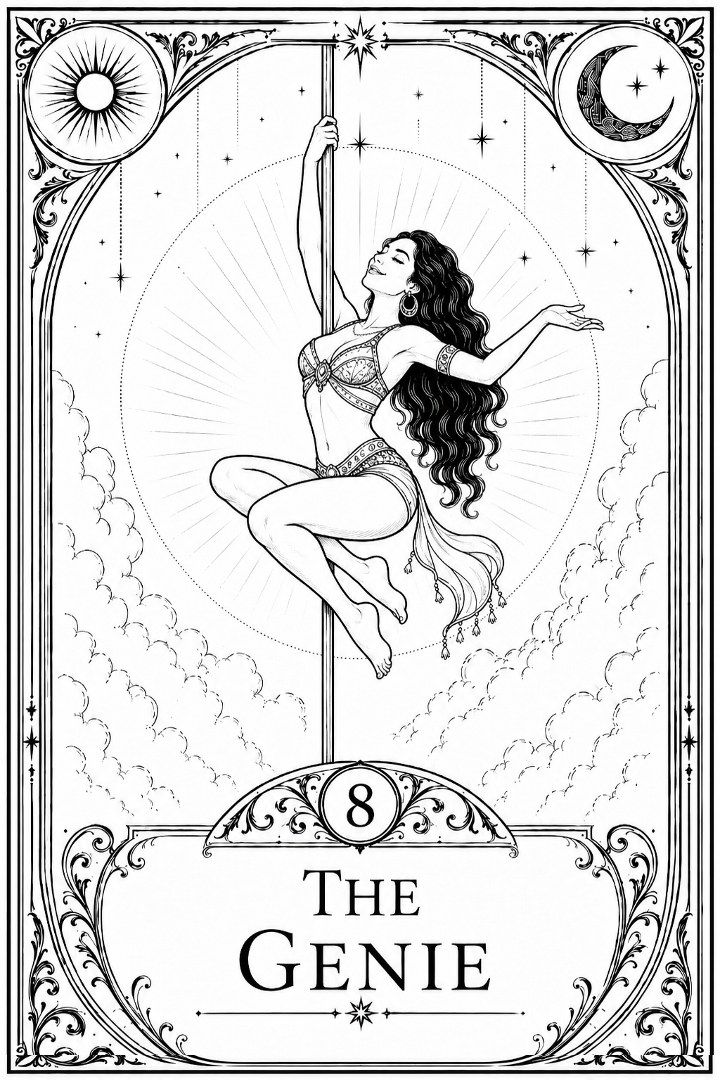
The Spread
Present Card: The Genie
Crossing Card: Whimsy — reversed
Root Card: The Floorwork
Hidden Card: The Stage Name
Future Card: The Hoop
✦
Present Card: The Genie
The card of ridiculous possibility.
Upright: the body entering play without apology. The dancer discovering that a shape can be theatrical, pretty, excessive, and still require discipline.
Reversed: the body too embarrassed to pretend. The woman who has been made sensible for so long that play feels like exposure.
The move. The Genie begins from the pole. One leg wraps or hooks; the body folds and opens into a seated, floating shape. Depending on the version, it can look like a storybook pose, a lamp-spirit, a joke made graceful. It is not the hardest move in the vocabulary, but it asks the dancer to accept being decorative.
Decorative is not the same as useless.
That is one of the things the body has to learn.
✦
The first time Jade taught us the Genie, I did not take it seriously enough.
That was my mistake.
Some moves announce their difficulty. The Invert has the courtesy to sound alarming. The Layback looks like a negotiation with death. The Climb burns immediately enough to make doubt unnecessary. The Genie sounded like something from a children’s party.
Jade demonstrated it after warm-up, when the room still smelled faintly of disinfectant and grip spray and women pretending not to check their bruises. She moved into the shape with the usual betrayal of ease: hook, fold, lift, open. A pause. A small turn of the head. A line through the foot. Not much, apparently. Not strength in the obvious sense. Not danger in the way danger had become almost reassuring.
Then she held it.
She held the ridiculous shape until the ridiculousness changed state. At first it was a pose. Then it was a balance. Then it was a character. Then, somehow, it was beautiful.
Jade came down and clapped once.
She said, the trick with this one is not to apologise for it.
Marion said, I apologise for almost everything in advance. It saves admin.
Jade said, not today.
Marion said, noted, but emotionally unrealistic.
We laughed, which was becoming one of the studio’s methods of instruction. Laughter opened the door. Jade then made us walk through it.
She put the music on. Something with brass in it. Too cheerful. Too knowingly theatrical. The sort of music that immediately removed all plausible claims that we were doing this for upper-body strength.
Jade said, give it a little face.
I said, absolutely not.
Marion said, legally I have no face.
Jade looked at us both in the mirror.
She said, you’re allowed to enjoy yourselves.
That should not have sounded radical.
It did.
I stood beside the pole and prepared to become a woman who had opinions about a move called the Genie. My body, which had by then accepted bruising, gripping, climbing, inverting, leaning back, and waving badly through the spine, drew the line at play.
Play was worse.
Play required consent from parts of the self that strength could bypass. You can grit your teeth through strength. You can survive fear with stubbornness. You can learn technique by repetition. But play notices whether you have joined in. It knows when the face is lying.
I hooked the leg incorrectly. Jade corrected it. I folded too cautiously. Jade corrected that too. I opened the shape as if opening a suspicious letter.
Jade said, more.
I said, there is no more.
She said, there’s always more.
Marion, from the next pole, said, that sentence has ruined many lives.
The room laughed again.
I tried again: hook, fold, lift, open. The first version looked, in the mirror, like a woman attempting to sit in an invisible deckchair while reconsidering several life choices.
Jade said, good.
I said, no.
She said, good beginning.
I allowed that.
The second version was better. Not good, but less apologetic. The body began to understand the mechanics: where the skin gripped, where the knee locked, where the hand could soften, where the shoulder had to stay awake. The Genie was not flimsy. It only pretended to be. Under the storybook shape was work. Under the little theatrical tilt of the head was a chain of decisions.
Jade came over.
She said, you’re doing the move, but you’re refusing the character.
I said, I don’t have a character.
She said, everyone has a character.
I said, mine is tired council employee with a mortgage.
Marion said, mine is woman found alive after admin.
Jade said, both usable. Again.
That was Jade’s genius. She did not remove the joke. She put it to work.
I went again: hook, fold, lift, open.
This time I let the head turn. Only slightly. Only enough to feel foolish. But the movement changed when the face joined it. The pose stopped being an arrangement of limbs and became an address to the room.
Not seductive.
Not yet.
Not exactly.
Something more dangerous than seductive.
Present.
Jade saw it.
She said, there.
I said, what?
She said, you stopped hiding behind the technique.
I had thought technique was the respectable part. Technique was the alibi. The body could say, I am not performing, I am learning. I am not playing, I am training. I am not becoming visible, I am executing instructions.
The Genie exposed that lie.
A move can be technical and still ask for theatre. A woman can be serious and still be ridiculous. The body can make a shape that is both work and play.
The old life had not allowed many things to be both.
The Genie did.
After class, Jade mentioned Ormskirk as if she were mentioning a supermarket.
We were sitting on the studio floor, shoes off, water bottles between us, the room cooling around the poles. Marion was flat on her back with one arm over her eyes, announcing to no one in particular that her pelvis had resigned. Jade was scrolling through her phone.
She said, you two should think about Ormskirk.
Marion lifted the arm from her face.
She said, I’m sorry, I thought you said Ormskirk.
Jade said, I did.
Marion said, is that a place or a condition?
Jade turned the phone towards us.
There was a poster. Glittered lettering. A weekend of workshops. Pole, hoop, silk, chair, floor, burlesque. Beginner-friendly sessions. Open training. Showcase. Troupe categories. Stalls. Evening performances. A hotel name. Dates. Prices.
It looked ridiculous.
It looked expensive.
It looked impossible.
It looked like something happening to other women.
Jade said, we’re putting a small troupe piece together.
I said, who is we?
Jade said, us.
Marion said, define us legally.
Jade said, the studio. Whoever wants in. Nothing massive. Beginner-intermediate. Fun. You’d rehearse here, go up for the weekend, do workshops, perform the troupe piece, come home exhausted and insufferable.
Marion said, I’m already two of those things.
I said nothing.
I was looking at the poster.
There are moments when the future does not arrive as revelation. It arrives as admin. Dates. Deposits. Travel. Costume contribution. Rehearsal times. Shared rooms available if anyone wanted to keep costs down. Payment by the end of the month.
The future had a booking link.
That felt obscene.
Jade said, no pressure.
People say no pressure at the exact moment pressure enters the room.
She said, just think about it.
I did not need to think about it. I was already thinking about it. The thinking began before I had given it permission and divided itself instantly into columns.
Cost.
Excuse.
Time.
Risk.
Want.
The want column was the most dangerous because it had no practical solution. Cost could be calculated. Excuses could be invented. Time could be negotiated, hidden, mislabelled, borrowed from other obligations. Risk could be dressed as something else.
Want just sat there.
Bright.
Unreasonable.
Marion took the phone from Jade and zoomed in.
She said, there are workshops in chair dance.
Jade said, yes.
Marion said, and burlesque.
Jade said, yes.
Marion said, and something called liquid motion, which sounds either illegal or medical.
Jade said, you’ll love that.
Marion looked at me.
She said, we’re going, aren’t we?
I said, absolutely not.
The sentence came out too quickly to be trusted.
That night, I looked at the poster again in bed. Not for long. Long enough. I had screenshotted it in the studio while pretending I had not. The glow of the phone made the bedroom ceiling look lower. He was asleep beside me, turned away, breathing with the confidence of a man whose life had not just acquired a secret hotel in Lancashire.
I opened the image.
Workshop pass.
Hotel.
Travel.
Costume contribution.
Food.
Possible shared room.
Deposit due.
The numbers were not enormous. That made them worse. If the numbers had been enormous, I could have closed the phone and called the whole thing impossible. But the numbers were not impossible. They were only difficult. Difficult is more dangerous than impossible because difficult requires a decision.
Then there was the question of where I would be. A work thing, perhaps. A training weekend. A course. A cousin. A friend from the old days.
The lies queued politely, each carrying its own small suitcase.
I hated them.
I also inspected them.
He did not ask what I was smiling at.
This was ordinary.
By then, not asking had become one of the structural beams of the marriage. He did not ask because he assumed he knew the available answers: work, children, shopping, some minor domestic irritation. I did not tell him because I had learned that new information, offered into the wrong room, does not become shared. It becomes handled.
So I turned the phone face down.
The future waited under my hand.
A woman who is not considering going does not begin arranging the lie.
✦
Crossing Card: Whimsy — reversed
The card of play made foolish.
Upright: the adult who has not exiled the ridiculous. The body allowed to pretend, exaggerate, invent, sparkle, overdo, enter the game.
Reversed: the room where silliness shrinks. The joke that is not shared. The woman who learns to become sensible when the door opens.
The move. Whimsy is not a pole move, but every performance contains it. A tilted hat. A look to the audience. A hand placed with unnecessary drama. A pause held half a second too long. The dancer knows the difference between foolishness and play. Foolishness is what happens when the room reduces you. Play is what happens when you choose the excess yourself.
✦
He used to call me silly.
Sometimes stupid.
Sometimes childish.
Not as a grand accusation. More as a correction to the temperature of the room.
He did not forbid play. That would have been too obvious, and he was rarely obvious in the ways that would have made him easy to describe. He only made it smaller. He had a way of standing in a doorway that changed the scale of things. The thing itself might remain — the joke, the voice, the mood, the small madness of a room that had been happy without permission — but once he entered, it became aware of itself.
That was usually enough.
The Ormskirk poster frightened me because it was ridiculous in a way that refused to lower itself. Glittered text. Feathered silhouettes. Workshops with names that sounded like dares. Women on the photographs bent into impossible shapes while smiling as if gravity had been a misunderstanding. The whole thing was excessive, theatrical, brightly unserious in a way that required enormous seriousness to achieve.
I could imagine showing him the poster.
That was the test.
Not because I intended to show him. I did not. But the mind sometimes checks the temperature of a desire by briefly placing it in the wrong room.
In the wrong room, Ormskirk became absurd.
Not gloriously absurd.
Just absurd.
A weekend away to do what?
A troupe dance?
At your age?
In Ormskirk?
He might not even have said all of that. Some of it would have been done with eyebrows. Some with the pause before the sentence. Some with the small tired smile that made me feel, before he had spoken, that I was already explaining too much.
That was the cross.
Not that he would stop me.
Perhaps he would not have stopped me. Perhaps if challenged he would have said, go if you want, with the tone of a man generously allowing a foolishness he did not need to understand. Perhaps he would have made a joke and left the room. Perhaps he would have forgotten the dates immediately and asked, three days before, where I was going again.
But the damage had already been done by the fact that I knew the shape of his incomprehension.
I knew how small the poster would become in his hand.
The old life had trained me to pre-reduce my own joy before anyone else had the chance.
Whimsy appears reversed in this chapter because the invitation was not only an invitation to go away for a weekend. It was an invitation to be ridiculous on purpose. To rehearse a troupe dance. To pay money we did not have lying around for the privilege of feeling exposed in a hotel function room. To put the body into music and costume and public foolishness and say, yes, this too.
In the old house, ridiculous had been something used to put me back. Ridiculous meant too much. Childish meant stop. Silly meant lower the voice, end the game, make the room adult again.
In the studio, ridiculous meant try the Genie again and put your face in it. Ridiculous meant Marion lying on the floor claiming to have resigned from her pelvis. Ridiculous meant a poster for a weekend in Ormskirk that seemed to contain, somehow, every part of me the old life had trained into apology.
The cross was not his anger.
Anger would come later.
The cross was smaller and older than anger.
It was the knowledge that if I let this wish into the house uncovered, it would not survive the air.
✦
Root Card: The Floorwork
The card of returning to the ground on purpose.
Upright: the dancer using the floor as partner, stage, playground and witness. The body allowed to roll, crawl, slide, pause, laugh, recover, invent.
Reversed: the floor as duty. The woman on her knees cleaning, searching, gathering, tending. The body low because life has put it there, not because the dancer has chosen the level.
The move. In pole, floorwork is not what happens before the dancing starts. It is part of the dance. The dancer uses the floor deliberately — knees, hips, hands, spine, hair, breath. She travels low. She turns the ground into choreography. She makes the thing beneath her part of the performance.
The floor is not failure.
The floor is where play begins.
✦
I had known floorwork before I knew it was called floorwork.
Not in studios. Not under lights. Not with pointed feet or hair flicks or a count of eight. I knew it in the sitting room, with cushions pulled from the sofa and the children deciding the carpet was lava. I knew it on kitchen tiles, crouched under the table to retrieve a missing shoe while giving the shoe a voice and a legal defence. I knew it on wet Saturdays, lying on the floor with a saucepan on my head because I had been appointed queen of something with unstable borders.
The children and I could make a ship from cushions, a microphone from a wooden spoon, a courtroom from the laundry basket. We could give voices to vegetables. We could turn school shoes into missing persons. We could survive whole afternoons by inventing laws for kingdoms no one else could see.
The ground was never just ground then.
It was sea.
Stage.
Courtroom.
Castle.
Island.
Escape route.
The children did not find this strange. Children rarely object to abundance. If you tell a child the carpet is lava, the carpet becomes lava immediately and with complete legal force.
I had forgotten that adults could do this too.
Or perhaps I had been taught they could not.
By the time I came to pole, the floor had become practical. Something to hoover. Something to mop. Something to kneel on while looking under beds. Something that collected crumbs, socks, hair bands, receipts, and the small plastic pieces from games no one admitted owning. The floor was where I picked things up.
In the studio, the floor was different.
Jade would make us come down from the pole and stay there. Not collapse. Not rest. Stay. She taught us how to move through the ground with intention: hand, hip, roll, knee, arch, turn. She said the floor was not a punishment for falling. It was another apparatus.
Another apparatus.
The Genie had its root in the Floorwork because both asked the same thing of me: stop treating play as an accident. Stop treating ridiculousness as something to tidy away. Stop assuming the ground is only where useful women kneel.
In the old house, the floor had been duty.
In the studio, the floor became theatre.
It remembered the children before I did: the carpet-lava, the spoon microphones, the kingdoms with unstable borders, the ridiculous voices, the full-body willingness to enter a game and let it be real while it lasted.
The body had not lost play.
It had stored it low.
The Floorwork brought it back through the knees.
✦
Hidden Card: The Stage Name
The card of the self rehearsed before it is lived.
Upright: the chosen name. The door the self builds before the house exists. The dancer understanding that artifice is not always escape; sometimes it is preparation.
Reversed: disguise. The false self used to avoid the true one. The name worn as armour because the body has not yet learned to stand without it.
The move. A stage name is not a move, but it changes every move. The same hand placed under another name becomes theatrical. The same walk becomes entrance. The same body, called differently, begins to answer differently.
A stage name is not a lie.
A stage name is a room the self can enter before the life has caught up.
✦
It began as a joke.
Most dangerous things do.
Jade said we would need names for the troupe programme if we did the showcase.
Marion said, programme?
Jade said, yes.
Marion said, as in printed?
Jade said, usually.
Marion sat up.
She said, excellent. I’ve always wanted to disappoint people in writing.
Jade said, you can use your real names or stage names. Up to you.
The room changed.
Not dramatically. No music stopped. No one gasped. But something quick and glittering passed across the floor.
Stage names.
The phrase belonged to another kind of woman. A woman with eyeliner skills. A woman with fewer excuses. A woman who did not have to be back by five because something needed defrosting. A woman who would not have to explain a weekend in Ormskirk as anything other than a weekend in Ormskirk.
Marion said, what would yours be?
I said, I don’t know.
She said, yes you do.
I did.
That was the irritating thing.
The name arrived whole.
Saskia St. Clement.
I said it before I could stop myself.
Marion stared at me.
Then she said, good God, she sounds expensive.
I said, she sounds unbearable.
Jade, who was tightening a bolt on one of the poles, said, she sounds like she points her feet.
That settled it more than I wanted it to.
Saskia St. Clement remained in the room after we stopped laughing.
I went home with the name still attached to me in some small, ridiculous way. I did not write it down. I did not say it again. I certainly did not tell him. But while I brushed my teeth that night, I looked in the mirror and thought it silently.
Saskia St. Clement.
The woman in the mirror did not become her.
Not yet.
But she heard.
✦
Future Card: The Hoop
The card of the circle entered.
Upright: the body stepping into the ring. The dancer suspended inside a shape that holds and frames her. Play lifted from the floor into air.
Reversed: the closed circle. The woman looking at the ring from outside, certain it belongs to other bodies, other ages, other lives.
The move. Aerial hoop, or lyra, is a steel circle suspended from above. The dancer enters it, sits inside it, hangs from it, balances against it, turns within it. The hoop is apparatus and frame at once. It holds the body, but it also displays it. It makes a picture of the dancer while asking her to trust the air.
The hoop is a playground made serious.
A swing with consequences.
✦
Somewhere inside the future Ormskirk offered, there would be a hoop.
Not a metaphorical one.
A real one.
A steel circle hanging from a rig in a hotel function room, beneath a ceiling whose confidence I would not share. I would see it before I touched it, and the first thing I would think, absurdly, would be playground.
Not circus.
Not aerial.
Playground.
A swing. A climbing frame. A roundabout after rain. The old childhood machinery of risk before risk had paperwork. Metal under the hands. Legs lifted. The body testing how far it could go before someone said careful.
The hoop would hang there, empty, looking both impossible and already occupied by every woman who had ever believed the circle was not for her.
I would stand beneath it and feel the same old division: want, then refusal.
The wanting would arrive first because the body is quicker than the mind when joy is involved. The refusal would arrive afterwards, dressed more respectably. Too old. Too heavy. Too late. Too ridiculous. Too much money. Too many women watching. Too many ways to look foolish in a hotel nowhere near anywhere I had ever imagined becoming myself.
The instructor would say, who’s new to hoop?
Several hands would go up.
Mine would not.
Then Marion, somewhere beside me, would say, put your hand up, you coward.
So I would.
The Hoop is the future card of the Genie because both ask the body to enter a shape that looks like play and turns out to require seriousness. The Genie had taught me that ridiculousness could be held long enough to become beautiful. The Hoop would teach me that play could leave the ground.
The first thing would be sitting inside it.
That sounds easy.
It would not be easy.
Nothing that looks like sitting in aerial work is simply sitting. There is always a hand pulling, a hip adjusting, a knee hooking, a bruise being born in private. The hoop would press into the body with the blunt honesty of steel. It would not care that I had imagined something more graceful. It would not care that, from the floor, other women made it look like being held by the moon.
I would climb in badly.
That is the truth of most beginnings.
One foot. One hand. Wrong hip. Corrected hip. Grip. Pull. A sound no one would dignify by naming. Then somehow, with less dignity than planned, I would be inside the circle.
Inside it.
The hoop would frame me before I was ready to be framed. It would make a picture out of a woman still negotiating with her stomach, her age, her shorts, her fear of being watched from below. The circle would not ask whether I felt like a picture. It would make one anyway.
This is one of the violences and mercies of apparatus.
It gives the body a form before the mind has agreed to deserve it.
I would sit in the hoop and hold the sides. My thighs would complain. My hands would overgrip. The room would turn slightly because the hoop, unlike the pole, has opinions about stillness.
The instructor would say, breathe.
I would breathe.
Marion would say, you look like you’re waiting for an interview.
I would say, I am.
But then the hoop would move. Only a little. A slow turn. A small swing. Enough for the body to understand that the ground was no longer in charge.
The child I had been would recognise it before the woman did.
The child who had climbed trees. The child who had spun too fast on playground roundabouts and staggered off laughing. The child who had hung upside down from bars until the blood rushed to her face. The child who had not yet been told that risk should become dignity, that play should become housework, that ridiculousness should be kept for children and women who did not know better.
The Hoop would return that child to me in steel.
Not innocence.
Innocence is overrated and mostly invented by people who wish women had less memory.
The Hoop would return something better: permission to enter the circle knowingly. To play after knowledge. To climb in with bruises, marriage, motherhood, mortgage, shame, jokes, and still let the body swing.
The future card is not the next move I will learn next week.
The future card is the circle waiting in the ridiculous world beyond the ridiculous invitation.
The future card is not escape from the body.
It is the body entering the ring.
The body framed.
The body lifted.
The body, despite everything, allowed to play in the air.
✦
To draw the Genie is to be told that play is not the opposite of seriousness.
It is one of seriousness’s oldest disguises.
Whimsy reversed crossed the chapter because the old house had taught me to make myself sensible before anyone asked. The Floorwork remembered the games I had once built from carpet, cushions, spoons and knees. The Stage Name waited hidden, absurd and expensive-sounding, a woman I had not yet earned but had somehow already named. The Hoop hung somewhere ahead, a circle I would one day enter badly and still enter.
I did not say yes that night.
I said absolutely not several more times, in several rooms, to several versions of myself. I said it while making tea. I said it while brushing my teeth. I said it while opening the washing machine and finding, among his shirts, one of my pole shorts I had forgotten to hide.
Absolutely not.
But the poster remained on my phone.
The deposit date remained in the month.
The name remained in the mirror.
Saskia St. Clement.
Ormskirk.
A troupe dance.
A weekend that cost too much and meant nothing.
Nothing at all.
Which was why I could not stop thinking about it.
IX
The Outside Leg Hang
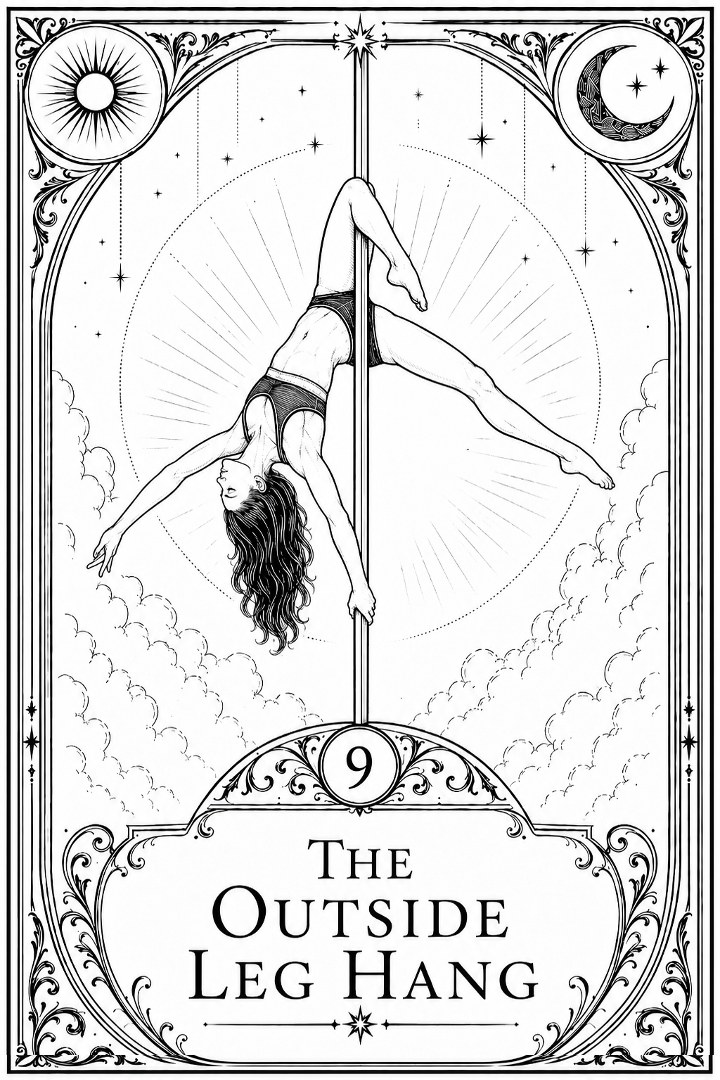
The Spread
Present Card: The Outside Leg Hang
Crossing Card: The Costume Change — reversed
Root Card: The Chorus Line
Hidden Card: The Mirror Check
Future Card: The Story Reel
✦
Present Card: The Outside Leg Hang
The card of commitment by one point.
Upright: the body trusting the hook, the grip, the single place that must hold. The dancer learning that release is possible only after attachment is secure.
Reversed: the half-hook, the panic grip, the body that will not let go because it has not yet believed the hold.
The move. The dancer climbs, positions the outside leg high across the pole, hooks behind the knee and lets the body tilt away. At first the hands stay on. They always do. Then, if the hook is true and the body has committed enough, the hands can open.
The whole body hangs from one decision.
✦
The first lie was not spoken.
It was paid for.
A deposit. Non-refundable. Thirty-five pounds sent through a booking link while the kettle boiled and the washing machine entered its final, furious argument with the floor.
That was how the future became real. Not as revelation. As a transaction.
I had meant to ask Jade a sensible question first. Several sensible questions. What level was the troupe piece? How many rehearsals? What exactly did beginner-intermediate mean when said by a woman who could turn herself upside down while explaining safeguarding policy? Would there be costumes? Would there be photographs? Would the hotel be respectable? Would shared rooms involve strangers? How much of the weekend would require the kind of social enthusiasm I had not possessed since approximately 1998?
Instead, I clicked pay.
The screen thanked me.
That seemed excessive.
I closed the phone and stood in the kitchen with the kettle breathing steam beside me, aware that nothing in the room had changed. The mugs were still on the draining board. The tea bags were still in the tin. His newspaper was folded on the table, untouched since breakfast. A sock, inexplicably, lay beneath a chair as if abandoned during an escape attempt.
Nothing had changed.
Everything had.
The first Ormskirk rehearsal was on a Thursday.
Jade called it rehearsal rather than practice, which immediately made the room more serious. Practice belonged to ordinary lessons. Practice suggested mistakes could remain private. Rehearsal implied destination. Rehearsal meant that, somewhere beyond the mirrors and the grip spray and the Tuesday-night bruises, there was a room in which other people would watch us do the thing we were not yet good enough to do.
Marion arrived carrying two coffees and the air of a woman attending her own sentencing.
I had also dressed for the occasion, if by occasion one means the discovery that leggings can express regret. My new shorts were in my bag, folded small enough to qualify as rumour. I had not yet put them on. There are limits to bravery before seven-thirty on a Thursday.
Marion handed me a coffee.
She said, are we still pretending this is normal?
I said, absolutely. It’s important to maintain standards while dismantling a life.
She looked at the studio door.
Then she said, good. I’d hate to go feral without a framework.
There were six of us in the troupe at first. Jade, of course, because every small amateur performance requires one person who can actually do the thing. Marion and me. A nurse called Leanne who had three children, astonishing shoulders and a laugh like a door opening. A quiet woman called Priya who worked in finance and could split lower than most furniture. And Nessa, twenty-four, tattooed, bendy, and apparently constructed from elastic bands and confidence.
I disliked her immediately for about four minutes.
Then she offered me grip.
This is how women are sometimes redeemed.
Jade showed us the first section of the routine. Eight counts walking in. Eight counts around the pole. A turn. A drop to the floor. Floorwork. Rise. Genie. Transition. Later there would be an Outside Leg Hang, though Jade said the words lightly, as if mentioning a decorative garnish.
I said, sorry, a what?
Jade said, Outside Leg Hang.
Marion glanced at me.
She said, did you hear the capital letters?
I had.
Jade said, eventually.
There it was again.
Eventually.
The word in which teachers keep their knives.
We began with the walk.
Walking in a routine is not walking. This is one of dance’s humiliations. A person may have spent forty-nine years crossing rooms without incident and then, under instruction, become suddenly incapable of moving from one side of a studio to another without looking as if she has been asked to impersonate furniture.
Jade said, count it.
We counted it.
She said, don’t rush the first four.
We rushed the first four.
She said, again.
We went again.
The room changed when there was a line of us. Not dramatically. The same poles, the same mirrors, the same women in shorts trying not to look at one another’s knees. But the energy was different. A class forgives individuality. A routine exposes relation. If I turned late, someone else had to wait. If Marion forgot the arm, the arm disappeared from the picture. If Priya came up too quickly from the floor, my slowness became visible beside her.
The body had to learn not only itself, but the bodies near it.
That was harder than I expected.
And lovelier.
For all her jokes, Marion was nervous. I noticed it during the first run-through. She checked the mirror before the music started, not with vanity but with alarm, as if hoping another woman had turned up in her clothes and might be persuaded to perform on her behalf.
Then the count began.
She moved anyway.
That was friendship too, though neither of us would have called it that. Not encouragement. Not speeches. Just the sight of another woman being frightened and continuing on count.
By the end of the first rehearsal, my thighs were hot, my wrists were tender, and my brain had become a room full of numbers shouting over one another. Eight counts in. Four counts turn. Drop on five. Head on seven. Rise on one. Smile never, according to my face. Jade disagreed.
She said, again from the top.
Marion said, I’ve lost the top.
Jade said, you’ll find it.
Marion nodded as if accepting a difficult diagnosis.
We laughed, but we went again.
Then Jade introduced the Outside Leg Hang.
Not fully. Not the version that would go into the routine later. A preparation. A shape near the shape. A way for the body to begin understanding what would be required of it.
She climbed, hooked the outside leg, tipped her body sideways and let one hand open as if gravity had agreed to behave.
The studio went quiet.
That always happened when Jade moved beyond instruction into demonstration. She could explain for half an hour, but the body teaching the room was different. The room believed her because the pole did.
She came down.
She said, don’t worry. We’re only finding the hook today.
Only.
The word only has been responsible for a great deal of suffering.
I climbed. Not high. High enough. I brought the outside leg across. Jade guided the knee, the hip, the angle. The pole bit behind my knee with the intimate cruelty of apparatus. I tried to keep both hands where they were.
Jade said, good. Now let the body tilt a little.
I said, I don’t want to.
She said, I know.
Not unkindly.
That made it worse.
I tilted.
The hook held.
Not elegantly. Not comfortably. Not in any way a person would choose to remember on film. But it held. My hands stayed on. My shoulders argued. My face, in the mirror, belonged to a woman listening for bad news.
Jade said, there.
I said, where?
She touched the outside of my hooked knee.
She said, this one.
The whole body hangs from one decision.
I hated how much I understood that.
I came down badly and pretended it was deliberate. This is one of the older strategies of middle age: convert disaster into intention as quickly as possible.
Jade said, you see? It’s about trusting the hook.
Marion looked at the pole, then at her own leg.
She said, I’m going to need a more trustworthy hook.
Jade smiled.
She said, then we’ll build one.
That stayed with me, more than the joke.
Build one.
The Outside Leg Hang was the first move that made commitment feel mechanical. You could not negotiate with it. You could not hover near the shape and hope to be counted. The hook had to be placed. The body had to tip. The hands could not release until the leg had agreed to tell the truth.
Half-commitment failed.
The deposit had known that before I did.
✦
Crossing Card: The Costume Change — reversed
The card of the body dressed for the life it has not yet admitted wanting.
Upright: the practical transformation. Fabric chosen for movement, grip, line, safety, performance. The dancer understanding that costume is not vanity; it is part of the form.
Reversed: the hidden purchase, the parcel opened quickly, the receipt folded twice, the washing done at the wrong time. The woman learning that a lie can be made of fabric.
The move. A costume change is not only what happens backstage. It is the moment the body crosses from one role into another. In dance, clothing changes what movement is possible. Skin must grip. Knees must slide. Fabric must not catch where the body needs release. The outfit is part of the technique before it becomes part of the image.
✦
The first purchases were practical.
That was how they got in.
Grip, because everyone used grip. Knee pads, because floorwork on bare knees was no longer evidence of commitment but poor planning. Smaller shorts, because fabric got in the way. A sports bra that did not attempt to apologise for existing. A black vest that tied at the side. Nothing outrageous. Nothing that could not, in a generous light, be called exercise clothing.
Exercise clothing was safe.
Exercise clothing belonged to women who did not want to die of heart disease.
Exercise clothing had moral cover.
The parcel arrived on a Tuesday.
He was home.
That was inconvenient.
The doorbell rang while I was upstairs changing the sheets. I heard him open the door, heard the low exchange with the delivery driver, heard the small papery thud of cardboard on the hall table.
He called up, something for you.
I said, coming.
I did not come immediately. That would have looked guilty. I also could not wait too long. That would have looked guilty differently. Marriage teaches timing in small, useless arts.
When I came downstairs, he was standing in the hall with the parcel in his hand, turning it once to look at the label.
He said, what’s this?
Gym stuff, I said.
He looked at me.
More gym stuff?
Not suspicious. Not yet. Amused, perhaps. Mildly puzzled. The tone he might have used if I had bought another notebook or a new kind of herbal tea. Something faintly excessive, faintly female, faintly outside the range of things he considered worth attention.
I said, for class.
He handed me the parcel.
He said, you’ll have a whole wardrobe for this soon.
There was no cruelty in it. That was the problem with so much of it. No cruelty, exactly. Only the small pressure of being observed from above.
I smiled.
I said, hardly.
Then I took the parcel into the bedroom and opened it with a pair of nail scissors because I did not want the tearing sound to carry.
Inside were the knee pads, folded like soft black mouths, the shorts smaller than I remembered ordering, the vest, the grip. I took everything out and put the cardboard immediately in the recycling, flattened beneath cereal boxes and an empty envelope from the bank.
The shorts I held for too long.
They were not obscene. That was the wrong word. They were ordinary within the form. Nessa wore shorter ones. Jade often wore less. Half the women in the studio had already crossed this threshold without ceremony. Skin was practical. Skin gripped. Skin allowed the pole to hold what fabric would slide away from.
But in my bedroom, with his shirts hanging in the wardrobe and the radiator ticking under the window, the shorts looked like evidence.
Not of sex.
Not yet.
Of wanting to be seen in a body that had stopped seeking permission from the house.
I hid them in the back of the drawer beneath winter tights.
That was ridiculous. They were shorts. But objects change when they are concealed. A thing hidden becomes fluent in accusation. The grip became contraband. The knee pads became a secret. The vest with the tie at the side became a sentence I was not yet ready to say.
At rehearsal, they were normal.
That was the shock.
I arrived in the new shorts expecting some announcement from the universe. There was none. Leanne was adjusting one knee pad with her teeth. Priya was stretching against the wall. Nessa was upside down on a pole, apparently bored by the laws of anatomy.
Marion looked at my shorts.
She said, for Tesco, yes. For here, absolutely not.
Jade glanced over.
She said, much better. You’ll grip.
That was all.
The room accepted the body before I did.
This is another thing dance does. It changes the category of the object. At home, the shorts were a secret. In the studio, they were equipment. At home, the knee pads looked like proof of a life I had not declared. In rehearsal, they were simply sensible. At home, a tied vest seemed theatrical. In the mirror, under the lights, it made the line cleaner.
Costume begins before costume.
The form asks for what it needs and the body, if it wants to continue, obeys.
After the second rehearsal, Jade mentioned shoes.
Not for now, she said.
I said, good.
She said, eventually.
Nessa had a pair of Pleasers in her bag: black, high, shining, impossible-looking things wrapped in tissue as carefully as weapons or relics. She took one out to show us. Marion held it more carefully than I expected.
She said, they’re heavier than they look.
Nessa nodded.
I touched the heel with one finger.
The weight surprised me too. Less like fashion than equipment. Less like seduction than machinery. The platform gave it a strange seriousness. It was not pretending to be a normal shoe. It had no interest in pavements, offices, school gates, kitchens, supermarkets, respectable surfaces of any kind.
It belonged to rooms with mirrors.
It belonged to music.
It belonged to women who had already crossed a line I was still calling distant.
Jade saw me looking.
She said, not yet.
I said, I know.
But the body had heard the yet.
That night, I washed the shorts separately in the bathroom sink and hung them under a towel to dry.
This was not sustainable.
I knew that.
But early lies often survive by pretending they are temporary. One parcel. One rehearsal. One weekend. One little adjustment to the washing. One thing hidden until the right moment, though the right moment never announces itself because the lie exists precisely to avoid it.
He did not ask about the shorts.
He did not know to ask.
That was the mercy.
That was also the danger.
✦
Root Card: The Chorus Line
The card of becoming one body among others.
Upright: the shared count, the peripheral vision, the discipline of matching without disappearing. The dancer learning that individuality is not lost inside a line; it is sharpened by it.
Reversed: the woman out of time, watching others move together from the edge.
The move. A chorus line is not a single trick. It is the agreement between bodies. The arm must rise because the arm beside it rises. The turn must arrive on the same count. The dancer must know herself well enough to join without vanishing.
✦
Macau had taught me the line.
Literally.
The line of girls. The line of legs. The line of shoulders in the mirror before the show, each of us adjusting a strap, a lash, a feather, a blister, while watching the others through the glass. You learn quickly in a chorus line that the body is not private. Not because it belongs to the audience, but because it belongs temporarily to the count.
One woman late and the line stutters.
One arm low and the picture breaks.
One face worrying and the glamour shows its workings.
I had loved that more than I knew how to admit at the time. The discipline of not being the only body in the room. The relief of exactness. The way a group of women could become one animal under lights, each still herself, each made sharper by the bodies beside her.
There is freedom in solitude, but there is another kind in timing.
The Ormskirk troupe woke that memory.
Not immediately. At first it was mostly confusion. We stepped on counts, missed hands, forgot exits, laughed too early, turned the wrong way and apologised in whispers to women who had made identical mistakes four seconds earlier. Marion, who could remember complex HR grievance procedures from 2011, could not remember whether the right arm came before or after the hip roll.
She looked personally betrayed by choreography.
I found this comforting. Competent women should fail publicly from time to time. It keeps the species kind.
Slowly, over rehearsals, the line began to gather itself. Leanne’s timing pulled mine forward. Priya’s calm held the middle. Nessa softened the transition because Jade told her twice that flexibility was not the same as musicality. Marion became reliable on the entrance, possibly because she had decided the first eight counts were within her jurisdiction.
And I began to remember.
Not the steps from Macau. Those belonged to another room, another age, another body wearing feathers under hotter lights. What returned was deeper than choreography. The old peripheral intelligence. The habit of feeling another woman move beside me without looking directly at her. The count entering the body below thought. The small correction made because the picture required it.
It was not glamorous yet.
That helped.
No audience. No costume. No lights except the studio strip lights that gave everyone the complexion of a minor illness. No applause. No fantasy. Just six women trying to make an arm arrive together.
The seriousness of that almost broke my heart.
There are people who think performance begins when someone watches.
They are wrong.
Performance begins when the private body accepts public discipline. When the gesture matters because it is not only yours. When your timing becomes part of another woman’s trust.
Jade filmed us from the back of the studio after the third rehearsal, not for posting, she said, just to check spacing.
We groaned.
Everyone groans when a teacher says video, even if everyone also wants the video. This is one of the hypocrisies by which rehearsal survives.
She propped the phone against a water bottle and counted us in.
Five, six, seven, eight.
Walk. Turn. Drop. Slide. Rise. Genie. Transition. Mark the hang because not yet. Face the front. Hold.
We finished badly, which is to say honestly.
Jade picked up the phone and watched, one hand over her mouth.
Marion said, tell us quickly. Are we a safeguarding issue?
Jade said, no.
Marion said, strong start.
Jade said, useful.
Useful is a teacher’s word for terrible with potential.
We gathered around the phone.
There we were. Not good. Not hopeless. Six women in a room, trying to become a single sentence and mostly succeeding in punctuation. Marion’s arm was late. My rise was early. Nessa had overdecorated the turn and looked briefly as if she had wandered in from a different production. Priya was exact. Leanne laughed halfway through and made everyone else look more human.
I watched myself because I could not help it.
At the back of the line, slightly to the left, in the new shorts, face too serious, shoulders less frightened than before.
I did not look like Macau.
I did not look young.
I did not look like the girl under feathers who had known exactly where her arm belonged.
But I did look like someone returning to the count.
That was enough.
✦
Hidden Card: The Mirror Check
The card of seeing what the body knows before the mind agrees.
Upright: correction without punishment. The dancer checking line, timing, grip, face, foot, breath. The mirror used as tool rather than judge.
Reversed: the old surveillance. The woman looking only for what is wrong.
The move. Every dancer learns the split between feeling and seeing. A movement can feel enormous and look small. It can feel awkward and look alive. The mirror teaches the body to compare sensation with evidence.
✦
The phone became another mirror.
Smaller, crueller, more permanent.
At first, I used it correctly. That is what I told myself. I watched the rehearsal videos to learn. I checked the counts. I paused on the turn. I looked at the angle of the knee in the preparation for the Outside Leg Hang. I watched Jade’s version, then mine, then Jade’s again, as if the difference between us might be solved by repetition and denial.
The phone was homework.
The phone was correction.
The phone was not vanity.
That remained true for almost a week.
Then I began watching for other reasons.
Not often. Not obsessively, or not in a way I would have admitted. But sometimes, when the house had gone to bed and the dishwasher was muttering to itself in the kitchen, I would sit in the bathroom with the door locked and watch the clips without sound.
The bathroom was the only room with a lock no one questioned.
Without music, the body looked stranger. More exposed. Movement without sound becomes confession. The face concentrates. The hand searches. The hip misses the count. The shoulders reveal worry before the mouth knows it is worried.
The first videos were difficult to watch.
I looked for the old things. Stomach. Arms. Thighs. Neck. Age. The body trained by decades of women’s magazines, mirrors, shop windows, changing rooms, jokes, pregnancies, photographs, and the particular cruelty of overhead lighting did what it had been taught to do. It searched itself for evidence against itself.
There was plenty.
There is always plenty, if prosecution is the aim.
But the mirror check had begun to change. Jade had changed it without telling me. She did not look at a body and say thinner, younger, better. She said line. She said grip. She said breathe. She said that hand is dead. She said point the foot unless the flex is a choice. She said don’t throw the head; offer it. She said again.
Again is not an insult.
Again is a door.
So I watched again differently.
I saw that the second week was better than the first. Not beautiful. Better. I saw the knee find the hook faster. I saw the hand release its panic by a fraction. I saw the drop to the floor become less like bad news and more like choreography. I saw the Genie stop apologising.
I saw the body learning.
After Jade showed us the rehearsal video, Marion stayed quiet longer than usual.
I said, that bad?
She shook her head.
She said, no. You look different.
I waited for the joke.
It did not come.
She said, not younger. Don’t worry, I’m not about to insult us both. Just different. Like you’re listening to something the rest of us can’t hear yet.
I looked back at the phone.
There were many things I could have said.
I said, my knee hurts.
Marion nodded.
She said, yes. Transformation is very badly designed.
One night, I found the first video Jade had ever taken of me, months earlier, before Ormskirk, before Saskia, before the new shorts and the deposits and the secret washing. I had kept it, though I had pretended not to. In it, I was attempting a spin and failing with the full dignity of a woman negotiating with furniture. I watched it once, then opened the latest rehearsal clip.
The difference was not dramatic enough for anyone else to call transformation.
That was why I trusted it.
A little more lift. A little more line. A little less apology in the shoulder. A body beginning to believe the pole might hold.
I watched the clips side by side in my mind and felt something dangerous move through me.
Not pride exactly.
Pride still felt too large and public.
Something smaller.
Evidence.
I had evidence.
The old mirror had asked: what is wrong with you?
The new mirror asked: what has changed?
That was the hidden card.
Not that I was becoming beautiful. Beauty was too unstable a god to build anything on. Not that I was becoming young. I was not, and the attempt would have been grotesque in the old sense, not the useful one.
The hidden truth was this: I was becoming visible to myself in motion.
Still photographs had always lied by stopping the body at the wrong moment. Mirrors lied by offering only the angle you were willing to face. But video kept the before and after in the same hand. It showed the stumble and the correction. The failed hook and the better hook. The woman who could not and then the woman who nearly could.
Nearly could is a powerful country.
I began visiting it often.
✦
Future Card: The Story Reel
The card of becoming the story.
Upright: the body no longer hidden at the back of someone else’s frame. The dancer seen not only moving, but changing.
Reversed: exposure before consent. The woman turned into inspiration before she has decided what the story means.
The move. A reel is choreography compressed into proof. A few seconds, a room, music, captions, cuts, the illusion of effortlessness edited from repetition and sweat. It can advertise a class. It can sell a dream. It can also trap a life inside a sentence.
✦
Later, Jade will ask if she can tell my story.
Not the whole story. No one ever means the whole story when they say story. They mean the part that can survive music and captions. The part that fits under a voiceover. The part that encourages strangers to book a beginner class on a wet Sunday evening because a woman on the internet made them believe their body was not finished.
She will ask kindly.
That will make it harder.
She will say, I think it would help other women.
She will say, you don’t have to.
She will say, we can keep it simple.
Fifty-year-old woman starts pole lessons and changes her life.
I will hate the sentence immediately.
I will also understand its usefulness.
This is the difficulty with being made into a story. The simplification can be false and still feed someone. A woman somewhere, tired in a car park after work, might see the reel and think, perhaps. Another woman, older than she feels allowed to be, might see my body climb badly into a hoop and think, not too late. Someone might book the class. Someone might stand outside a studio door with her heart behaving like an animal and go in.
A sentence can be too small and still open a door.
But that will be later.
After the split.
After the house.
After the night when the old life finally says what it has been implying for years.
Who do you think you are?
After the answer begins to matter less.
In Chapter Nine, there is only the first reel.
Jade makes it on an ordinary rehearsal night. She says she wants a quick clip for the studio account, just the beginning of the troupe piece, nothing identifying, nothing close-up unless we agree. We can stand where we like. Anyone who does not want to be in it can step out.
I should step out.
That is the sensible thing.
I do not step out.
I move to the back.
This is what compromise looks like before it admits it is surrender.
Jade sets the phone against the mirror. She adjusts the angle, frowns, moves it again, checks the light. Marion checks her hair in the mirror and says, if I become famous from this, I want it known I was under-rehearsed.
The music starts.
Five, six, seven, eight.
We walk in.
Not perfectly. But together enough.
I am at the back, slightly behind Marion’s raised arm. Safe. That is what I tell myself. Unnamed. Unfocused. One body among several. A woman in a class. A background figure. Not the subject.
The reel goes up that evening.
Jade tags the studio, not me. The caption says something cheerful about beginner-intermediate troupe rehearsals and trying something new. There are sparkle emojis. There is a line about Ormskirk. There is, mercifully, no mention of Saskia St. Clement, who remains for now a name in a mirror and not a handle in the world.
I watch the reel while standing in the kitchen, waiting for pasta water to boil.
Once.
Then again.
Then I put the phone down because he comes in.
He says, what are you looking at?
I say, nothing.
It is the wrong answer. Not because it is suspicious. Because it is untrue in a way I can feel entering the room.
He opens the fridge.
He says, we out of cheese?
I say, top shelf.
He finds it. The moment passes. The old life resumes its talent for not noticing the things that will one day destroy it.
Later, in bed, I watch the reel again.
There I am.
Not centre.
Not named.
Not yet.
At the back, half-hidden, late by a fraction on the turn, face serious with concentration. Anyone else would have missed me.
I do not.
That is the problem.
The Outside Leg Hang has taught me that the body can hang from one decision. The Costume Change has taught me that fabric can become a lie. The Chorus Line has taught me that a woman can join without vanishing. The Mirror Check has taught me to look again.
And the reel, small and ordinary and barely public, has done the thing I had feared and wanted in equal measure.
It has kept me.
There I am, at the back of someone else’s frame, not yet the story.
But there.
X
The Butterfly
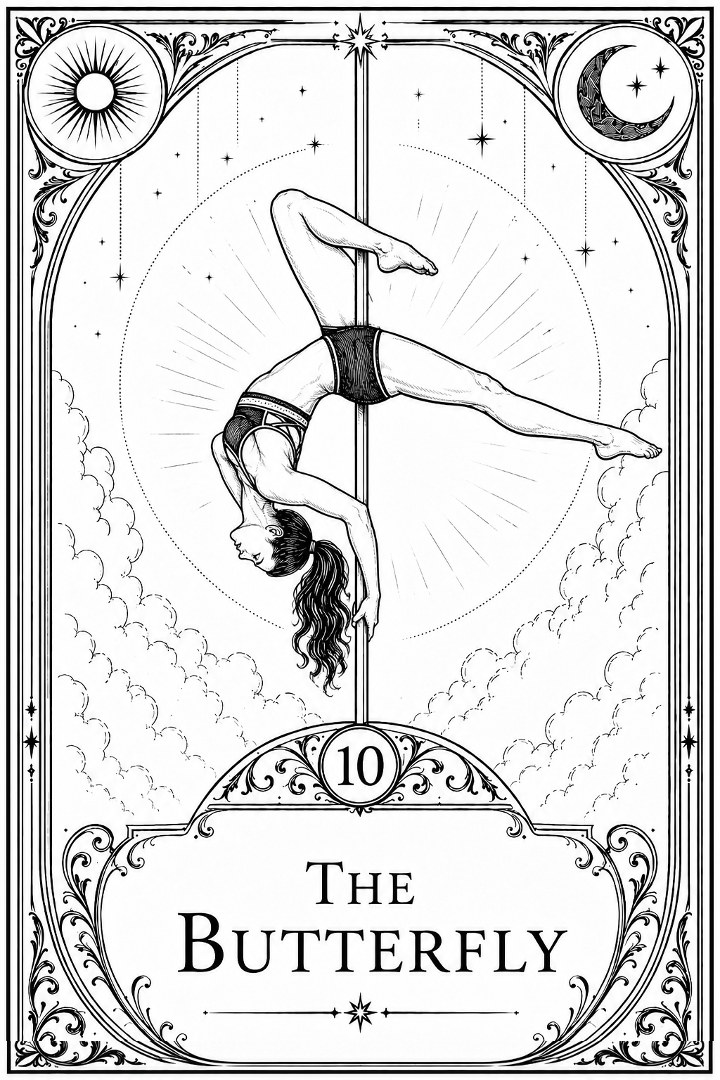
The Spread
Present Card: The Butterfly
Crossing Card: The Turn — reversed
Root Card: The Quick Change
Hidden Card: The Spotlight
Future Card: The Count
✦
Present Card: The Butterfly
The card of visible transformation.
Upright: the body opened into shape, strength made decorative, effort becoming image. The dancer learning that beauty is not the absence of work but the arrangement of it.
Reversed: the pinned body, the specimen, the woman looked at but not moving. Transformation mistaken for display.
The move. The Butterfly begins from an inverted position. One leg hooks, the other extends away, the body opens from the pole into a line that looks lighter than it is. From the floor, it can seem almost ornamental.
It is not ornamental.
It is labour with wings.
✦
The first time I saw the Butterfly, I thought it was misnamed.
Butterflies suggest delicacy. A thing of air and colour. A creature children draw when they have not yet learned how difficult wings are. The pole version was nothing like that.
The pole version was a trapdoor with pretty legs.
Jade demonstrated it after rehearsal one night, not because it was in the Ormskirk routine yet, but because Nessa had asked about progression and Jade was incapable of answering a simple question without becoming briefly airborne. She climbed, inverted, hooked one leg, opened the other, and there it was: the body extended away from the pole, held by decisions too small for the audience to see.
For a moment, the studio forgot to breathe.
That was the cruelty of beautiful moves. They concealed their invoice.
From the floor, the Butterfly looked like a shape a body had simply agreed to become. One hooked leg. One reaching leg. Arms strong but not ugly with it. A curve through the back. Head released enough to imply confidence, but not so much that the neck disappeared into drama.
It looked like transformation. It looked like freedom. It looked, frankly, expensive.
Then Jade came down and said, it’s mostly pain behind the knee and not panicking.
That helped.
I had begun to distrust anything that looked too much like revelation. Revelation, in pole, usually meant someone had edited out the bruises.
Jade said we would start with the preparation. Always the preparation. The body’s admin department. The unphotographed work beneath the image. Grip. Climb. Invert. Hook. Check. Breathe. Open a little. Come down before the nervous system wrote to its MP.
Marion sat on the floor beside me and looked up at the pole.
She said, I preferred it when butterflies were insects.
I said, I preferred it when my hobbies had chairs.
That was not strictly true. Chairs had begun to seem suspiciously flat.
When my turn came, I climbed with more competence than grace, which is at least a category of progress. The Outside Leg Hang had changed something. Not that I trusted the hook entirely. Trust is too noble a word for what existed between my knee and the pole. It was more like a hostile working relationship. But the body knew where to look for the hold now. It knew the place that had to tell the truth.
Jade stood near me, one hand ready but not touching.
She said, find the hook.
I found it.
She said, good. Now open the other leg a little.
I said, define a little.
She said, less than your fear thinks.
That was annoying because it was useful.
I opened. Not much. Not enough to be called Butterfly by anyone generous with language. Moth, perhaps. Troubled comma. Woman reconsidering gym membership. But something happened when the second leg moved away from the pole. The shape began to exist. Not fully. Not beautifully. But in outline.
My body made a first draft of wings.
The mirror caught it before I did.
That was the shock. Not the pain, though there was pain. Not the fear, though there was fear. The shock was seeing the line appear in the glass and recognising, before I could protect myself from recognition, that it was mine.
Jade said, there.
She said it quietly.
I came down too fast and landed with the elegance of furniture being delivered.
But I had seen it.
Only for a second.
Enough.
This is how danger grows: not by giving you the whole thing, but by giving you a glimpse accurate enough to ruin your previous excuses.
After class, Jade asked if she could use a still from the rehearsal video.
Nothing close-up, she said. Just a progress post. The shape is coming.
The shape is coming.
I should have said no.
I had learned by then that should is often the voice of the life already losing.
I said, only if I’m not tagged.
Jade nodded. No tag. No name. No face if you don’t want. We can crop.
She showed me the frame. I was half-turned, hair falling, one leg still too low, ribs working harder than they should have been. It was not a good Butterfly. It was not even a nearly-good Butterfly.
But it was undeniably a woman opening from the pole.
There are images that do not flatter you and still tell the truth.
I said, fine.
Jade posted it that evening.
Not on my account. I did not properly have an account yet. Not one anyone could find. She posted it on the studio page with a caption about progress, patience, and women surprising themselves. There was a butterfly emoji, which I felt was unnecessary but apparently compulsory.
The comments came slowly.
Amazing.
This is so inspiring.
I’m too old for this but love watching.
I could never.
Where are you based?
Is this beginner friendly?
I read them while sitting in my car outside work the next morning, fifteen minutes early because traffic had failed to be terrible. My laptop bag sat on the passenger seat. My access card lay in the cup holder. Through the windscreen, I could see the office entrance and a man from finance struggling with a Pret bag in a wind that had made other plans.
I was wearing a navy dress, tights, and the expression of a woman who had once used the phrase action log without irony.
On my phone, a stranger had written, I wish I was brave enough.
I stared at that for longer than I should have.
Then I went inside and reset my password because the system required it every thirty days, perhaps as punishment for employment.
✦
Crossing Card: The Turn — reversed
The card of the room changing direction.
Upright: the controlled turn, the dancer spotting the wall, choosing the axis, returning to face the front.
Reversed: the turn that happens to the room before anyone admits it. The evening altered by a key in the lock, a smell of beer, a voice half a degree louder than it needed to be.
The move. Every turn depends on a point of return. The dancer spots, rotates, finds the front again. Without the spot, the body loses the room.
✦
On Stella Nights the house lost its spot.
They were every Friday.
That is important.
Regularity gives a thing edges. You can plan around it. Count it. Call it a pattern and therefore almost an object.
Friday became a shape. Friday became a warning. Friday became the night I learned to go to bed early.
It began as practicality. He would be out after work. A drink with someone. Then another. Football. A reason that expanded. By the time the key turned in the lock, the evening had already chosen its direction.
So I learned to remove myself before the turn.
Dinner earlier. Kitchen cleared. Phone charged upstairs. Pyjamas before nine. A book open whether I read it or not. The small rituals of absence performed in advance.
It was not avoidance.
It was choreography.
The key in the lock still had its rhythm. Less precise. A fraction too loud. The door opening with unnecessary force. Cold air entering with him, carrying beer, pavement, the damp wool smell of outside places.
Then his voice.
You in?
As if the house might answer first.
Sometimes I answered from upstairs. Sometimes I did not.
He was not violent.
I need to say that because violence is a line people understand. Without it, everything becomes foggier. He did not hit me. He did not throw chairs. He did not become the kind of man who makes explanation simple.
He became more himself and less edited.
That was all.
That was enough.
On Fridays his humour sharpened first. Not always at me. Sometimes at the television, politicians, neighbours, people from work, drivers, the children’s generation, anyone who used the word journey without luggage. He could be funny. I have said that. The room often laughed before it noticed the direction of travel.
Then came the attention.
A man half-drunk can miss a burning building and notice a changed lipstick.
He noticed small things badly.
New top?
No, I said.
He looked again.
Looks new.
I said, I’ve had it ages.
That was sometimes true. Ages is flexible under pressure.
He opened the fridge.
Anything to eat?
There’s pasta.
Again?
It was not again. Or it was, in the way every domestic meal is again if one wishes to be philosophical and irritating. I said nothing because nothing was sometimes the shortest route through the room.
He took another beer from the fridge.
The can opened with that small, bright violence.
If I was downstairs, I kept my phone face down beside me. This had become a habit. Habits are just lies that have found a comfortable shape. Face down meant nothing to see, nothing glowing, nothing arriving from elsewhere. It also meant exactly the opposite.
He nodded at it.
Popular tonight?
I said, what?
Your phone.
No.
He smiled.
No?
Just studio stuff.
Still doing that?
I looked at him.
Still doing that.
He drank. The television, unwatched, threw blue light at the wall.
Keeps you busy.
It was not a question. It was not an accusation either. It sat in the room between the two, gathering strength.
I said, it’s good for me.
He made a small sound. Not disagreement. Not agreement. A sound that meant he had heard the sentence and placed it somewhere beneath reply.
The room turned.
Not enough for anything to fall. Enough for me to feel the axis move.
That is the Turn reversed. Not the dramatic spin. Not the collapse. The almost invisible loss of front. The dancer no longer able to spot the wall because the wall has become unreliable.
Most Fridays, I was already upstairs when it happened.
That was the skill I had learned.
To leave before the turn.
Root Card: The Quick Change
The card of becoming between scenes.
Upright: the swift transformation. Costume, face, hair, shoes, breath. The body crossing from private to performance because the cue is coming.
Reversed: the woman half-dressed between lives, one self not yet removed, the next not yet safe to wear.
The move. A quick change is not simply changing clothes quickly. It is choreography under pressure. Hooks, zips, pins, straps, powder, sweat, hands helping hands, the body altered in the small space before the music begins again.
Every performance depends on what happens where the audience cannot see.
✦
Macau had taught me quick changes.
Not beautifully. Practically. There was no romance in a quick change once you had done enough of them. Romance belonged to the audience, who believed glamour walked on fully formed. Backstage, glamour sweated, swore, lost hooks, borrowed pins, shared powder, bled quietly into tights and learned how to remove one costume without destroying the next.
There were women who could change entire lives in thirty seconds.
Feathers off. Sequins on. Hair corrected. Strap fixed. Lipstick repaired. Someone else’s elbow in your ribs. A dresser’s hands at your back. Music already moving towards the cue.
You did not ask whether you felt ready.
Ready was not the unit of measurement.
The cue came.
You went.
I had forgotten that, or perhaps I had translated it into other forms. School mornings. Work clothes. Dinner clothes. Funeral clothes. Mother at parents’ evening. Wife at drinks. Sensible woman in navy. Woman who knew where the passports were. Woman who could locate a PE kit, write a difficult email, remember a birthday, soften a silence, and be in the right outfit for each version.
Life had been one long quick change.
Only the costumes had become less honest.
The studio changed that. Or began to. It made the costume visible again. Not fancy dress. Not disguise. Equipment first, then declaration. Shorts because skin grips. Knee pads because the floor does not care about dignity. A tied vest because the line mattered. Later, perhaps, shoes too high for ordinary surfaces.
Before I bought my own, Jade lent me a pair.
They were old studio Pleasers, black, scuffed at the platform, with ankle straps softened by other women’s beginnings. She handed them to me after rehearsal as casually as if she were passing over a resistance band.
Just try walking in them first, she said.
Walking.
Always the humiliation.
The first lesson in Pleasers was not sexy. It was architectural. Weight forward. Ankles awake. Knees soft. Do not look at the floor unless you want the floor to become your destination. The platform changed the room. It changed the distance between me and my own feet. It made every movement slightly later than expected and every hesitation more visible.
Marion watched me take three steps along the mirror.
She said nothing.
That was how I knew it was serious.
By the end of the night, my calves had developed separate personalities and my respect for women who danced in heels had become almost religious.
But the shoes did something else too.
They changed the count of the body.
In trainers, I still looked like a woman attending a class. In the Pleasers, even borrowed, scuffed and half a size wrong, the body understood that rehearsal was no longer only rehearsal. The walk had become entrance. The floor had become stage. The ridiculous had acquired height.
Then the face.
That surprised me most.
Jade said it during rehearsal for the Ormskirk piece. We were running the opening section and I was concentrating with the full severity of a woman defusing a bomb.
She stopped the music.
She said, you know your feet are doing it.
I said, good.
She said, and your hands.
I said, excellent.
She said, your face has filed a complaint.
I looked in the mirror.
She was right.
My body was entering the routine. My face was still at work, reading an email with consequences.
Jade said, again, but this time let the face know it’s invited.
I said, my face has concerns.
She said, it can bring them, but it still has to come.
So I began to practise the quick change no one could see. Not clothes. Not make-up. The change between the woman doing the school run in memory and the woman walking into music now. The change between apology and entrance. Between trying not to be noticed and deciding, briefly, to help the room see.
At home, this became ridiculous.
I would stand in the bathroom after work and attempt eyeliner with the concentration of a medieval monk illuminating a plague manuscript. My daughter, when she was still at home, had once made it look easy. She could draw wings on her eyes in a moving car. I could not reliably draw two lines on a stationary face.
Still, I practised.
Not much. Not drag. Not glamour yet. A darker line. A better lip. Hair down instead of clipped back with the exhausted plastic thing I used for cooking. Small changes. Almost deniable.
That was how Saskia entered.
Not all at once. Not through the front door. She came in through parcels, mirror checks, eyeliner, captions not posted, bios written and deleted, the body discovering which version of black looked intentional rather than apologetic.
The account took eleven minutes to create and two days to admit existed.
Saskia St. Clement.
The name looked absurd in the username field.
Good.
Absurdity had been underused in my life.
I did not post at first. I adjusted the bio, which immediately became a referendum on identity. Beginner pole dancer sounded too small. Midlife pole journey made me want to walk into the sea. Returning dancer sounded grand and untrue in a way that might become true later. Mother, worker, dancer felt like three women arguing over a chair.
In the end, I wrote:
Learning to return to the body.
Then I deleted it.
Then I wrote it again.
The first post was a hand.
This is how cowards begin revolutions.
Not a face. Not a full body. Not even a move. Just my hand on the pole, grip chalk caught in the lines of the palm, the bruise behind my knee visible only if you knew where to look. The caption said: starting again, which was both accurate and unbearably earnest.
Three people liked it.
One was Jade.
One was Marion.
One appeared to be a tattoo artist in Wigan.
Fame had not yet become difficult to manage.
But something had crossed.
A quick change is dangerous because it proves the self is not fixed. You can enter one side of a curtain as one woman and come out the other side as another, and the audience will accept what the body insists upon.
The old life had depended on my changes being useful to other people.
This one was not useful.
That was why it felt like freedom.
✦
Hidden Card: The Spotlight
The card of chosen visibility.
Upright: the dancer entering light by consent. The body not merely seen, but offered. The woman learning that being visible is not the same as being available.
Reversed: exposure. Glare. The old fear that the light will strip, judge, pin, punish, make a specimen of the body before the body has moved.
The move. A spotlight does not create the dancer. It reveals the agreement between dancer and room. Step into it too soon and it feels like interrogation. Step into it by choice and it becomes weather the body can use.
✦
I told myself the account was for progress.
This was partly true.
Progress is a respectable word. It wears sensible shoes. It implies measurement, discipline, effort, improvement. It does not imply hunger. It does not imply the small shock of refreshing a screen and finding that someone in another town, another country, another life, has seen your body move and pressed a heart beneath it.
I posted progress.
A knee hook. A failed Butterfly preparation. A clip of the Ormskirk opening with my face mostly out of frame. A bruise on the back of my thigh, edited into black and white because apparently even damage can be curated if one is determined enough.
The followers came slowly.
Thirty-seven.
Sixty-two.
Ninety-one.
One hundred and eighteen.
Numbers too small to matter and large enough to matter completely.
Jade shared one of my clips to the studio story. That brought strangers. Not many. Enough. Women with usernames involving dogs, birth years, yoga, divorce, cake, books, gym attempts, menopause jokes, and flowers. Women who wrote things I did not know where to put.
I’ve wanted to try pole for years.
This makes me feel brave.
I’m fifty-two. Am I too late?
My husband would laugh at me.
That one I did know where to put.
I put the phone face down.
Then picked it up again.
The hidden card was not that I wanted followers.
Followers are too crude a name for what I wanted then. I did not want fame. Fame seemed inconvenient and badly lit. I did not want men, though men arrived eventually because men will enter any room if the door is digital and they think there might be skin inside.
The first one arrived on a Wednesday, between a woman asking about grip and a woman asking about class time.
I will not write what it said. It was not clever. It was the kind of message men send to say: whatever room you build, we have keys.
I sat with the phone in my hand and felt the old world reach into the new one as if there had never been a wall.
Then they're not the audience — but he was in the audience. That was the correction the sentence needed. The wrong audience does not stay outside because the right one is seated. It buys tickets too.
I blocked him taps. The old world had never offered that.
Two more arrived that month. I blocked them too. My thumb learned the gesture the way it had learned the grip — badly at first, then without thought.
The account was not a garden. The algorithm had its own opinions. The clip that did best that autumn was the one I liked least, filmed at an angle I had not chosen, watched for reasons that had nothing to do with the shoulder I had finally fixed. Attention is not witness. Some of the count was not counting what I was.
I kept the account anyway.
Not because the wrong audience did not matter.
Because for the first time in my life, I was the one deciding who stayed in the room.
I wanted witness.
That was different. Witness does not consume. Witness says, I see what is happening. Witness keeps the before and after. Witness understands that a woman learning to open into a Butterfly at nearly fifty is not trying to become twenty. She is trying to find the part of fifty that still has wings.
The spotlight frightened me because it answered something I had not admitted asking.
Look.
Not look at me because I am pretty. Not look at me because I am available. Not look at me because I have solved the body or beaten age or become inspirational in a way that makes everyone more comfortable about decay.
Look because I am still moving.
That was the hidden thing.
I wanted to be seen moving.
Not frozen. Not judged. Not pinned to an age, a role, a marriage, a before. Moving.
My daughter found the account before I told her.
Daughters are part bloodhound and part tribunal.
She sent me a screenshot of my own hand.
Then a message.
Mum?????????
I considered denial, which was ambitious given the hand was attached to my arm.
I rang her from the car.
She said, why is your bio so bad?
I said, hello to you too.
She said, also the lighting in the third video is criminal.
I said, I thought you’d be embarrassed.
There was a pause.
Then she said, Mum, you look happy.
I had no answer to that.
She followed immediately, then began sending suggestions with the confidence of a person who had grown up online and therefore believed all adults were making preventable errors in public. Better light. Shorter captions. Stop using full stops like you’re resigning from something. Don’t say journey. Everyone says journey. Use the window in the studio. Ask Jade to film from lower down, but not too low because, you know, dignity.
I said, thank you for preserving my dignity.
She said, someone has to.
Then she said, does Dad know?
The question changed the car.
Not because it was accusing. It wasn’t. It was practical. My daughter had inherited, from somewhere, the female gift for locating the pressure point in a room she was not even standing in.
I said, not really.
She was quiet.
I said, he knows about the classes.
That sounded ridiculous as soon as I said it. The way children know about weather. The way someone knows there is a sea because they have seen a postcard.
She said, but not this.
I looked through the windscreen at a woman trying to reverse into a space too small for her confidence.
No, I said. Not this.
My daughter did not tell me to tell him. That was its own kind of mercy.
She said, be careful.
Not frightened. Not dramatic. Just careful.
The word sat between us with its coat on.
My son found out two days later, because sisters are also news agencies.
He rang me.
He said, I’m proud of you, Mum, but I’m not following the account.
I said, fair.
He said, emotionally I support you. I’m just not putting this in my feed.
That was the most loving thing he could have said.
Then, after a pause, he said, does Dad know?
There it was again.
The family weather report.
I said, he knows I go to class.
My son made a sound. Not judgement. Recognition.
He said, right.
I said, it’s complicated.
He said, yeah.
He did not ask me to explain. Sons can be kind in ways that look like retreat.
Then he said, I’m glad you’re doing it, though.
I said, even if you never watch?
He said, especially if I never watch.
The children complicated the shame. They did not remove it. Shame is not a coat someone else can take from your shoulders. But they altered the room around it. My daughter was delighted, bossy, protective. My son was affectionate and carefully absent from the comment section. Neither of them died of embarrassment. Neither of them asked me to stop.
That mattered more than I expected.
It also made his silence louder.
Not his literal silence. He spoke plenty. About work, bins, petrol, politics, whether we needed milk. But there was a silence around the part of me now becoming visible elsewhere. A silence I had once mistaken for privacy and now recognised as absence with furniture.
He did not know about Saskia.
Not yet.
But he knew something had entered the house.
He noticed everything except the thing that was changing.
✦
Future Card: The Count
The card of numbers becoming possibility.
Upright: the dancer finding the count, the rhythm, the measure by which movement becomes repeatable. The woman learning that attention, gathered slowly, can become structure.
Reversed: counting as judgment. Age, weight, money, followers, years lost, years left. The numbers that reduce the body before it has moved.
The move. Every routine begins with a count. Five, six, seven, eight. The count does not dance for you. It does not make you brave. It simply tells the body when to begin.
✦
Later, there will be other counts.
Views. Likes. Saves. Followers. Small numbers at first. Numbers too small to change a life, but large enough to suggest that a life might one day be changed.
The account did not save me.
That would be a stupid story.
No woman should be asked to make escape depend on an algorithm.
I still had a job. I still had a salary, a contract, a pension contribution, a laptop that heated my thighs in meetings, a manager who used the word bandwidth as if it were weather. I still had spreadsheets, passwords, compliance training, calendar invitations from people who considered fifteen minutes a personality.
Work remained.
Money remained money.
Rent would not be paid in comments saying queen.
And yet.
The account changed the arithmetic.
Not enough to live on. Not then. Not even close. But enough for a line of thought to appear where before there had been only wall. If strangers watched, perhaps strangers might book. If women commented, perhaps women might come to a class. If Jade could fill a beginner workshop with a reel, perhaps a story could become more than exposure. If I could keep improving, keep posting, keep being useful to women who were frightened of the door, then perhaps one day attention could become work.
Not rescue.
Possibility.
Rescue is passive. Possibility asks you to stand up and do your own admin.
The count grew slowly.
One hundred and eighteen.
One hundred and forty-three.
Two hundred and six after Jade shared the Butterfly preparation.
Three hundred and something after a menopause account reposted one of my clips with the caption: more of this.
I hated that caption.
I loved that caption.
Both things were true.
There were saves now. Shares. Messages. Questions from women who began with apology, as if wanting to move required permission from a stranger.
Sorry, can I ask, do you need to be strong before starting?
Sorry, I’m fifty and not fit at all.
Sorry, this is probably silly.
Sorry, my husband would think I’d lost my mind.
The word sorry appeared so often it began to feel like the real subject of the account.
I answered when I could.
No, you don’t need to be strong before starting. Starting is how strength begins.
No, fifty is not too late.
No, silly is sometimes the door.
No, I did not write the last answer.
I wanted to.
Instead I wrote something safer.
The count did not make me brave.
It counted the bravery after the fact.
Five, six, seven, eight.
Post.
Refresh.
Regret.
Refresh.
Pretend not to care.
Care.
There is a rhythm to public becoming and it is not dignified.
On a Friday near the end of that month, the count crossed five hundred.
Five hundred and twelve, to be exact. Exactness matters when numbers are still small. Later, perhaps, people round. At five hundred and twelve, every twelve is personal.
I saw it upstairs, before he came home. I was already in bed, book open, phone low under the quilt like a teenager or a spy. Downstairs, the kitchen was cleared. The lights were off. The house had been prepared for Friday.
Five hundred and twelve. A number large enough to feel like a crowd and small enough that I could still imagine every single one of them finding me disappointing.
I looked at the number for too long.
Then the key turned in the lock.
The house heard it before I did.
There was the small failure of metal against metal, the second attempt, the door opening too hard. Cold entered. Beer entered. The night entered wearing his coat.
His voice came up the stairs.
You in?
I did not answer immediately.
The phone was still lit in my hand. Five hundred and twelve strangers, or not strangers exactly, not friends, not customers, not rescue, but witnesses gathered in a number too small to change anything and too large to dismiss.
You in?
Yes, I called.
He came upstairs a few minutes later. Not all the way at first. Bathroom. Tap. The heavy quiet of a man trying to be quieter than he is. Then the bedroom door opened.
He stood there with his shirt untucked at one side, face softened by drink and sharpened by whatever drink had failed to soften.
You awake?
I held up the book slightly, as evidence of innocence.
Reading.
He looked at the phone beside me.
Thought you were reading.
I am.
He smiled.
Multitasking.
There was no accusation in the word, not officially. Nothing one could write down. Nothing one could explain to a friend without hearing oneself become petty and overwrought.
He came into the room and sat on the edge of the bed to take off his shoes. One shoe came off easily. The other resisted him and became, briefly, the evening’s enemy.
Busy night online?
I said, what?
He nodded towards the phone.
You’re always smiling at that thing lately.
I put the phone face down.
Am I?
He laughed once.
You tell me.
The room waited.
There are counts inside silence. Beats. Half-beats. The place where the next line should arrive. The place where music would have helped.
I said, it’s just dance stuff.
Dance stuff.
He repeated it as if tasting a foreign food he had already decided not to like.
Then he stood, put the shoes by the wardrobe with exaggerated care, and began unbuttoning his shirt.
Keeps you busy.
You said that before.
Did I?
Yes.
Must be true then.
He smiled again, and for a moment he was almost charming. That was the difficulty. He could still find the old doorway into the room. He could still stand there with his shirt half-open, smelling of beer and cold air, and look like a man one might once have wanted to impress.
Then he said, funny thing for a woman your age to get so into.
There it was.
Not the explosion.
Not yet.
A match tested against the box.
I looked at him.
He did not look away.
I could have answered. I could have said many things. I could have said, what age would be better? I could have said, funny thing for a man your age to still come home smelling like a student bar. I could have said, don’t.
Instead, I said nothing.
Silence was habit.
But it was no longer agreement.
That was new.
He went to the bathroom. The tap ran. I picked up the phone again only after the door closed.
Five hundred and twelve.
The number had not changed.
Of course it had not. Numbers do not rescue you from rooms. They do not argue on your behalf. They do not stand in front of a man and say, she is allowed. They do not pack bags. They do not sign leases. They do not make courage transferable.
But they remained.
Five hundred and twelve.
Somewhere beyond the bedroom, beyond Friday, beyond the smell of beer and the old reflex of silence, there were women asking whether it was too late.
I did not know how to answer them honestly yet.
I only knew that when the count began, the body moved.
Five, six, seven, eight.
The Butterfly had taught me that beauty is work arranged where people can see it. The Turn reversed had taught me that a room can lose its axis without moving. The Quick Change had taught me that a self can alter behind the curtain. The Spotlight had taught me that witness is not the same as permission.
And the Count had begun.
Not large enough to save me.
Not yet.
But large enough to prove that elsewhere existed.
He had not accused me yet.
But accusation had begun choosing its clothes.
XI
The Superman
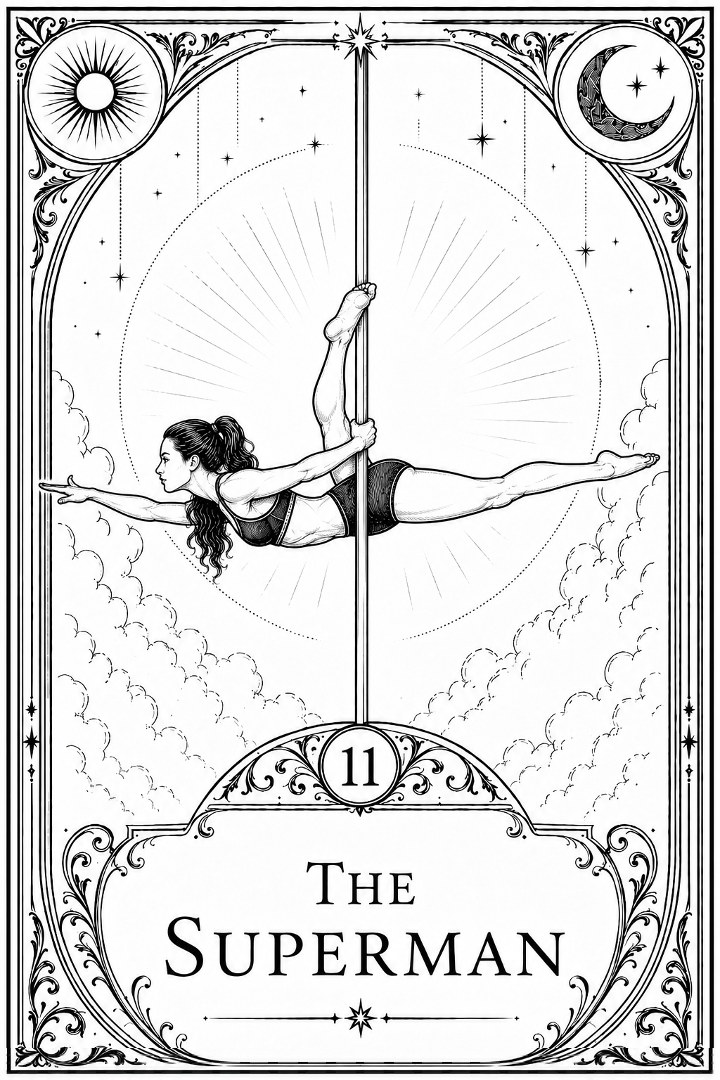
The Spread
Present Card: The Superman — reversed
Crossing Card: The Spot — reversed
Root Card: The Front Row — reversed
Hidden Card: The Double — reversed
Future Card: The Curtain Call
✦
Present Card: The Superman — reversed
The card of being mistaken for flight.
Upright: the body extended, held, displayed by strength it has earned. The dancer learning that what looks like showing off may in fact be survival under pressure.
Reversed: the heroic shape misunderstood as vanity. The woman accused of spectacle by someone who cannot see the work beneath the line.
The move. The Superman holds the body face down and away from the pole, one leg gripped, the body extended as if flying. From the floor, it can look triumphant.
From the skin, it feels like being removed from yourself with a blunt instrument.
✦
The Superman was an offensively named move.
I thought that immediately.
Not because men should not have moves named after them. Men have had quite enough named after them, but that was not the principal objection. The problem was the promise. Superman suggested ease, rescue, power, a cape, a jaw, a body untroubled by gravity because the story had already decided it was special.
The pole version offered none of this.
The pole version was mostly thigh skin, betrayal and a position no civilised person would choose without music.
Jade demonstrated it after warm-up, because apparently Chapter Eleven of any life requires a fresh humiliation. She climbed, moved into position, trapped the pole high against her thigh, leaned forward, extended the body, and opened both arms.
There it was.
Flight.
Or the photograph of flight.
That distinction mattered.
From the floor, she looked weightless. Strong, long, deliberate. The line ran from the reaching arms through the ribs, the hips, the leg. It was one of those shapes that made the room briefly stupid with admiration.
Then Jade came down and slapped the side of her thigh.
She said, that one’s rude.
Nessa nodded with the seriousness of a doctor confirming a diagnosis.
Marion looked at me.
She said, I don’t like it when the beautiful ones are violent.
I said, that sentence has done a lot of work in civilisation.
Jade said, we’ll start with the entry.
We had learned by then that the phrase start with the entry meant pain had simply been delayed for administrative reasons. Still, we gathered around the poles with the obedient suspicion of women who had paid to be harmed in specific, improving ways.
The Superman began from a familiar place and then turned treacherous. Climb. Position. Grip. Shift the hip. Trap the pole with the thigh. Lean the body forward. The arms came last, though the eye wanted them first. The arms were the photograph. The hold was elsewhere.
That was the rule of most beautiful things.
The picture lied about the source of its own strength.
When my turn came, I got as far as the preparation and stopped.
Jade stood beside me.
She said, don’t throw yourself into it.
I said, I had not planned to throw myself anywhere.
She said, good. Place yourself.
That was better. Placing sounded less heroic and therefore more likely.
I shifted the hip. The pole pressed into the inside of my thigh with the calm brutality of fact. I leaned forward half an inch and immediately reconsidered every choice that had brought me to the room.
Jade said, breathe.
I said, I am.
She said, with your lungs.
I disliked precision when it was correct.
I breathed. The body lowered. The thigh gripped. My hands stayed on the pole, not because they were needed at that exact second, but because the idea of removing them seemed legally unsound.
Jade said, one arm.
I said, no.
She said, not both. Just one.
That was how the impossible often entered. Not as apocalypse. As a smaller request.
One arm.
I released the right hand. The body stayed. Not comfortably. Not gracefully. But it stayed, held by a strip of skin and a level of trust I would not have recommended to anyone.
The mirror showed me something I did not feel.
It showed a woman leaning forward from the pole, one arm reaching, one hand still holding, face locked somewhere between concentration and tax audit. It was not Superman. Not yet. But it was recognisably on the way.
A body does not have to arrive to betray the place it started from.
Jade said, there.
She always said that. There. As if the future were not a country but a point on the skin.
I came down with less drama than I felt entitled to and stood rubbing my thigh.
Marion said, you looked good.
I said, I looked like I was being repossessed.
She said, yes, but elegantly.
That was enough. Compliments at our age required accuracy.
By the third attempt, I could hold the preparation long enough for Jade to step back. By the fifth, I released both hands for a fraction of a second and felt the whole room move through my body. The shape was not flight. Not really.
It was exposure under load.
That was more interesting.
Superman was the first move that made me understand how easily strength can be mistaken for display. From the outside, a body extended looks as if it is offering itself. Look at me. See what I can do. Admire the line.
Inside the move, the body is not asking to be admired.
It is trying to survive the hold.
That distinction would become important.
The card sits reversed at the head of this spread. Not because the body got the move wrong. The body held. The reading of it was about to be taken out of my hands.
✦
Crossing Card: The Spot — reversed
The card of looking in the wrong place.
Upright: the dancer finding the fixed point, the eye returning to what keeps the body from losing the room.
Reversed: fixation. Suspicion. The gaze that thinks it has found the truth because it has found a point to stare at.
The move. In turning, the spot saves the dancer from dizziness. The head returns to one point while the body rotates beneath it. Without the right spot, the room blurs.
With the wrong spot, the body still falls.
✦
He thought there was a man.
Not at first in words. He was not careless enough for that. Suspicion entered the house as weather first, then furniture. It moved things around. It sat in the space between questions. It took ordinary sentences and turned them slightly, so that they no longer faced the wall they had faced before.
You’re late.
Only ten minutes.
Still.
New perfume?
No.
You smell different.
Studio.
Right.
Right became one of those words with no fixed meaning. It could mean agreement, disbelief, boredom, injury, or a note made quietly for later.
The strange thing was that he was not entirely wrong. That was what made the days before discovery so difficult. He had spotted something. He had simply spotted the wrong thing.
There was secrecy. There was heat. There were clothes hidden badly and then better. There were parcels I collected before he came home. There were videos I watched in the bathroom with the door locked. There was a name he did not know. There was a version of my body being seen by strangers. There was a woman smiling at her phone in another room.
There was desire.
He was wrong about the object.
He was not wrong about the weather.
A man would have been easier for him. A man would have given the story edges he understood: betrayal, sex, blame, competition, a name to hate. A man would have made my changing body evidence of desire travelling in a direction he could recognise.
There was no man.
That was the part he would not forgive.
At dinner one night, not Friday, which made it worse, he asked who Jade was.
I looked at him too quickly.
That was my mistake. The body is an appalling witness under pressure.
I said, my teacher.
He said, teacher.
Pilates teacher.
He smiled at the table.
Does she have a surname?
Probably.
You don’t know?
I said, I’ve never needed to send her a Christmas card.
That should have been light. It came out sharp. Sharpness gives suspicion a handle.
He put his fork down.
You’re very defensive.
I’m not.
You are.
I said nothing because the old training reached me before the new body could.
Silence had once been my safest shape. By then it had become unreliable.
He picked up his fork again and cut into his food with unnecessary care.
Just asking.
That was another phrase that had learned to carry luggage.
After that, I noticed him noticing.
Not always. Not skilfully. He was not a detective. He was a husband, which is sometimes more dangerous because husbands know the version of you they expect to see. Anything outside that version appears first as insult.
He noticed when I put my phone face down.
He noticed when I put it face up too quickly.
He noticed a black strap drying over the bath.
He noticed the bruise behind my knee and said, that from Pilates?
I said yes.
He said, looks like something else.
I said, what else?
He shrugged.
I waited.
He said, nothing.
The word landed badly.
The Spot reversed is not blindness. Blindness would have been simpler. The Spot reversed is attention without understanding. The eye fixes, the body turns, the room blurs, and the dancer believes the problem is motion when the problem is the point she has chosen.
He fixed on betrayal because betrayal was a story with rules.
My change had no rules he trusted.
One Friday, I came home from rehearsal and found him already in the kitchen. That happened sometimes: the pub cancelled, or the friend ill, or the weather inconvenient. A Friday with him home early had the unnatural feel of a train arriving at the wrong platform.
He was standing by the counter with a beer open beside him.
He said, good class?
I said, yes.
He looked at my bag.
Learn anything nice?
There was a tone on nice I did not like.
I said, not nice exactly.
He said, what then?
Painful.
He laughed.
Sounds fun.
I put the bag by the stairs and kept my body between him and it without intending to. Then I realised I had intended to.
He saw that too.
What’s in there?
Clothes.
He smiled.
Must be some clothes.
I said, for rehearsal.
Rehearsal.
For Ormskirk.
There it was. I had not meant to say it. Or rather I had meant, eventually, to say something like it in some better room, under better lighting, with a calmer man and a version of myself who had slept properly.
He looked at me.
What’s Ormskirk?
A weekend thing.
What weekend thing?
Dance.
Dance.
He said it as if testing the strength of a floorboard.
Dance was not Pilates. We both heard the word land where the lie had been.
I said, yes.
You’re going away for dancing.
It’s a workshop weekend. And a troupe piece.
A troupe piece.
He repeated things now. Not because he had not heard them. Because repetition made them smaller.
I said, yes.
He picked up the beer and drank. He was not drunk. Not yet. That made the moment cleaner and therefore more frightening.
When were you planning to mention this?
I opened my mouth.
No good sentence arrived.
He nodded once, as if confirming something privately.
Right.
Then he left the kitchen.
The beer stayed on the counter, sweating into a ring.
I stood beside my bag and felt the hook behind my knee again. The place where the body had to tell the truth.
✦
Root Card: The Front Row — reversed
The card of the audience too close to watch properly.
Upright: the witness who receives the performance without needing to own it. The room that gives attention back as energy.
Reversed: the gaze that leans forward, judges, claims, interrupts without speaking. The watcher who believes nearness gives him authority over the stage.
The move. The front row changes everything. It is not the largest part of the audience, but it is the nearest. The performer feels it first: the breath, the cough, the crossed arms, the person who has decided before the music begins.
The wrong audience does not have to boo.
Sometimes it only sits too close.
He had always been a front-row man.
Not literally. In theatres, he preferred the aisle. In cinemas, the middle back. At school plays, when the children were small, he stood near the exit because he said the chairs were made for people without knees. But in life, he took the front row. He watched closely enough to comment and not closely enough to understand what the watching did.
There had been a dinner once, years earlier, with friends whose names I now remember mostly as glassware and noise. Someone asked whether I still danced. I said no, lightly, because no had by then become the official version. He told the story of Macau before I could decide whether to tell it myself.
Not cruelly.
He told it well. He always told stories well.
My wife nearly became a showgirl, he said.
People laughed.
Nearly, he said, was doing a lot of work.
More laughter.
I smiled because the room required it.
He put a hand on my shoulder.
Then life intervened, didn’t it?
That was how he put it. Life. A civilised word. A word with curtains. Not pregnancy, not fear, not return flight, not a mother at Heathrow, not the body changing the count. Life intervened. The room accepted this because rooms prefer neatness after wine.
Someone asked if I ever missed it.
He answered again.
She misses the costumes, probably.
A bigger laugh that time.
I remember the weight of his hand more than the sentence. Not heavy. Not threatening. Almost affectionate. But placed. A hand that told the room where I belonged in the story.
Beside him.
Under the joke.
I could have corrected him.
I did not.
That was the old performance. Smile. Lower the stakes. Do not make the room uncomfortable by asking it to recognise where the laughter had landed.
The Front Row reversed is not hatred of being seen. I did not hate being seen. That was the lie I had told myself to survive being watched badly. I hated the audience that mistook proximity for permission. The audience that believed knowing me gave it the right to reduce what it saw. The audience that sat too close and called interruption intimacy.
At the studio, the front row was different. Women watched because they were next. Because they were learning. Because they had the same bruise or feared the same drop or wanted the same impossible line. Jade watched to correct. Marion watched to witness. Nessa watched with the generous impatience of youth. Leanne watched with her mouth open, forgetting to pretend she was unimpressed.
The gaze changed the body.
That is one of the truths no one tells you. The wrong gaze makes the body defend itself. The right gaze lets it risk accuracy.
His gaze had always made me perform smaller.
Not always. Nothing is always. This is the difficulty with the truth. There were evenings when he looked at me with real warmth. There were photographs where his hand is at my waist and I remember wanting it there. There were years when I would have called his attention love and not been entirely wrong.
But attention can curdle.
By Chapter Eleven, his gaze had curdled into ownership.
When he watched me now, he was not seeing a woman becoming. He was seeing property altered without permission.
That was the root.
The front row had decided the stage was his.
✦
Hidden Card: The Double — reversed
The card of the second self mistaken for a lie.
Upright: the stage self, the alter ego, the name under which the body risks what ordinary life forbids.
Reversed: the double exposed before she is understood. The chosen self treated as deception because she did not ask permission to appear.
The move. Every performer contains a double. Not a fake self, not necessarily, but the self with the volume changed. The walk becomes entrance. The hand becomes gesture. The name becomes a door.
The double is not always a disguise.
Sometimes it is the truth in costume.
✦
He found Saskia on a Saturday morning.
That was almost comic.
Not Friday night. Not in the full theatre of beer and accusation. Not under blue television light with the house tilted and waiting. Saturday morning. Pale sun. Kettle. Crumbs on the worktop. The ordinary cruelty of daylight.
I was upstairs when he called.
Who’s Saskia?
The name travelled through the house incorrectly. It sounded vulgar in his mouth. Not because the name was vulgar, but because he had found it before I had chosen how to explain it.
I came downstairs too quickly.
Another mistake.
He was at the kitchen table with his phone in his hand. His face was calm in the way faces become calm when they have already decided what the evidence means.
I said, what?
He turned the phone towards me.
There I was.
Not fully. Not the whole account. A grid of small squares. My hand on the pole. My back in the mirror. A clip frozen at the beginning of the Ormskirk routine. A bruise. The Butterfly preparation. Saskia St. Clement at the top in the username field, ridiculous and elegant and suddenly indefensible under kitchen light.
He said, is this you?
I said, yes.
The answer surprised us both.
There had been other options. Evasion. Partial truth. Joke. Delay. The technicalities of social media. But the woman in the squares was too obviously mine to abandon.
He looked at the phone again.
Saskia St. Clement.
He said the name slowly.
Jesus Christ.
I said, it’s a stage name.
For what stage?
For pole.
Pole.
Again the word returned smaller.
Then the other word arrived. He did not shout it. He set it down.
Pilates.
The word that had lived on the kitchen counter for a year, returned like something broken.
I did not answer. There was no answer that was not the whole year.
He scrolled. I hated that. His thumb moving through the grid, through the small record I had built one post at a time. The hand. The knee. The clip. The line. The caption. The comments. Women saying brave, beautiful, inspiring, not too late, I wish.
He said, who are these people?
Followers.
Followers.
Not friends.
Some are.
He laughed once.
Are they?
He scrolled again.
I wanted to take the phone from him. Not because he had no right to see public posts. That was the difficulty. I had made them visible. I had chosen the spotlight, or begun to. But there is a difference between the public and the person you fear most becoming the room.
He opened a reel.
Music came from his phone, thin and tinny and obscene in the kitchen. My body moved in miniature. The Ormskirk opening. Walk. Turn. Drop. Rise. Genie. Transition. My face mostly out of frame, thank God, then briefly visible as I looked toward the mirror.
He watched without blinking.
Then he said, do the children know?
The question struck harder than I expected.
I said, yes.
Both of them?
Yes.
He looked up.
So everyone knows except me.
That was not true.
It was also true enough to be dangerous.
I said, you knew about the classes.
He put the phone down on the table.
Not this.
There it was. The sentence my daughter had already found.
Not this.
He stood and went out of the kitchen. For one wild second, I thought the confrontation was over. This shows how hope will humiliate itself under pressure.
He came back with the box.
The Pleasers had arrived two days before.
My own pair.
That was the important part. Not Jade’s old studio pair with the softened straps and scuffed platforms. Not the borrowed shoes I had practised walking in under the studio lights, gripping the mirror rail with one hand and what remained of my dignity with the other.
Mine.
I had worn them once. Three minutes, alone, one hand on the bedpost, laughing so quietly the house never heard. Then I had wrapped them back in their tissue — black patent, high, impossible, less like shoes than a dare with buckles — and hidden them at the back of the wardrobe beneath a folded blanket and two handbags I had not used since the children were small.
That was what the old life did with joy. It rewrapped it and hid it under the winter things.
He put the box on the table.
What are these?
Shoes, I said.
This was accurate and therefore useless.
He opened the box.
The tissue parted.
The shoes lay there like evidence in a language he understood.
He looked at the shoes.
I looked at the shoes.
We were not looking at the same shoes.
For a moment, neither of us spoke.
The Double reversed is not the discovery of a secret self. It is the secret self being translated by the wrong interpreter.
In the studio, the shoes were apparatus. Not yet mine in practice, but part of the form, part of the future vocabulary of the body. Height changes the angle. Platform changes balance. The shoe lengthens the line, alters the walk, makes floorwork possible in another register. It is equipment before it is theatre.
In the kitchen, they were sex.
There was no rescuing them from that.
He touched one heel with two fingers and then let go as if the object had embarrassed him.
You’re joking.
I said nothing.
You’re actually joking.
Still nothing.
He looked at me then, properly. Not at the account. Not at the shoes. At me.
Who do you think you are?
The line did not arrive loudly.
That made it worse.
Loudness gives the body permission to defend itself. Quiet contempt enters more easily. It does not break the windows. It changes the air.
I said, don’t.
Don’t what?
Say it like that.
Like what?
Like I’ve done something disgusting.
He looked at the shoes, then the phone, then me.
Haven’t you?
The word landed. Not because I believed it. Because some part of me had been waiting for it since the first parcel, the first short, the first post, the first time I had turned the phone face down and felt the lie find its comfortable shape.
He said, you’re a fifty-year-old mother.
Nearly, I said.
What?
I’m not fifty yet.
It was a stupid answer.
It was also the only answer that arrived wearing shoes.
He stared at me.
That’s what you’re going with?
Apparently.
He laughed then. Not kindly, not fully, not the laugh from dinner tables where other people softened the edges. This laugh had no audience except me, and that made it more honest.
You look ridiculous.
There it was.
The old word.
The word from cushions and tea towels. The word from songs in the kitchen. The word from every room where joy had become aware of itself and begun putting itself away.
Ridiculous.
I looked at the shoes on the table. At the phone beside them. At my own hand, suddenly visible to me as if it belonged in one of the photographs. The skin at the knuckles. Grip chalk still caught faintly in the lines from the night before. A bruise yellowing at the wrist.
He meant ridiculous as reduction.
But Chapter Eight had changed the word.
Ridiculous no longer belonged only to him.
That was the problem.
He said, I want it stopped.
The account?
All of it.
The classes?
He looked at me.
All of it.
The weekend?
His face changed.
What weekend?
I closed my eyes.
There are moments when the body understands before the scene has finished arranging itself. The hook is false. The hand is slipping. The count has moved and you are late. The room has already seen.
Ormskirk, I said.
The workshop weekend.
You’re still going?
I had no safe answer.
He said, after this?
This.
As if he had found a crime scene.
I said, it’s paid for.
He laughed again.
Oh, well, if it’s paid for.
That was when I knew the chapter was ending.
Not the marriage. Not yet. Endings are rarely kind enough to arrive when first summoned. There would be more conversation. Repetition. Silence. A night in the spare room or not. A morning where one of us made coffee and the other behaved as if coffee were not astonishing under the circumstances.
But something had ended.
Not because he had seen the account.
Because he had seen it and chosen shame as the only available translation.
✦
Future Card: The Curtain Call
The card of returning after exposure.
Upright: the performer stepping back into the light after the work has been seen. The body acknowledging the room without asking to be forgiven for being there.
Reversed: exit in shame. The woman leaving before the applause because someone has convinced her the stage was never hers.
The move. The curtain call comes after the performance, but it is still part of the performance. The dancer returns not to explain the work, but to stand before the room that has witnessed it.
A curtain call does not ask permission.
It receives the fact of having been seen.
✦
Later, much later, I would understand that he had given me the wrong audience for the last time.
Not in that moment. In that moment, I shook. I was angry, yes, but anger was not clean yet. It was braided with shame, old obedience, fear, habit, money, weather, children, the thousand dull logistics that keep people standing in rooms where the air has become unbreathable.
I did not make a speech.
That is important.
Women in stories make speeches at the right time because stories are kinder than kitchens. They say the thing. They name the wound. They gather themselves into a sentence and walk out under the protection of structure.
I stood there and looked at my shoes on the table.
That was what happened.
My beautiful, stupid, impossible shoes. The ones he had never seen me in. The ones he had translated instantly into sex, shame, madness, spectacle, whatever word was easiest to hold against me.
I thought of the Superman.
The body extended into pain and mistaken for flight.
I thought of the Butterfly.
Labour with wings.
I thought of the Count.
Five hundred and twelve women, or almost women, or accounts, or witnesses, or numbers; not rescue, not income, not a plan, but not nothing.
I thought of Saskia St. Clement, dragged into daylight before she was ready, ridiculous name and all.
Then I thought of Macau, which surprised me.
Not the pregnancy. Not the ending. The line. The cue. The women changing costumes in thirty seconds because the music did not wait for readiness. The body walking on because the count had arrived.
The cue came.
You went.
He said, are you listening to me?
I looked at him.
Yes.
Then stop it.
For a moment, I almost felt relief. There it was at last. Not fog. Not weather. Not the sentence with its hands in its pockets.
A command.
Commands are easier than atmosphere. They give the body something to push against.
I said nothing.
But silence was no longer agreement.
It was rehearsal.
He mistook that, too.
He thought I was yielding because I did not answer. He thought the room had returned to its proper shape because I stood still inside it. He thought shame had done what shame had always done.
The Curtain Call waited somewhere beyond him.
Not applause. Not triumph. Nothing so clean. A curtain call is not victory. It is simply the refusal to vanish after being seen.
I would not vanish.
Not that day. Not the next, perhaps. Not quickly enough for the woman I would later become. But something in me had already stepped back towards the light.
He wanted an exit.
He wanted the account deleted, the shoes returned, the weekend cancelled, the classes reduced to an episode we might one day mention with the weary amusement people reserve for diets, hobbies and emotional weather.
A little madness.
A phase.
A funny thing for a woman my age.
But the body knows when the performance is not over.
It knows the difference between leaving the stage and being removed from it.
That night, after he went upstairs, after the kitchen settled, after the shoes lay once more in their tissue and the phone slept black on the table, I opened the account.
I did not post.
I did not delete it.
That was the first answer.
The next answer would take longer. It would involve bags, money, a solicitor’s email, a daughter’s voice, a son’s careful silence, a friend offering a sofa, Jade saying come to class anyway, and the strange administrative violence of ending a life that had once been called ordinary.
But the first answer was simpler.
The account remained.
The shoes remained.
Ormskirk remained.
The stage, ridiculous and badly lit and nowhere near anywhere I had imagined becoming myself, remained.
And somewhere ahead, not close enough to touch, but real enough to alter the room, the Curtain Call waited.
Not because I had performed well.
Because I had been seen.
And I was not finished.
XII
The Ayesha
The Spread
Present Card: The Ayesha
Crossing Card: The Dismount — reversed
Root Card: The Fall Mat
Hidden Card: The Grip Change
Future Card: The Hand Spring
✦
Present Card: The Ayesha
The card of holding away.
Upright: the body suspended from its own opposition. One hand pushing, one hand pulling, the centre held between forces. The dancer learning that balance is not peace; it is tension organised.
Reversed: collapse into the old support. The body too frightened to hold itself away from what has always held it.
The move. The Ayesha begins from inversion. The hands split their work. One pushes, one pulls. The body moves away from the pole and holds itself in space, strength travelling through opposition.
It looks like freedom.
It is actually argument.
✦
I went to class anyway.
That was the first act of disobedience I could recognise as mine.
Not the account. Not the shoes. Not the posts made in half-light and deleted captions. Those had all been secret acts, private crossings, little doors opened while the house looked elsewhere. Going to class after he had told me to stop was different.
It was not hidden. It was not explainable. It was not, in any useful sense, wise.
I packed the bag after work with the care of someone assembling evidence. Shorts. Grip. Knee pads. Water. The old towel. The borrowed Pleasers from Jade, scuffed at the platform, softened at the ankle straps by other women’s beginnings. My own new pair remained at home in their tissue because there are stages to defiance, and I had not yet become a woman who could carry them out under his roof.
I put the bag by the front door.
He saw it.
No. Not of course. Nothing was inevitable until we made it so.
He was in the kitchen, standing at the counter with his phone in one hand and a mug in the other. Tea, not beer. The sober version was almost worse. Sobriety made contempt feel chosen.
He said, where are you going?
I said, class.
He looked at me.
Tonight?
Yes.
After the weekend?
I zipped the bag.
Especially after the weekend was the sentence that came to me. I did not say it.
I said, yes.
He put the mug down very carefully.
So that’s it.
I waited.
You’re just going to carry on.
I looked at the bag. At the hallway. At my shoes by the mat. At the ordinary door through which I had left for supermarkets, school runs, work, funerals, dinners, a hundred weatherless errands. The same door now looked theatrical. A flat thing with a handle, suddenly promoted to symbol.
I said, I’m going to class.
He laughed once.
You hear yourself?
Yes, I said.
That surprised me.
It surprised him too.
For a moment, the house had no next line.
Then he said, pathetic.
Not loudly. Loudness would have helped. He said it like a conclusion reached after reasonable consideration.
I picked up the bag.
My hand shook. That annoyed me. I wanted the body to understand the occasion and behave accordingly. The body did not care about literary timing. It shook because it was frightened.
I opened the door and went out.
Outside, the evening was damp and badly lit. A neighbour’s recycling box had blown over. Someone’s dog barked with the moral intensity of a committee. I sat in the car for three minutes before starting the engine, both hands on the wheel, breathing as if I had just climbed.
This is something stories get wrong.
The first act of freedom often looks like a woman sitting in a parked car, trying not to be sick.
At the studio, Jade knew. Not because I told her. Because teachers know the difference between ordinary tired and the kind of tired that arrives carrying a room behind it. She looked at me once, not long enough to embarrass me, then said, we’re doing Ayesha prep tonight.
I almost laughed.
The universe had become unsubtle.
Marion came in late, hair damp from rain, and stopped when she saw my face. She did not make a joke. That was how I knew I looked worse than I thought.
Jade gathered us around the pole and demonstrated the grip. Split grip. One hand high, one low. Push and pull. The body not clinging to the pole but held away from it by opposing forces.
She said, this one is not about yanking yourself up. If you pull with everything, you collapse. If you push without engaging the centre, you collapse. You need opposition. Push, pull, lift, breathe.
Balance is not peace.
It is tension organised.
I wanted to write that down. Instead, I put my hands on the pole.
The first attempts were low. Sensible. The body learning the argument before the full sentence. High hand pulling. Low hand pushing. Shoulders awake. Ribs contained. Hips lifted. Legs not yet glorious, not yet anything anyone would call a shape. Just work. Pressure travelling through skin and bone and decision.
Jade came to me.
She said, don’t collapse into the pole.
I said, I’m very fond of collapsing into available support.
She smiled, but softly.
She said, not tonight.
I placed my hands again. High hand. Low hand. Push. Pull. Centre. For a second, only a second, the body moved away from the pole and did not fall back.
It was not an Ayesha. It was not even close.
But the space opened.
That was enough to frighten me.
The pole was still there. I had not abandoned it. I had not flown. I had not become a poster, a reel, an inspiring sentence under music. I was simply no longer pressed against the old support.
One hand pushed.
One hand pulled.
My body held in the argument between them.
Afterwards, while everyone stretched, Marion sat beside me on the floor.
She said, do you need somewhere to sleep?
I looked at her.
She said it plainly. No decoration. No detour through comedy. Just the offer placed between us like a mat.
I said, not tonight.
She nodded.
Then she said, the sofa is hideous, but emotionally available.
That nearly broke me.
I laughed once, badly.
She put her hand on my ankle. Not comfort exactly. Contact.
Jade walked past us, carrying a stack of mats.
She said, come to class anyway.
I said, I did.
She looked at me.
She said, I mean every time.
✦
Crossing Card: The Dismount — reversed
The card of the exit that refuses elegance.
Upright: the controlled return to the floor. The dancer choosing when and how to come down.
Reversed: the stumble, the collapse, the landing taken before the body is ready. The woman discovering that leaving is still leaving, even when it lacks grace.
The move. Every aerial shape must end. The dismount is part of the move, not the failure of it. To come down well requires timing, strength and a floor willing to receive you.
Not every exit is beautiful.
Some are only necessary.
✦
I did not leave that night.
That would have made a cleaner chapter.
I came home.
He was in the sitting room with the television on and the sound too low for watching. This is how men perform not waiting. He did not look at me when I came in.
Good class?
I said nothing.
He turned his head.
Good class?
Yes.
He nodded.
Of course.
The word hung there.
I put my bag down.
He said, so this is the plan.
What plan?
You tell me.
I am not good at these conversations. I was not then. I am perhaps not now. There are people who can stand in emotional weather and name each cloud as it passes. I could not. I could feel everything and translate almost none of it fast enough to be useful.
He said, I asked you to stop.
I know.
And?
I did not stop.
He laughed.
Clearly.
I stood in the doorway, still wearing my coat. That seems absurd now, but I remember it. The coat mattered. It meant I was not fully in the room. It meant part of me had not agreed to stay.
He said, you realise how this looks?
To whom?
To anyone.
There it was. The imagined audience. The court. The front row assembled from people whose names he did not need to provide. Anyone. Everyone. People. The old gods of ordinary life.
I said, I don’t know what you want me to say.
I want you to say you’ve lost your mind and you’re done.
I almost smiled. Not because it was funny. Because he had finally said the shape of the bargain out loud. Madness in exchange for forgiveness. Shame in exchange for peace. Call it an episode and the marriage might make room for it. Call it a mistake and perhaps the room would let me back in.
I said, I haven’t lost my mind.
He looked at me.
No. I suppose you think you’ve found yourself.
There was enough accuracy in it to hurt.
The Dismount reversed is not leaving. Not at first. It is the failed attempt to come down gracefully from a shape that can no longer hold. It is trying to return to the floor and discovering the floor has moved. It is the body reaching for the old landing and finding air.
We argued, though argument is too clean a word. We repeated. He asked the same questions in different coats. I gave answers too small for what they needed to carry.
Are you having an affair?
No.
Then what is this?
Dance.
Don’t insult me.
I’m not.
Do you know how ridiculous you sound?
Yes.
That stopped him for a moment.
Because I did know.
I knew how ridiculous I sounded. A woman nearly fifty, standing in a coat in her sitting room, defending pole classes, a stage name, shoes too high for ordinary surfaces, a weekend in Ormskirk, and an account followed by strangers asking whether it was too late to begin.
It was ridiculous.
I no longer accepted that ridiculous meant wrong.
He said, I don’t know who you are.
I said, neither do I.
That was the truest thing I had said all night.
It did not help.
The split did not happen in one sentence. It never does, whatever people say later. Later, for convenience, they choose a line. They say, that was when. Humans like hinges. But marriages end in layers. A sentence here. A silence there. A look that cannot be taken back. A bag by the stairs. A password changed. A bed not shared. A daughter asking, does Dad know? A son saying, do you need money? A woman going to class anyway.
That night, I slept in the spare room.
Slept is generous.
I lay under a duvet too thin for the season and listened to the house perform itself around me. Pipes. Radiator. His footsteps once on the landing. The bathroom light under the door. The small domestic sounds that insist life is continuing, even when the form has failed.
At some point, my phone lit up.
A message from my daughter.
Are you safe?
I stared at the words.
Safe is a difficult word when no one has hit you.
I wrote: yes.
Then deleted it.
I wrote: I’m okay.
Deleted that too.
In the end, I wrote: I’m in the spare room.
Three dots appeared.
Then: Do you want me to come?
I cried then. Quietly, which annoyed me even through the crying. There is something humiliating about managing the volume of your own collapse.
I wrote: no. But thank you.
She wrote: Does he know I know?
I looked at the ceiling.
I wrote: probably not.
She wrote: I love you. Also your bio is still bad.
That was when I laughed.
Not well.
But enough.
✦
Root Card: The Fall Mat
The card of support beneath risk.
Upright: the prepared floor, the padded ground, the people and structures that do not remove danger but make practice possible.
Reversed: the fantasy of unsupported courage. The woman pretending she can leap without needing anyone.
The move. In aerial work, a mat is not cowardice. It is how the body learns risk honestly. It does not make the fall painless. It makes the attempt possible.
A fall mat does not make the body brave.
It makes bravery survivable.
✦
The next morning, I joined a Teams call about quarterly planning from the spare room.
My camera was off. My microphone was muted. Beside me, in a laundry basket, were two bras, a passport, the borrowed Pleasers wrapped in a towel, and a folder containing insurance documents from 2016 for reasons known only to a previous version of myself.
Someone said deliverables.
I wrote down solicitor.
Someone said alignment.
I wrote down spare keys.
Work continued.
This was offensive and useful.
At eleven, my son rang.
I did not answer because a man called Gareth was explaining a dependency matrix with the confidence of someone who had never had to pack emotionally significant shoes beside tax paperwork. I messaged: can I call you back?
He replied: yes. Is this urgent urgent or family urgent?
I looked at that for a long time.
Then I typed: family urgent.
He called again two minutes after the meeting ended.
He said, are you all right?
I said, yes.
He said, Mum.
I said, no.
There was a small silence.
Then he said, do you need money?
I answered too quickly.
No.
He heard that, because he is my son and not an idiot.
He said, okay, but do you need money?
I sat on the edge of the spare bed. The duvet was still twisted from the night. On the wall opposite me hung a framed print we had bought fifteen years earlier in a shop by the sea because we had both liked the blue. I could not remember the last time either of us had looked at it.
I said, I have my job.
I know.
And savings.
I know.
And whatever happens with the house.
Mum.
I closed my eyes.
Not today.
He accepted that.
Sons can be kind in ways that look like retreat.
He said, where are you going to stay?
I said, I don’t know yet.
He said, you can come here.
You live in a flat with two other people and a bike in the hallway.
He said, the bike can learn compassion.
I laughed.
Then he said, seriously.
I know.
There was a pause with something in it.
Then he said, Mum. Can I ask you something.
Yes.
The dancing. Is it the thing you did before me?
I stood very still in the spare room.
Before me. Not before I was born. Not before you were married. Before me. My son, who is not an idiot, had done the arithmetic of his own existence at some point in the last thirty years, quietly, the way I had taught him to do everything, and had been carrying the answer around in case it was ever needed.
I said, it’s the thing I did before everything.
He was quiet.
Then he said, is it good to have it back?
And that was the question. Not: do you regret me. He would never ask that, because he would not do it to either of us, and because the answer underneath was not his to carry. He had asked the only version of the question that love could survive.
I said, yes. It’s good to have it back.
He said, good.
And then, because he is my son: I’m still not following the account.
I laughed, and he heard that I was crying, and he stayed on the phone without saying anything, the way I had once stood outside his bedroom door when he was fifteen, listening, not going in.
The fall mat began appearing everywhere once I admitted I needed one.
My daughter sent the name of a solicitor a friend had used, then three messages clarifying that sending a solicitor’s name did not mean she was telling me what to do, then a fourth message telling me what to do.
Marion sent a photograph of her sofa with the caption: structurally disappointing, morally sound.
Jade sent nothing for most of the day. Then, at four-thirty, a message arrived.
Class is here when you need it. No explanation required.
No explanation required.
That may be the kindest sentence in any language.
I did not reply immediately because I was in the supermarket buying milk, toothpaste, bananas, and a packet of socks I did not need. Crisis does strange things to shopping. The body, faced with the collapse of a marriage, often decides the real emergency is hosiery.
At home, or the place that was still technically home, he had gone out. I knew this before I opened the door because the house felt unobserved.
On the kitchen table was a note.
We need to talk properly.
Properly.
The word sat there wearing his shoes.
I put the milk in the fridge. I took the note upstairs and placed it on the spare bed beside the laundry basket. Then I opened my laptop and searched furnished rentals within twenty miles.
This is not how freedom looks in films.
Freedom, in practice, has filters.
Max rent. Minimum term. Parking. Bills included. Available now. No pets. Deposit required. References. Employment status. Council tax band. Street view. Commute time. Is there mould around the window if you zoom in?
I made a spreadsheet because panic needed somewhere to go.
There were not many options.
There are never many options at the exact moment a woman requires them. Every available flat seemed either too expensive, too far, too damp, or decorated by someone with a spiritual attachment to beige. I looked anyway.
The fall mat did not remove the risk.
It made the attempt possible.
That evening, he came home sober and controlled.
I preferred Friday weather. Weather at least admits it is weather.
He stood in the doorway of the spare room and looked at the laundry basket.
So now you’re moving out?
I said, I’m thinking.
That’s not an answer.
No.
He folded his arms.
He was quiet for a moment. When he spoke again it was in a voice I had not heard for years, and I understood, too late, that it had been in the house the whole time, in a drawer, underneath the other one.
He said, I don’t know when you stopped telling me things.
I could have given him the date.
I didn’t.
Because the honest answer was worse than a date. The honest answer was that I had tried, for years, in the small ways that do not look like trying — a song half-sung when he came in, a class mentioned at the right volume, a bruise left uncovered on the counter of a conversation — and each offer had been picked up, turned over, and handed back smaller.
He said, we were all right, weren’t we. Before.
And here is the thing I have to put down, because the chapter’s ethics requires it: he believed that.
He was not lying. He was not performing. He stood in the doorway of the spare room, a man who had been handed a life he thought was working by a woman who had made it look like it was working, and he was asking, sincerely, when the weather had changed.
I had made the marriage look easy the way a dancer makes a hold look easy.
He had watched thirty years of the Held Smile and believed the face.
That was his failure. It was also, in part, my craft.
I said, we held.
He looked at me as if I had answered in a foreign language.
Which, in fairness, I had.
You’re really going to blow up our marriage over pole dancing?
There it was again. The reduction. The sentence made small enough to mock.
I said, no.
He waited.
I said, I think the marriage is already blown up.
His face changed. Not much. Enough.
For a moment I saw the boy he might once have been before all this hardening, before the jokes and the beer and the front row and the need to make rooms smaller around himself. He looked startled. Almost hurt. Almost young.
Then it closed.
He said, unbelievable.
I said, yes.
He left.
The house did not fall down.
That seemed unfair.
✦
Hidden Card: The Grip Change
The card of changing what holds.
Upright: the hand releasing one hold because another has taken enough weight. The dancer learning that transition is not betrayal; it is technique.
Reversed: the hand that refuses to move, even when the old grip has become injury.
The move. A grip change is the most dangerous part of many transitions. For a moment, the body belongs to neither hold. The old hand has begun to release. The new hand has not yet proved itself.
That moment feels like falling.
Sometimes it is only change.
✦
I changed passwords first.
This sounds unromantic because it was.
Email. Banking. Cloud storage. The account. Work laptop. Phone. The old shared streaming service, because even collapse has subscriptions. Passwords are the modern version of moving furniture against a door. Not dramatic. Not sufficient. Necessary.
Then documents.
Passport. Birth certificate. Marriage certificate. House paperwork. Insurance. Pension statements. Payslips. The file marked Important, which contained several things that were not important and omitted several things that were. I found a warranty for a kettle we no longer owned and a school photograph of my daughter with missing teeth and a fringe she later denied in court.
I put the photograph in the bag.
Not because I needed it.
Because leaving makes archivists of us all.
At ten that night, I opened the account and looked at Saskia St. Clement.
She had survived the day.
That seemed indecent, somehow. The grid remained. The hand, the bruise, the Butterfly preparation, the first clip, the Ormskirk rehearsal. Five hundred and something followers. A woman had messaged: I booked my first class. Terrified. Thank you.
I did not know what to do with that.
My life was in a laundry basket and someone had thanked me for courage.
The mismatch was almost comic.
I typed three different replies and deleted all of them.
In the end, I wrote: terrified is allowed.
Then I put the phone down.
The grip change had already begun.
Not in the dramatic places. Not in speeches. In passwords, laundry baskets, bank balances, spare keys, the name of a solicitor written on the back of an envelope. In the way I no longer waited for his mood before deciding whether a room was safe enough to enter. In the way I texted Marion without apologising first. In the way I packed the Pleasers beside the passport, as if both belonged to the same country.
Old grip: house, husband, silence, habit, shared calendar, Friday weather, the front row.
New grip: salary, children, friends, studio, body, account, solicitor, ridiculous shoes, my own hands.
Neither grip held fully yet.
That was the terror.
That was also the technique.
Saturday came. He went out before lunch. No note. No explanation. The door closed more quietly than usual, which felt like performance.
I packed then.
Not everything. Temporary packing, which is one of the lies people tell themselves when permanent is still too large a word. Three days, perhaps. A week. Space. Time. Phrases with soft edges.
Clothes for work. Clothes for class. Underwear. Toiletries. Laptop charger. The folder. The photograph. The borrowed Pleasers, because I needed to return them. My own Pleasers, because I could not leave them in the wardrobe for him to find again or throw away or handle with contempt.
I packed the shoes last.
They took up too much room.
That felt correct.
When the suitcase would not close, I took out two jumpers and left in the shoes. This, I thought, was the first honest inventory of my life.
I messaged Marion.
Is the sofa still morally sound?
She replied immediately.
Morally excellent. Structurally ambitious. Come.
Then another message.
Do you want me to collect you?
I looked around the bedroom. The bed. The wardrobe. The window. The pile of rejected clothes. The small domestic museum of a life that had not believed it would become evidence.
No, I wrote. I can drive.
A minute later, she replied.
Good. But I’m staying on the phone while you leave.
That was friendship. Not advice. Not rescue. A voice in the hand while the body crossed the room.
I called her when I brought the suitcase downstairs.
She answered on the first ring.
I said, this is ridiculous.
She said, excellent. We know what to do with ridiculous now.
I stood in the hall.
The house was quiet. The kind of quiet that tries to persuade you nothing has happened. Shoes by the door. Post on the table. A coat on the banister. The ordinary objects had no loyalty. They would remain for whoever stayed.
Marion said, are you moving?
I said, yes.
My voice sounded far away.
She said, good.
I said, I feel sick.
She said, also correct.
I said, what if I’m making a terrible mistake?
She did not answer too quickly. That mattered.
Then she said, you might be.
I closed my eyes.
She said, but staying might be one too.
There it was.
No cheerleading. No slogan. No woman-made-of-fire nonsense. Just the terrible fairness of it.
Both choices had teeth.
I want to write that I walked out well.
I stood in the hall and could not remember how doors worked. There was a coat on the banister that was his and I straightened it, I straightened his coat, I stood in a house I was leaving and tidied it for the man I was leaving it to, and Marion was saying something in my hand and I couldn’t, the words were, I had been speaking English for forty-nine years and the words were suddenly all nouns — door, coat, keys, kettle, Sunday, boy at the top of the stairs with a football, girl asleep on my chest in that chair, that chair, we never threw out that chair —
Marion said my name.
Not Saskia. My name.
I picked up the suitcase.
The grip changed.
✦
Future Card: The Hand Spring
The card of the woman who has stopped being held.
Upright: the body that lifts itself by its own grip. The hands taking the whole weight, the body suspended by intention alone.
Reversed: the lift attempted before the strength is ready. The body trying to prove freedom before it has learned trust.
The move. The dancer stands at the pole, both hands gripping above her head. The shoulders engage, the core locks, and the body lifts — feet leaving the floor, legs extending into shape. The Hand Spring is one of the moves in which the dancer discovers that the pole is no longer carrying her in the old way. It is not cradle, lap, or spine. It is axis. Resistance. Witness.
The dancer lifts herself.
The same card, dealt twice. In the first spread of this book, the Hand Spring was the future of the Crucifix. Dealt here, at the end of the leaving, it reads as freedom understood in reverse: not felt at the moment of leaving, recognised later, when the body looks back and sees the fall differently.
It did not arrive reversed. Reversed, in this position, it would have meant rescue — the old hope that someone else would lift the body clear. No one was coming to lift me clear.
✦
There will be a me who looks back at this morning and does not see freedom.
Not at first.
She will see the suitcase wheel catching on the mat. She will see the car with the old receipt in the cup holder and half a packet of mints in the side pocket. She will see the Pleasers wrapped in tissue and a jumper, the passport in the handbag, the laptop on the back seat.
She will see hands shaking on the steering wheel.
She will see a woman trying to leave without looking like a woman leaving.
She will see the red light where I cried because my daughter wrote, I love you. Tell me when you get there, and my son wrote, Proud of you. Still not following the account.
She will see the road behind me in the mirror.
The house getting smaller.
Not small enough yet.
Never small enough yet.
At the time, it will not feel like freedom. It will feel like a bad dismount. A landing taken early. Knees bent, breath gone, pride injured, the music still playing somewhere behind me.
But she will know what I cannot.
She will know that freedom did not arrive as triumph.
It arrived later as the absence of weather.
A Friday evening when a key in a lock two doors away did not change my breathing. A kitchen song that remained a song. A bottle of milk put into a fridge without explanation. A video posted at midnight without his face appearing in the imagined front row.
My daughter ringing and not asking, does Dad know?
My son asking how I was and me answering without editing the report.
The first night alone that felt less like punishment than space.
The first time I wore the shoes because I wanted height, not proof.
The first time my body took up room and the room did not punish it.
That future me will understand the Hand Spring.
Not as a trick.
Not as triumph.
As a grammar of force.
Hands placed. Shoulders engaged. Centre alive. The body rising because no one else is coming to lift it and, by then, this is no longer tragedy.
It is technique.
She will look back through the rear-view mirror of that morning and see what I could not see from inside it.
Leaving was not the Hand Spring.
Leaving was the floor.
The ugly, necessary, ungenerous floor.
The place where the suitcase caught. The place where the body landed badly. The place where the hands would one day go.
There will be a me who knows this.
There will be a me who can say that freedom did not begin when I felt free.
It began when I stopped asking the old room to let me rise.
XIII
The Phoenix
The Spread
Present Card: The Phoenix
Crossing Card: The Entrance — reversed
Root Card: The Silk
Hidden Card: The Troupe
Future Card: The Spotlight
✦
Present Card: The Phoenix
The card of return without purity.
Upright: the body rising from what burned, not cleansed by it, not made innocent, but altered enough to move differently. The dancer who learns that rebirth is not becoming new. It is returning with evidence.
Reversed: the performance of transformation. The woman trying to make pain look tidy because audiences prefer flames with meaning.
The move. The Phoenix is not magic. It is grip, timing, shoulder, nerve. Like most named things, it sounds more mythic than it feels.
The body does not rise from ashes.
It rises from practice.
✦
I disliked the Phoenix on principle.
Too much myth for a move that began with inner-thigh negotiations and ended, too often, in a noise no bird of legend would have approved. Phoenix suggested flames, purity, a creature rising gold from its own destruction with the theatrical confidence of something that had never had to worry about parking.
The pole version was less poetic.
The pole version involved grip, shoulder, timing, skin and a private conversation with fear. It required the body to rotate, open, lift, trust. It required one part of the body to behave like architecture while another part pretended to be music.
Jade loved it.
That should have been warning enough.
She said, it will be beautiful in the routine.
Marion said, I have concerns about any sentence beginning it will be beautiful.
Nessa said, it really will.
Nessa was twenty-four and therefore had a dangerous relationship with optimism.
The Phoenix had entered the choreography late, after Ormskirk stopped being a word on a poster and became a threat with a postcode. Jade had watched us run the middle section three times, head tilted, one finger against her mouth, which by then we knew meant she was about to improve our lives through pain.
She said, the transition after the floorwork needs height.
Marion said, legally?
Jade ignored her. Teachers hear only the frequencies that support their vision.
She walked to my pole.
You could take Phoenix there.
I laughed because the alternative was spiritual collapse.
I said, absolutely not.
Jade said, not full Phoenix. A version.
This was how danger entered the studio. As a version.
The first version was ungenerous. I went into the preparation, turned badly, lost the line, and came down with the delicate grace of a wardrobe misunderstanding a staircase. The second version was worse because it was closer. The body found part of the shape and then panicked at the exact moment it might have become possible.
Jade said, again.
I said, I am nearly fifty and recently homeless.
She said, you are temporarily on Marion’s sofa.
Marion said, emotionally luxurious, structurally mixed.
Jade said, again.
So I did it again.
That was the secret, in the end. Not courage. Repetition. The body did not believe in speeches. The body believed in again. Again made a path where bravery only made announcements.
By the time Ormskirk came, the Phoenix was not reliable.
That mattered.
I do not want to make the final chapter dishonest. I did not arrive in Ormskirk as a woman newly polished by pain. I arrived under-slept, over-packed, bruised behind one knee, with a bank balance that had become a weather system and a bag full of things that made no sense beside one another: grip, charger, lipstick, passport, resistance band, solicitor’s letter, protein bar, false eyelashes, two pairs of shoes, one borrowed and one mine.
The marital house was behind me, but not far enough behind to become story. Marion’s sofa had made brave attempts at hospitality and failed anatomically. My daughter was texting hourly. My son had sent a message that said: Good luck. Still not watching. Proud though.
I read it three times.
The Phoenix waited in the routine like a joke the body had not yet learned how to tell.
Ormskirk waited too.
For months, it had been a poster, a booking confirmation, a line in Jade’s messages, a threat in my husband’s mouth, a destination on the satnav I did not entirely believe. Ormskirk sounded too practical to change a life. Too municipal. Too close to somewhere with a carpet showroom.
That was the point.
No one in my old life would have chosen it as a prize.
Which was why, in the end, I did.
The hotel appeared after a roundabout, between a retail park and a stretch of road whose main emotional feature was traffic management. It looked like the sort of place where middle managers went to learn about compliance and emerged three hours later with a branded pen and no new understanding of themselves.
Marion was in the passenger seat, eating crisps with the seriousness of a woman preparing for war.
She said, this is it?
I looked at the sign.
I said, apparently.
She said, I expected more feathers.
Then the automatic doors opened and a drag queen walked out carrying a suitcase large enough to contain weather.
Marion paused with a crisp halfway to her mouth.
She said, I withdraw my complaint.
The circus had come to town.
Not metaphorically.
Ormskirk, God help it, was ready.
✦
Crossing Card: The Entrance — reversed
The card of the body offered to an audience again.
Upright: the dancer walking into the light. The body that has earned, by its labour, the right to be watched. The opening pose held under the spotlight before the first beat lands.
Reversed: the entrance attempted before the woman is ready. The body presenting what it does not yet own. Visibility mistaken for arrival.
The move. The first position of a pole routine, taken under the lights, before the choreography begins. The dancer walks from the wings to her pole. She finds her mark. She places her hands, her feet, her gaze. She holds. The music has not yet started, or has just started, and the body is offering itself to the audience in the shape of a held opening line. The Entrance is the move that no studio practice can fully prepare a dancer for. It cannot be rehearsed in front of a mirror. The mirror is a kind audience. The real audience is not.
It is the move in which the body says: I will be looked at, and I will not collapse under the looking.
✦
The Entrance was the Future card of the Pole Sit, dealt upright. It crosses this final spread reversed: the threshold refusing the body. The old audience arriving before the real one. The woman nearly leaving because being unseen once felt safer. To enter is to be read before being explained.
The workshops were held in shabby hotels in places like Ormskirk.
I want to write the word shabby carefully, because shabby was part of the truth and not an insult. The carpets were patterned to hide old wine. The conference rooms had low ceilings and strip lights and curtains the colour of weak tea. There were urns for coffee, biscuits in plastic wrappers, and signs on tripods pointing to Suite B, Suite C, Function Room 2.
And then, for one weekend, those rooms became impossible.
By ten o’clock on Saturday morning, the hotel had begun to change. Drag queens arrived with luggage that had abandoned any pretence of a weekend. Strippers arrived with garment bags over one arm and ordinary trainers on their feet. Hoop artistes came carrying circles of steel. Burlesque dancers came with feathers, fans, corsets, eyelashes, glue, tape, glitter, powder, paint.
Women who, at breakfast, had looked like accountants or teaching assistants or deputy managers from somewhere near Preston walked back through the lobby two hours later as creatures from another planet entirely.
Not beautiful, as a rule.
Better than beautiful.
Extraordinary.
That was the first thing Ormskirk taught me. Beauty was too small a word for it. Beauty belonged to the old world — to symmetry, youth, thinness, approval, the quiet ranking of women against one another in rooms where no one admitted the ranking was happening.
This was not beauty.
This was invention.
This was audacity.
This was a man from a call centre in Wigan becoming Sissy Spearmint for forty-eight hours and making the room believe her. This was a mother of three from Nottingham stepping onto a function-room stage as Sugar Le-Suere and removing one glove over eight counts as if the glove had wronged her personally. This was a man who sold insurance during the week arriving in a wig the colour of cherryade and making fifty strangers scream with joy before lunch.
Beside the fire exit, a burlesque performer dressed as a cow adjusted one of her udders while smoking an imaginary cigarette.
No one looked surprised.
That was when I began to trust the room.
The cow was called Daisy Chain. I learned this from the programme, which described her act as pastoral filth with a dairy twist. She had painted lashes, black-and-white satin patches, hooves made from platform shoes and a tail she kept accidentally shutting in doors. Her udders were anatomically unhelpful and magnificent. Later, I would watch her milk herself into a champagne coupe while a room of women roared as if art had finally remembered where it lived.
This is the kind of sentence that should not be true.
Most of the best things in Ormskirk were sentences that should not be true.
The insurance man walked past, cherryade wig now fully committed, carrying a hula hoop, a riding crop, a bunch of bananas and what appeared to be a tray of emergency muffins. A woman in red sequins was sewing herself into a costume beside a vending machine that sold cheese-and-onion crisps. Someone in a cape asked reception whether there was anywhere to warm up a sword. Two aerialists stretched their hamstrings against skirting boards while discussing childcare. A strip performer with a glittered beard queued for coffee behind a bride-to-be on a hen weekend who looked as if she had just discovered a new religion and was not sure whether it required a waiver.
There were stalls too, selling the tricks of the trade. Pasties and tassels. Gloves. Rhinestones. False lashes. Fishnets. Fans. Little pots of adhesive. Seamstresses making alterations on the spot, women standing half-dressed behind screens while someone knelt at a hem with pins in her mouth. A man at a table selling custom headpieces made from feathers, wire and impossible confidence. A woman demonstrating how to tape a shoe so it would survive a chair routine. Someone steaming a corset in the corner. Someone else crying in the toilets because she had forgotten part of her routine, while three strangers told her, with total sincerity, that she was going to be magnificent.
This was the world as it might have been if the rules had been written by tired women with glue guns and no patience for shame.
It was excessive, handmade, badly lit, overperfumed, kind, competitive, ridiculous, hungry, sore. It was full of people the old world would have called too much or not enough, sometimes both before lunch. Too old. Too fat. Too loud. Too male in a dress. Too female in a beard. Too ordinary in the daylight. Not pretty enough. Not young enough. Not professional enough. Not serious enough. Not normal enough.
And yet they had made a world.
That was the revelation.
Not that beautiful people could be magnificent. We had all been taught that. We had been drowned in that lesson since childhood. The real revelation was that less-than-average people — by which I mean people made average by the dull arithmetic of ordinary life, people with mortgages and varicose veins and sensible cars and exes and bad backs and packed lunches and jobs in HR and call centres and procurement and payroll; women, men, almost-women, not-only-women, all of them carrying some old instruction to be smaller — could put on lashes, tape, feathers, boots, horns, hooves, rhinestones, glitter and nerve, and build something more magnificent than anything the approved beautiful had ever been given to inhabit.
The old world had confused average with small.
Ormskirk corrected it.
By noon, the hotel lobby had become a border crossing between selves. Legal names at reception. Stage names in the corridors. Women answering to both and neither. Someone shouted for Sandra and three women turned. Someone shouted for Sissy and one woman lifted a gloved hand without looking up from her toast.
And me.
Saskia St. Clement.
I had chosen the name before I knew what to do with it. Or perhaps the name had chosen me, which is the sort of sentence I would have mocked before I understood what a stage name is for. A stage name is not a lie. A stage name is a room the self can enter before the life has caught up. It is scaffolding. It is permission. It is a handle on the future woman’s door.
At registration, the woman behind the table looked at her list.
Name?
For half a second, I nearly gave her the old one.
Then I said, Saskia St. Clement.
She found me with her finger.
There you are.
There I was.
A wristband, a lanyard, a timetable, a number, a room key. The ordinary bureaucracy of transformation.
Marion leaned towards me.
She said, I’m going to need a better name.
I said, Marion is already quite theatrical if you say it with enough illness.
She said, I was thinking Velvet Disappointment.
I said, too honest.
Jade appeared behind us with a clipboard, her hair tied back, her eyes already doing mathematics.
You’re here, she said.
I said, apparently.
She looked at my face. Then at the bag. Then back at my face.
Good.
Not are you okay. Not how was leaving. Not has he called. She would ask those things later, or not. Jade understood that thresholds are ruined by too much tenderness.
She said, we’re in Function Room 2 at three. Don’t be late. Don’t over-rehearse. Eat something.
Marion said, I have eaten crisps.
Jade said, something that once had a vitamin.
Then she was gone, absorbed by the machinery of the day: keys, music, poles, room times, lost eyelashes, nervous women, a teacher trying to make order from a circus that had no intention of being tamed.
The Entrance reversed is not fear of a room.
It is fear of entering as the person the room requires.
I could walk into a hotel. I had walked into thousands of rooms. Work rooms. School halls. Hospitals. Kitchens. Marital rooms. Rooms where I was useful, rooms where I was polite, rooms where I knew which version of myself was expected and could produce her quickly enough to pass.
This room wanted Saskia.
That was different.
Saskia had been a username, a joke, a dare, a little room built online for the body before the life caught up. Now she had a wristband. Now she had a routine. Now she had shoes. Now she had to walk.
In the bathroom before rehearsal, I stood in front of a mirror with lighting designed by a hostile committee and tried to put on lipstick.
My hand shook.
A woman in silver horns was beside me fixing a false lash with surgical focus.
She said, first time?
I looked at her reflection.
Yes.
She nodded.
You’ll either cry or spend forty quid on rhinestones by tea.
I said, those are the options?
She said, sometimes both.
Then she leaned closer to the mirror and said, fuck, I’ve glued myself to myself.
I laughed.
The body needed that.
Old shame prefers silence. It grows well in dignified rooms. It has less success beside a woman in silver horns detaching her own eyelid from a tube of adhesive while muttering legal threats against gravity.
I finished the lipstick.
Badly.
But red.
That counted.
✦
Root Card: The Silk
The card of ascent by another fabric.
Upright: the body leaving the floor by a route it did not know existed. The climb translated into cloth. The dancer discovering that the pole is not the only vertical language.
Reversed: the body tangled in possibility. The woman who sees the next world too soon and mistakes wonder for being out of place.
The move. Aerial silk hangs from above in two long falls of fabric. The dancer climbs by wrapping, stepping, gripping, locking, pulling. Unlike the pole, the silk moves. It gives and tightens. It burns differently. It requires trust not only in the body but in the knot, the wrap, the fabric, the ceiling, the hands.
The Silk is not pole.
That is why it belongs here.
It is the first proof that the room I had entered was not a room.
It was a country.
✦
The Silk workshop was in a smaller function room at the back, beside a fire exit and beneath a ceiling that did not look trustworthy but apparently was. The silks hung in two long falls of fabric, soft and impossible. I stood beneath them with the same feeling I had standing beside the pole on the first night: the sense that an object had been waiting longer than seemed reasonable for my body to arrive.
The instructor said, the silk is not trying to help you.
This proved accurate.
The pole, at least, stands still. The silk is alive in a more irritating way. It moves when you pull. It tightens when you panic. It burns the foot. It changes shape just when you think you have understood it. The climb is not the same as the pole climb. It is familiar and foreign at once, the way a word can look almost the same in another language and still refuse to be read.
Wrap.
Step.
Stand.
Pull.
Again.
By then, I knew the word again as a form of blessing.
I did not climb high. That matters. The future is rarely as cinematic as it should be. I did not shoot up the silk in one impossible ascent while women below me gasped and discovered I was meant for aerial all along. I sweated. I swore once, quietly. I got the wrap wrong. Someone near me got tangled and announced she was now legally a curtain.
But at some point, not high, not elegantly, my feet left the floor.
The silk held.
Not the way the pole held. The pole was blunt. Honest. Metal. The silk held by complication. By wrap and tension. By the agreement of fabric around limb. By the body understanding that support does not always look solid.
That was new information.
Except it was not, quite. I had imagined this, months before, in a life that still had a marriage in it, and it had arrived almost to the word. That is what a future card is. Not prophecy. Attention, paid early. Consequence, keeping its appointment.
The Silk belonged here because Ormskirk was made of the same lesson. It was not solid in the old ways. It did not look like a safe place. It had bad carpet, overstretched schedules, temporary rigging, women in hooves, cheap biscuits, emotional corsetry and a cow smoking an imaginary cigarette by the fire exit. Its authority was not obvious. Nothing about it had the clean weight of institutions.
And yet it held.
It held women who had been dismissed elsewhere. It held men in lashes and girls in glitter and mothers of three and women with new knees and old griefs and bodies that had survived things no costume could hide completely. It held the girl who had once gone to Macau and the woman who had left a marriage and the name Saskia St. Clement, which had sounded ridiculous until someone found it on a registration list and said, there you are.
There you are.
That is one of the things a country says when it recognises you.
I had thought belonging would feel like certainty.
It felt more like being wrapped correctly.
Not painless.
Not safe exactly.
Held by complication.
In ordinary life, we were largely ordinary people. That was what made it miraculous. We had jobs, bills, children, bad knees, mortgages, ex-husbands, ageing parents, council tax, washing machines that made concerning noises. We arrived from lives in which the body was mostly used for carrying things from one room to another.
Then the hotel doors opened and, for one weekend, the body became spectacle, instrument, joke, offering, weapon, altar.
People came to learn. They came to dance. They came to perform. Some came to compete, to win or lose, though by Sunday evening winning and losing seemed almost beside the point.
The real prize was belonging.
The real prize was the temporary country we built inside that ugly hotel, a country with its own laws and costumes and language, where the old world’s categories stopped working and everyone was allowed, briefly, to be more than the name on their payslip.
At three o’clock, we rehearsed in Function Room 2.
The room had six poles, a stage area marked with tape, and a carpet so violently patterned it seemed to be defending itself. Jade ran the routine like a military operation disguised as encouragement.
Places.
Count it.
Again.
Marion, left foot.
Nessa, don’t anticipate.
Saskia, breathe before the Phoenix or you’ll rush it.
Saskia.
The name came across the room cleanly.
My body answered before my embarrassment could.
That was the first time the name worked in public.
We ran the routine once badly, once better, once with a transition that collapsed because Marion’s heel caught in the tape.
Marion lay on the floor and said, tell my story.
Jade said, your story is that you didn’t point your foot.
Marion said, history is written by tyrants.
We ran it again.
By the fourth run, the shape began to appear. Six women. Six poles. Not matched. Not identical. Thank God. Nessa was liquid and quick. Leanne was powerful and slightly late in a way that made everything look more deliberate than it was. Marion moved like someone arguing with elegance and occasionally winning. I was older, more classical in the line, more careful in the transitions, less explosive, better when stillness was required.
The troupe did not make us the same.
It made difference countable.
That was another thing Ormskirk knew.
The old world had taught women to compare. This one taught us to synchronise.
Comparison says: who is better?
A shared count says: come in here.
Five.
Six.
Seven.
Eight.
✦
Hidden Card: The Troupe
The card of belonging without disappearance.
Upright: the body entering the company of other bodies. Not swallowed, not saved, not made ordinary, but held inside a larger rhythm.
Reversed: the old loneliness disguised as uniqueness. The woman believing she must become exceptional before she is allowed to be seen.
The move. A troupe is not a hiding place. It is a shared count. Each body enters differently. Each body risks being visible. The group does not erase the dancer.
It gives her somewhere to be strange.
✦
By seven o’clock, the dressing room had become a crime scene committed by glitter.
There were bodies everywhere. Half-dressed, overdressed, overdressing. Women in robes, women in fishnets, women with one lash on and one eye still human, women doing squats in sequins, women eating bananas while someone sprayed setting spray into the communal atmosphere like a blessing. The air tasted of hairspray, nerves, perfume, adhesive, coffee and crisps.
A burlesque dancer in emerald satin asked if anyone had tit tape.
Six women produced some.
That was community.
Someone’s music would not load. Someone’s zip broke. Someone’s mother rang. Someone lost a glove. Someone found the glove in a shoe. A drag queen called Cherry Bomb — the cherryade man, fully realised — stood in front of a mirror the size of a wardrobe and said, to no one in particular, I am but one eyelash away from litigation.
Marion, stationed one mirror down from a Bomb, was attempting her own false lash with the concentration of a disposal expert.
She said, seconded.
I said, you look wonderful.
She looked at me through one completed eye.
Do I?
Yes.
She put the lash down.
So do you.
I almost deflected it. Habit rose. The old little dance. No, don’t be silly. This? I look ridiculous. The body still knew the steps.
I did not dance them.
I said, thank you.
Marion nodded once.
Then she said, obviously we both also look insane.
Yes.
Good.
We were in costume by then. Not quite matching. Coordinated, Jade called it, which meant each of us had been given enough freedom to reveal our private understanding of drama. Black, red, gold, mesh, straps, shine. My own Pleasers were on my feet, no longer evidence, no longer hidden in tissue, no longer waiting in a wardrobe to be misunderstood. They were difficult, impractical, theatrical and mine.
The first time I stood in them at Ormskirk, I was taller than the old room.
That is not a metaphor.
It is also not only not a metaphor.
Jade came in with the clipboard and stopped.
For a moment, she did not teach. She simply looked at us.
Then she said, oh.
Jade’s oh was rare.
We received it with appropriate reverence.
She said, you look like trouble.
Nessa said, good trouble?
Jade said, obviously.
Then she checked the time.
You’re on in twelve.
The room changed.
Not visibly. The glitter continued. Cherry Bomb continued negotiating with destiny. Daisy Chain passed the door in full cow regalia, carrying a silver pail and eating a cereal bar. Someone laughed too loudly. Someone swore. Someone sprayed something.
But inside our group, the count shifted.
Twelve minutes is not time. It is a narrowing.
We walked towards the performance room together. Not hand in hand. That would have been too much. But close enough that the air between us knew.
The corridor was full of other performers. Feathers brushed my arm. A hoop artiste rolled past like an escaped moon. A woman in a rhinestone bodysuit stood barefoot by the wall, eyes closed, mouthing her counts. At the far end, beyond the double doors, the audience made the low restless noise audiences make before they become one thing.
The old audience arrived then.
Not the real one. The old one. The one carried in the body. My husband’s face. His laugh. You look ridiculous. The imagined front row. Women ranked against one another. Men deciding what a body was for. The old world with its clipboard, its categories, its tribunal of invisible anyones.
For a second, I stopped.
Marion noticed.
She did not ask if I was all right.
Good.
I would have lied.
She said, you don’t have to be fearless. Just on time.
That was better than comfort.
Jade turned at the door.
Remember, she said, the room doesn’t need your story. It needs your timing.
Then she opened the door.
The performance room was not grand. This also matters. It had a low stage, six poles, black curtains that had seen better fire regulations, and lights that made everyone look either holy or unwell depending on angle. The audience sat in rows of hotel chairs joined together with metal hooks, the kind used for training days and minor awards ceremonies. At the back, a table sold raffle tickets. To one side, the tea urn steamed with bureaucratic persistence.
The right audience was waiting in a room with a tea urn.
This is another sentence that should not be true.
The music before ours ended. Applause. A cheer. The previous performer came off stage flushed, laughing, alive. Someone hugged her so hard one of her feathers came loose.
Our names were called.
Not my legal name.
Saskia St. Clement.
The name went into the room before I did.
Then I followed it.
The Entrance is the move no mirror can teach. The mirror is loyal. It gives back what stands in front of it. An audience has its own weather. It breathes, shifts, hopes, doubts, decides. It can lift a body or break one. It can also, I was learning, do neither. It can simply witness.
We walked to our poles.
Six women.
Six poles.
Six ridiculous, difficult, overlit bodies in shoes no ordinary surface had requested.
I found my mark. I placed my hand. I lifted my chin.
There was a second before the music.
There is always a second before the music.
Inside it, whole lives apply for readmission. The kitchen. The sofa. The spare room. The suitcase. The girl at the barre. The plane. The mother sewing lycra at midnight. The woman in the car trying not to be sick. The husband with his sentence. The daughter asking, does Dad know? The son refusing the algorithm. Jade saying come to class anyway. Marion’s hand on my ankle. The pole above the kebab shop. The bruise shaped like a secret. The account. The cow. The cherry-haired man. The silk. The floor.
Then the first beat landed.
The body moved.
That is all.
That is everything.
The first eight-count happened without my permission. Walk, turn, hand, hip, drop. The second arrived and the group caught it together. I felt Nessa to my left, Marion beyond her, Leanne on the edge of my sight. Priya, somewhere behind me, exact as always. We were not perfect. Perfection would have been boring and, worse, suspicious. We were alive. The timing breathed. The line held. A cheer came from somewhere near the back when the first group shape landed, six bodies hitting the same angle, not identical but true.
Then floorwork.
Then rise.
Then transition.
Then Phoenix.
There was time before it. A tiny internal corridor. The body knows when the difficult thing is approaching. It starts gathering itself early. Grip. Shoulder. Breath. Do not rush. Do not perform the fear. Do not offer the room your apology before the move has even begun.
I heard Jade in my head.
Breathe before the Phoenix.
So I breathed.
The body took the pole. The weight shifted. The turn began. For half a second I was certain it would fail. Not dramatically. Not dangerously. Just enough. A hand slightly wrong. A shoulder late. A line broken. The kind of failure no one else would remember and I would carry home in my teeth.
Then the body found it.
Not full myth.
Not firebird.
Not resurrection scored by angels and a sponsorship deal.
Enough.
The Phoenix happened.
The room saw it.
I do not remember the sound clearly. I know there was sound. A lift from the audience, a collective intake, then cheering. But memory, at certain heights, becomes less reliable than skin. I remember the pole. I remember my shoulder. I remember the grip. I remember the point where the body might have collapsed into old shame and did not.
He had said ridiculous.
At Ormskirk, this was useless as an insult.
Ridiculous compared to what? The woman milking herself into glassware? The man with cherry hair and emergency muffins? The hoop artiste warming up beside a radiator? Marion in one false lash and the moral seriousness of a doomed queen? A room full of accountants, mothers, strippers, administrators, artists, not-quite-women, more-than-women, men in lashes, women in beards, bodies in scars and glitter and tape and hope?
Ridiculous had lost its border.
It could no longer find me alone.
We finished in a held shape. Six women. Breath ragged. Faces composed because discipline is a strange animal and sometimes returns when needed. The music ended. The lights stayed. The audience stood, or some of them did, or perhaps it only felt that way because the sound rose and hit the body from below.
We bowed.
I did not cry on stage.
The Held Smile, that old liar, had found a better use.
I cried in the wing thirty seconds later, into Marion’s shoulder. She was crying too, which made her lash situation catastrophic.
She said, I can’t see out of my left eye.
I said, you were wonderful.
She said, I know, but say it again because I’m damaged.
You were wonderful.
She nodded into my hair.
So were you.
Jade appeared and put both hands on my face.
For a moment, she said nothing.
Then: there.
There.
As if the future were not a country but a point on the skin.
✦
Future Card: The Spotlight
The card of chosen visibility.
Upright: the dancer entering light by consent. The body not merely seen, but offered. The woman learning that being visible is not the same as being available.
Reversed: exposure. Glare. The old fear that the light will strip, judge, pin, punish, make a specimen of the body before the body has moved.
The move. A spotlight does not create the dancer. It reveals the agreement between dancer and room. Step into it too soon and it feels like interrogation. Step into it by choice and it becomes weather the body can use.
The Spotlight was the Hidden card of the Butterfly. It returns here as the Future, and in this position it reads differently: visibility earned and survived. The dancer stepping into the light not to be approved, rescued or chosen, but to continue. The body becoming evidence for other bodies.
Under the wrong light, the dancer is inspected. Under the right one, she is witnessed. The difference is everything.
✦
There will be a me who looks back at Ormskirk as the first public proof.
Not the beginning. The beginning had been smaller: a class above a kebab shop, a lie called Pilates, a bruise shaped like a secret, a hand on a pole, a suitcase catching on a mat.
Ormskirk will not make me famous.
That would be too simple, and also too vulgar a reward for what the body has survived.
But something will begin there.
A video will be posted. Not perfect. Not even my best. A little late in the third eight-count, one hand not quite where Jade had drilled it, face too concentrated for the character. But the line will hold. The Phoenix will happen. The body will rise enough for the room to understand what it has tried to say.
Women will write afterwards.
Not thousands.
Enough.
I thought I was too old.
I booked a class.
I cried watching this.
Does it hurt?
Where do I start?
I used to dance too.
The account will grow slowly, then less slowly. Jade will ask, later, if she can tell the story properly. Not the neat version. Not the poster version. Not fifty-year-old woman changes life through pole, though some version of that sentence will appear because the internet cannot be trusted with complexity.
The real story will be harder to caption.
A dancer interrupted.
A body returned.
A marriage that could not survive the return.
A ridiculous woman in a shabby hotel discovering that ridiculous had been misfiled as shame.
There will be workshops after that. Not because I am the best dancer in the room. I will never be the best dancer in the room, which will be one of my freedoms. But because women will believe me when I say begin.
There will be other Ormskirks. Other shabby hotels. Other tea urns. Other carpets glittered past rescue. Other women standing at the edge of rooms, pretending to look for the toilets while actually trying to decide whether they are allowed to enter their own lives.
I will know them when I see them.
The woman in the corridor checking her phone because looking busy is easier than looking afraid.
The woman who says she is only here to watch.
The woman in leggings too big for her because she has not yet bought the clothes that admit intention.
The woman who laughs too loudly at jokes about being old because silence might reveal she is listening.
The woman who says, I could never, while her body is already leaning towards the door.
I will not tell them they are brave.
Brave is a heavy word to hand someone at a threshold.
I will say, come in.
Not loudly.
Not like a guru, or a survivor, or a woman who has solved anything.
Just come in.
The Spotlight will not save me.
It will give me work.
That will be the success.
Not being watched.
Becoming useful in the light.
By Monday morning, the circus will be gone.
The conference room will go back to quarterly sales meetings and regional training days. The urns will be emptied. The feathers will be hoovered from the carpet.
The glitter will remain, because glitter always remains, because glitter is the most honest substance in the world and refuses to pretend an event has not happened.
We will go home. We will put the ordinary clothes back on. We will answer emails. We will stand in supermarkets. We will sit in traffic. We will return to the lives that know our legal names.
But something will have happened.
For one weekend, in a shabby hotel in Ormskirk, the world will have admitted another version of us.
And we will have believed it.
Later, in the hotel bathroom, I found glitter on my shoulder and a bruise blooming behind my knee.
The music was over. Daisy Chain had become a woman again. Cherry Bomb had gone somewhere with his wig, his hoop and his impossible muffins. Marion was asleep on top of the duvet in one false eyelash and full stage make-up, like a murdered peacock.
My phone lit up beside the sink.
A message from my daughter.
I watched it.
You look happy.
Then, a second later:
Bio still needs work.
My son sent his too.
Proud of you. Still not watching the video.
I sat on the edge of the bath and laughed so quietly it was almost breath.
The room had gone back to being a room.
But my body had not gone back.
That was the prize.
Not applause.
Not rescue.
Not proof.
The room did not shrink.
Neither did I.
–
Back Matter
Court Cards
The Court Cards
The reading is over.
But every deck has its court — the cards that are not moves but people. These were mine.
Some of them I know the way you know family. Some I knew for one weekend, in one hotel, and have dealt here from what a weekend shows you. The studio women I can name twice. The Ormskirk court I can only name once. Their real names never crossed the tea urn, and that is as it should be — a court card records the truest name available.
That is what a court card is: a person read quickly, with love. If I have invented details, I have invented them the way the deck intended.
✦
Marion performing as Rose Miss-Conduct
The card of the friend who arrives sideways.
Upright: the joke that carries a rope. Rescue disguised as sarcasm so thoroughly that both parties can deny it happened. The woman who saves your life while appearing to check her phone.
Reversed: the deflection that never lowers its guard. The rescuer who cannot be rescued, because that would mean admitting there was water.
✦
Forty-three, give or take a year she declines to specify. Divorced a decade ago, from a man she describes only as a lesson. No children, one sofa, several dependants in the troupe. Pink hair cut blunt at the jaw, done the first time as a dare and kept as a policy. Twenty years in HR for a logistics company, where her job was to ask other people about their development goals until, one Tuesday afternoon, she noticed her own had become survive the quarter.
She booked her first pole class forty minutes after delivering a lunchtime webinar called Bringing Your Whole Self to Work to nine cameras-off squares. She decided to find out where the rest of her self had been living.
What she found was a room where nobody asked her to facilitate anything. Where feedback was a bruise and progress was a half-inch and no one, ever, said going forward. She was terrible for months, which she claims was strategic — expectation management — and she watched her own videos the way she read tribunal documents: braced, thorough, and secretly hoping for a happy ending.
She joined the circus for the reason most funny women join anything: to be somewhere her jokes were a way in instead of a way out.
She rejected Velvet Disappointment in the end — too honest, still — and chose a name with a flower on the door and a disciplinary hearing behind it.
Where the card sits now: still in HR, still pink, reliable on the entrance, catastrophic on eyelashes. Owner of a sofa of no structural merit and considerable moral standing. On Tuesday nights she is one mirror down, saying seconded.
✦
Jade
Performing as Jade
The card of the teacher with the keys.
Upright: authority worn so lightly it is mistaken for friendliness. The eye that misses nothing and mentions almost nothing. Patience as a discipline, deployed one again at a time.
Reversed: the corrector who is never corrected. The woman holding everyone's progress and no one's hand, including her own.
✦
She appears as Jade because Jade is the appearance. It was the stage name all along — eleven years of teaching under it, the keys cut to it, and none of us ever learned what her mother calls her. Thirty-five, perhaps thirty-six. One studio above a kebab shop, a playlist, a clipboard, a bottle of grip spray she guards like a relic. Bubbly in the lobby, forensic once the music starts. Calls everyone babe and means it differently each time.
She has never said what sent her in. Teachers rarely deal their own cards. There is a photograph behind the studio desk of a girl mid-leap in a gymnasium that is not this one, and she has never once referred to it.
What she gave me cannot be costed: a room, a word, a spot, a name called cleanly across a function room. She is the proof that again is a form of love with its sleeves rolled up.
Where the card sits now: at the front, taking the register, letting the jokes pass through the room without letting them take it.
✦
Nessa
performing as Liv Wire
The card of the girl the future is already fluent in.
Upright: generosity travelling faster than experience. The first to offer grip, the last to understand why anyone would hesitate.
Reversed: flexibility mistaken for invincibility. The overdecorated turn.
✦
Twenty-four. Tattooed, elastic, apparently assembled from rubber bands and optimism. An apprentice electrician, which surprises people who expect her to be made entirely of Instagram — she found pole online and came looking for the tricks, then stayed for the room, which is my journey run backwards. She shares a flat and a girlfriend and a cat with opinions.
She chose her name in about nine seconds, which is how long Nessa needs for most correct decisions.
She has never had to unlearn shame, which makes her either the luckiest woman in the studio or the one whose card has not been dealt yet. When she watches the older women dance, she goes quiet in a way she doesn't go quiet for anything else. I asked her once why. She said, because you all mean it differently.
Where the card sits now: upside down somewhere, bored by anatomy, lending out grip like a woman who has never once been told no.
✦
Leanne
performing as Florence Nightingown
The card of the strength that was never called strength.
Upright: power built by lifting other people. The laugh like a door opening. Timing so relaxed it reads as intention.
Reversed: the body spent entirely on others, with nothing held back for the owner.
✦
A nurse. Three children, one husband — a man who responded to the word pole by buying her better knee pads, which is its own kind of poetry. Shoulders that a decade of wards built and no gym could. She came to the studio because a physio told her to do something for her back, and stayed because it was the only hour of her week in which nobody needed her to be calm on their behalf.
She is slightly late on every count and it makes everything she does look deliberate. Jade stopped correcting it in the second month. Some things are style before they are error.
The name made her husband laugh so hard he had to sit down, which she took, correctly, as a blessing.
Where the card sits now: on the edge of my sight, exactly where she was on the night it mattered, laughing halfway through and making the rest of us look human.
Priya
performing as The Bottom Line
The card of precision permitted to play.
Upright: exactness as devotion. The quiet woman who is never late, never loud, never off by a degree.
Reversed: control as a locked room. The list that never includes its own author.
✦
Finance. A woman who could split lower than most furniture and who apologised, the first time she did it, for the state of her socks. She arrived with a written list titled Things I Have Never Done, produced it at no one's request, and worked through it in silence: item nine was a dance class. She has never shown anyone items one through eight.
She speaks perhaps forty words a class. Every one of them lands. It was Priya who said, watching me wobble through an early Layback, that a spreadsheet balances or it doesn't, but a body balances differently every day, and that this was the first system she had ever loved for being unreliable.
Forty words a class, and then this. Nobody saw it coming, which she notes is also true of the splits. It is always the quiet ones, and Priya is the proof the proverb keeps.
Where the card sits now: somewhere behind me, exact as always.
✦
Cherry Bomb
The card of joy with a mortgage.
Upright: the double life lived in broad daylight. Spectacle as generosity. The man who brings muffins to the revolution.
Reversed: none recorded. Some people arrive already the right way up.
Sells insurance Monday to Friday, and is good at it, in the way of men who genuinely wish you well. One wife, two children, a semi with a trampoline. The wig is the colour of cherryade because his daughters chose it — they do his lashes before every event, gravely, one eye each, and grade his muffins out of ten on the drive up. His wife sews the sequins and has opinions about hem weights. The whole family comes to the Sunday shows and sits in the second row, and when he takes his bow his son stands up first.
He started nine years ago at a charity night, borrowed frock, terrified, and brought baking because he didn't know what else to offer a room full of strangers. The frock went back. The muffins became doctrine.
He is the happiest married man I have ever met, and the reason I know that the circus is not an escape from a life. Done right, it is a life with the lid off.
Where the card sits now: one eyelash away from litigation, second row cheering.
✦
Sissy Spearmint
The card of the forty-eight-hour self.
Upright: the becoming that fits in a suitcase. Monday endured because Saturday exists.
Reversed: the self rationed. A whole woman issued a weekend visa.
✦
A call centre in Wigan, headset, script, average handling time. Then, one weekend a year — more, lately — the suitcase, the lashes, the voice that comes from somewhere the call centre has never once required. The room believes her because she believes her first.
I know almost nothing else, and the card records that too: some people you meet only as their truest selves, which is more than most biographies manage.
Where the card sits now: lifting one gloved hand at breakfast, not looking up from her toast.
✦
Sugar Le-Suere
The card of the glove that had it coming.
Upright: theatre made from spare minutes. The art of the school-run years, detonated.
Reversed: the wait. All those evenings the act was rehearsed in a kitchen, for no one.
✦
Nottingham. Three children, the eldest of whom was mortified for precisely one show and has sold merchandise at every show since. She started burlesque the September her youngest started school, in the six empty hours everyone assumed she'd fill with ironing. Eight counts to remove one glove, and in those eight counts, more command than most careers deliver in thirty years.
Where the card sits now: stage left, unhurried, making an entire room wait for a wrist.
✦
Daisy Chain
The card of commitment without explanation.
Upright: the bit, fully honoured. Pastoral filth with a dairy twist. Art from the parts of the farmyard nobody requested.
Reversed: dignity. She has never once been reversed.
✦
Nobody knows what she does on weekdays. There is a rumour she is a large-animal vet. No one has dared confirm it, because every possible answer improves her. The udders are anatomically unhelpful and magnificent; the tail has a documented history with doors; the champagne coupe is, she insists, dishwasher safe.
Where the card sits now: by the fire exit, smoking an imaginary cigarette, entirely at peace.
✦
The Belgian Woman
The card of the kindness that asks the question.
Upright: the witness who names what the room will not. Two fingers on a shoulder, correcting. A cigarette in a doorway, staying anyway.
Reversed: the truth told before the girl can hold it — which is sometimes the only time it can be given.
✦
I never learned her name. She held a clipboard in London, corrected my line in Macau, found me on a toilet floor and asked the only question that mattered, then cried in a corridor and told me I was still a dancer, which took thirty years to become true and was therefore not a comfort but a prophecy.
She would be old now. I choose to believe she is in a rehearsal room somewhere, appalled by someone's shoulder, fixing it with two fingers.
Where the card sits now: wherever the truth needs saying to a seventeen-year-old, gently, through smoke.
✦
The Sheffield Girl
The card of the not-recalled.
Upright: grace at the wall where the list is pinned. Oh, well done you, said steadily, meant at cost.
Reversed: the corridor after. The train home. The other life.
✦
I knew her for five hours thirty years ago and I have thought about her for all of them. She was funny on the stairs and steady at the list and gone by the afternoon. Every audition has one. Every recall is built on one.
I do not know what happened to her. The card does not know either. I hope she found a room, eventually, with a tea urn and bad carpet and a woman in silver horns, where no list was pinned to any wall.
This card is dealt for everyone the lists left off.
✦
The Husband
There is no card for him.
There nearly was.
✦
Saskia St. Clement
The card of the woman who went in.
Upright: the self built as a room before the life could catch up. The name that arrived whole and waited to be earned.
Reversed: no reversed meaning has been recorded. Some cards, once turned upright, do not turn back.
✦
Forty-eight when she stood outside a studio door with her coat still on. A mother for thirty years, a wife for twenty-seven, a dancer for all of them, underneath, like a stream beneath a house. She joined the circus because a card told her she was allowed to be vertical, and because a room above a kebab shop turned out to contain a country.
Where the card sits now: a small house, quiet in a different way. A daughter who audits the lighting. A son who is proud and still not watching. A Thursday-night class of her own, in a studio she teaches in, where women stand at the door pretending to look for the toilets, and she says, come in.
The account passed ten thousand this year. She rounds now — which the woman who once counted to five hundred and twelve, where every twelve was personal, would recognise as a kind of wealth. Sorry still arrives in the messages most weeks. She still answers it the same way.
And one Thursday, after the women had gone home and the lights were low: both hands above her head. A breath. A pull. The feet leaving the floor. No spotter.
The dancer lifts herself.
✦
About the Author
About the Author
PJ Beville is the author of The Tarot of Pole Dancing, his third novel. The novel began as an attempt to understand transformation: why, after decades of putting other people first, some people suddenly decide to reclaim the parts of themselves they thought were gone? Raised on the belief that everyone carries at least one, vital story within them, he spent years not so quietly observing the world before bringing this book to life. He lives happily on the wind-swept, sun-drenched coast of Jersey in the Channel Islands with his partner, Nicki. When not chained to a desk, he can be found chasing the horizon on an Indian motorcycle or seeking out the brightest corners of the island.
Also by the author:
A Door Made of Ink
A psychological novel that follows a reclusive music teacher who attempts to shield his estranged daughter from internet cruelty — only to get trapped in a deception born entirely out of love.
Life Mid-Crisis
The novel follows a man through childhood, corporate excess, wild friendships, dangerous desire and the eventual failure of the stories he told about himself.
Told in fragments, it is funny, profane, lyrical and self-indicting: less a life story than a set of exhibits left on a table after the lights come up.